Latest
What You Have to Decide Before Anybody WritesWriting It Before You Need ItCross Training Covered Everything Except the Role That Mattered MostBehind the Book: You Don’t Own Anything AnymoreBehind the Book: The Woke VirusBehind the Book: Galactic InvasionWhat’s New at The Writing King: Week of November 8, 2026Alexander Zhidkov: Decision MakingJessi Szurek: Expand Your RangeYou Don’t Own Anything AnymoreThe Budget Decided How My Department Was ShapedWhy Your Competitor’s Book Is Working and Yours Would NotWhy Are These Guys Smiling? A Business Book That Became a Wrestling MemoirPangram Wants to Decide Who Gets PublishedWhat You Have Enough Material For Right NowWhen a Book Is the Wrong ToolThe Woke VirusGalactic InvasionChatGPT Turns Four: From a Free Research Preview to GPT-6What’s New at The Writing King: Week of November 1, 2026Diwali: The Festival of Lights and the Story Behind the LampsHow Much Water and Power Does Heavy AI Use Take? I Ran My Own NumbersBad Boys: Ride or Die (2024)Vesuvius Day: The Teenager Who Wrote Down Pompeii’s Last DayAnti-Communism Week: Remembering the Writers Communism SilencedVoyager 1 One Light-Day: Fifty Years to Travel One Day of LightVellum Added an Optional AI Feature. A Pile-On Killed It in a Day.Are AI Subscriptions Losing Money? The Gym Membership Math Says NoAI Terms Every Writer Should Know, and Why Each One MattersWorking While Sick: What 24/7 On Call Cost MeHe Banned AI From His Writing Group. His Own Cover Got Called AI Slop.Who Writes the Fake Fan Mail Authors Get? Inside the Scam CompoundsSMS Appointment RemindersJoe Rockey: Ghostwriting His BookDarrell Stern: Stop Being Invisible, Become UnmissableFree BooksHow to Turn Your Expertise Into a Book People Want to Read | The Expert MethodWhat’s New at The Writing King: Week of October 25, 2026Challenger Remembrance Day: The Engineer Who Wouldn’t SignJoel Salomon: The Truth About MoneyReddit Is Putting Up a Login Wall. Wikipedia Won’t Be Far Behind.Victoria Chemko: The Body Is the First TechnologySir Patrick Stewart: A TributeA Year in the Bank: ADHD, Face Blindness and the Freedom to Walk Out | The Impossible Puzzles Show, Episode 326A Yale Economist Says We Won’t Be Missed. He Forgot the Bread Line.Walter Koenig: A TributeAI Has Paid Off Outside Tech. Apollo Is Reading the Wrong Scoreboard.I Don’t Post Bad ARC Reviews. I Send the Author a Note.The Little Red Book of Stuff That Works!Your Kids Are Your Own Fault

Paul M. Sutter

Paul M. Sutter

Paul M. Sutter is an American astrophysicist and science communicator who works on cosmology, particularly the large-scale structure of the universe, cosmic voids, and the early cosmos.

He took his doctorate in physics from the University of Illinois at Urbana-Champaign and has held research positions at the Paris Institute of Astrophysics, the Ohio State University Center for Cosmology and AstroParticle Physics, the Flatiron Institute, and Stony Brook University. His research output is genuine and continuing, which distinguishes him from a substantial number of people who write popular astrophysics.

He is unusually committed to public communication for a working researcher. He hosts the Ask a Spaceman podcast, has written a long-running column for Space.com, appears frequently on television science programming, and has served as chief scientist at the COSI science center in Columbus.

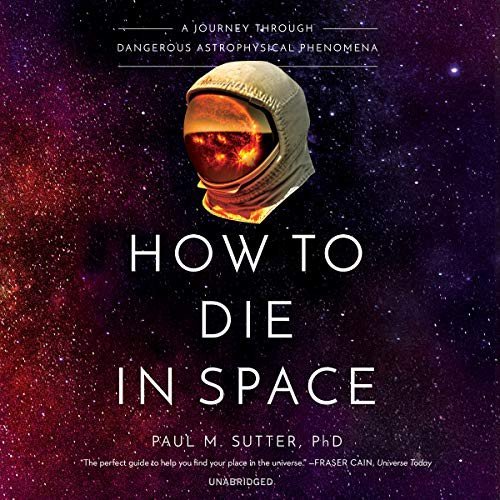
How to Die in Space, published in 2020, is his best-known book. It is organized as a travel guide for somebody planning a journey through the universe, working through cosmic rays, micrometeoroids, supernovae, neutron stars, magnetars, black holes, gamma ray bursts, cosmic strings, and vacuum decay, and explaining for each what it would do to a human being.

The conceit forces specificity, which is why the book works. A chapter about magnetars can stay abstract; a chapter about what a magnetar's field does to the iron in your blood at a stated distance has to supply numbers. He is also careful throughout to distinguish well-established physics from estimates on the edge of current theory, which makes the book unusually useful to science fiction writers.

His other books include Your Place in the Universe and Rescuing Science.