For twenty years I ran a technology department at a retailer, and I cracked down hard on one habit in the people who worked for me. I called it weasel words. Somebody would tell me “I think I can have that done by Friday,” or “Friday looks good,” and I’d stop them right there. That’s a weasel word, dude. Stop it. Can you have it done by Friday or not?
They hated it.
Nobody wanted to say “Yes, I’ll have it done by Friday,” because that’s a promise, and promises get broken. The hedge left a door open. Some of them got very subtle about it, and I kept catching them anyway.
I’m not immune.
I went to Toastmasters for six months to work on my own speech, and it helped, but I still catch fluff coming out of my mouth. In my writing I’ve been hammering redundant phrases out for years, and they keep sneaking back in.
What are fluff words in writing?
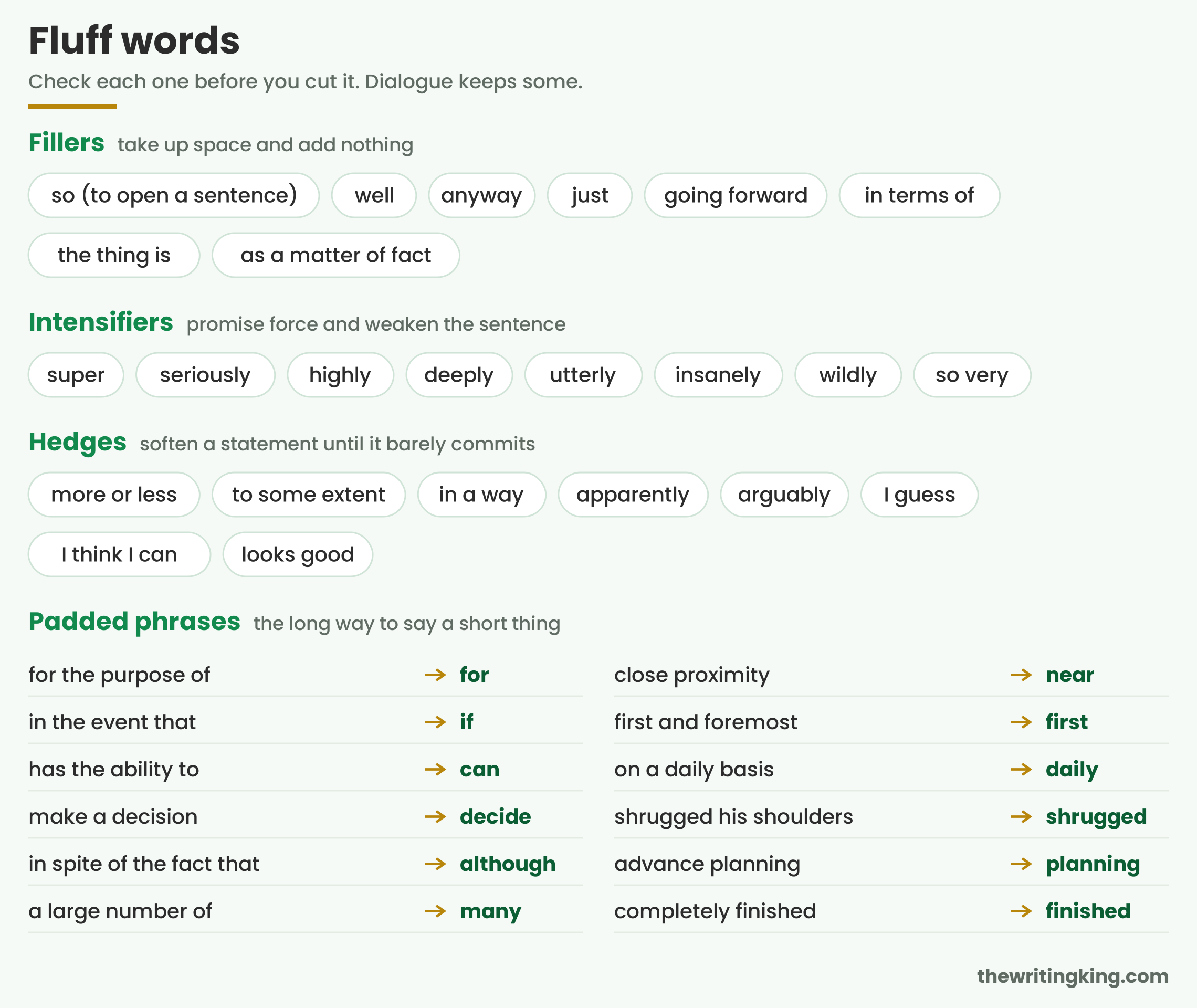
Fluff words are the words that take up space in a sentence without adding anything to its meaning. A chart from BookEditing.co.uk that’s been going around sorts them into four groups, and it’s a useful map.
Fillers are the throwaway words like “well,” “anyway,” “going forward” and “the thing is.” Intensifiers try to make a statement stronger: “super,” “seriously,” “highly,” “utterly.” Hedges soften a statement until it barely says anything, words like “in a way,” “apparently,” “I guess” and “looks good.” The last group is padded phrases, the long way of saying something short.
Four kinds of fluff, with the padded phrases I cut most and their short versions.
Download the fluff words chart (PNG) ↓
The hedge left a door open.
Most people skip the chart’s subtitle, and it’s the most important line on it: not every use is fluff, but each one needs a second look. Some sentences need “that” to make sense. “Just” can mean “only” or “a moment ago.” A word gets cut when it’s doing nothing. Its place on somebody’s list doesn’t decide that.
Why do intensifiers make writing weaker?
Intensifiers promise force and deliver the opposite. “Very angry” is weaker than “furious,” because the writer reached for an amplifier instead of the right word. Readers feel the reach. When every third sentence says “really” or “totally,” none of them sound sure of themselves. The words wear out, too. Use “extremely” once and it lands. Use it on every page and the reader stops hearing it, and you’ve spent your strongest tool on sentences that didn’t need it.
The fix is almost always a stronger word, and I’ve written about that trade before in strong verbs and adverbs. “Ran very fast” becomes “sprinted.” “Really tired” becomes “exhausted,” or better, a detail that shows it: she fell asleep with her shoes on.
An intensifier is a writer admitting the word they picked wasn’t strong enough.Share on X
How do you cut padded phrases like “for the purpose of”?
Padded phrases are the easiest fluff to fix and the hardest to see, because they sound like normal English. “For the purpose of” means “for.” “In spite of the fact that” means “although.” Nobody shrugs anything except their shoulders, so “shrugged his shoulders” is just “shrugged.”
The chart up top lists the padded phrases I catch most, in my own drafts and in client manuscripts. Keep it open on a revision pass.
Search your manuscript for each one, one at a time, and look at every hit before you change it, because a few of them belong in dialogue or in a quote. It’s tedious. It also takes a few hundred words of dead weight out of a typical book in an afternoon.
Are hedge words and weasel words the same as fluff?
They overlap, and in business writing they do the most damage. “I’ll try” and “It is what it is” are the two I hear most, and both are ways of not committing. I wrote a whole piece on hedge words that kill a leader’s credibility, and another on the hidden cost of weasel words like “studies suggest.”
Go back to my team and that Friday deadline. The sentence they gave me and the sentence I wanted carry the same information. One of them commits and one of them doesn’t.
A book works the same way. An expert who writes “I think this approach could help some readers” has told the reader he doesn’t believe his own advice. Say what you know. Qualify it once, where the qualification is true, and move on.
When should a writer keep filler words in dialogue?
The rule flips in dialogue, and a lot of writers get it wrong. It’s tempting to run a search and destroy on every filler, every “like,” every “you know.” Do that to your dialogue and every character ends up sounding the same, and all of them sound like a machine.
People don’t talk in clean sentences. Go to a party and listen. Sit in on a Toastmasters meeting, where people are working hard to get rid of exactly these words, and you’ll hear how deep they run. People say “um,” “kind of,” “I mean,” “you know.” They hedge. They repeat themselves. They trail off.
Dialogue that keeps a little of that sounds like a person. Dialogue with all of it scrubbed out sounds written, and readers notice, the same way they notice when your characters all sound like you. Use restraint. A character who says “like” once a page has a voice. A character who says it in every line is a transcript. Read the dialogue aloud. If it sounds like something a real person could say across a kitchen table, it’s working, fillers and all.
How does a ghostwriter keep a client’s filler words in their voice?
This matters even more in my work. A ghostwritten book has to sound like the client, and part of a client’s voice is their verbal habits. Some clients always say “um” or “you know” or start answers with “Look.” I listen for it in the interviews, and I put some of it back when I write.
Not all of it.
Nobody wants a memoir that reads like a raw recording. But if I sand every habit off a client’s voice, I’ve written my book with their name on it, and the people who know them will hear the difference on page one.
There’s a related trap I see now. Some writing that gets called AI-written is just a person with strong habits. I have phrasings that look a lot like the patterns people associate with AI, and they’re mine, from long before any of these tools existed. Fix fluff by knowing what each word is doing, and keep the habits that make a writer sound like a person.
My take
Fluff in your narration is a writer protecting himself. Every “I think” and “kind of” is a door left open in case you’re wrong, and readers can smell it. Cut it, commit to the sentence, and let the reader decide whether you’re right. Then leave your characters alone. They’re allowed to hedge, ramble and say “um,” because that’s how people talk.
What is the fastest way to find fluff on a revision pass?
Do it as its own pass, after the story and structure are settled. Search for the intensifiers first, then the padded phrases in the chart, then the hedges. For each hit, ask one question: does the sentence lose anything if this word goes? If not, cut it. If it’s dialogue, ask whether this person would say it, and leave it alone if they would.
The Writing Hub has the rest of my craft articles, and if you’d like someone to work through a manuscript with you, you can hire me through my book coaching service. My old team never did learn to love “I’ll have it done by Friday.” Their reports got done, though.
If you’re wondering whether a ghostwritten book can still sound like you, I wrote a whole chapter on how your voice survives the transfer, verbal habits included.