
My mom had a drawer full of S&H Green Stamps. She got them at the checkout every time she bought groceries, and she’d sit at the kitchen table licking them and pasting them into little books. Each book held 1,200 points. When she had enough books, she traded them in for something from the catalog.
The store paid you to come back.
You bought your groceries, and the store handed you a little extra for the privilege of your business. Nobody thought that was strange. It was how a store kept its customers.
Now I pay Walmart $150 a year to be a loyal customer. My whole shopping life fits in that one swap. Loyalty used to be something a store bought from you. Now it’s something you buy from the store, and the strange part is that for me, it’s still the best deal in town.
What were supermarkets like in the 1960s and 1970s?
The store of my childhood was Sage’s in San Bernardino. It wasn’t a supermarket the way we think of one today. Sage’s had a bakery, a deli, a meat counter, a drug counter, a coffee shop and toys, all under one roof. I shopped there with my mom from my earliest memories up through my teens.
Safeway was the other big name, and the stores followed a pattern. The supermarket sat in a strip mall with a separately owned drugstore next door and a handful of smaller shops around it. They all shared one enormous parking lot. You parked once and got everything you needed for the week, and nobody ever circled for a space.
And there were the stamps. Sperry and Hutchinson started S&H Green Stamps in 1896, and by the 1960s the company was printing more stamps than the U.S. Post Office. It mailed out 35 million catalogs a year. My mom had tons of them. Those stamps were the same idea as the coins and glasses I wrote about in Free With a Fill-Up: a business giving you something for nothing because it wanted you back next week.
Those stores were large and comfortable, and they were planned.
The parking was overwhelming. The shelves were full. That was the baseline, and every store I shop in now gets measured against it.
Is Publix more expensive than Walmart?
Yes, and by a lot. At the Publix near me in Clearwater, some prices run as high as 50% over Walmart’s. Today I looked at ground chuck, the 70/30 kind, at $8.95 a pound. Another package of ground beef was almost $12 a pound.
I stood there in the meat aisle thinking, what the hell.
Consumer Reports priced the same items at both chains in 2025 and found Publix about 20% higher overall. My cart runs higher than that, because I buy the things where the gap is widest.
But Publix is the store where employees give a damn. Publix is owned by its employees and the Jenkins family, and its stock plan is the largest employee ownership plan in the country, covering about 260,000 people. You feel that on the floor, where the staff are friendly and returns come with no argument. The Publix near me hires a very diverse group of people, every kind of person you can think of, and they’re all good workers. Turnover seems low, too. I see the same faces at the registers year after year.
The floors are filthy. Oh my God, the floors in my Publix. The shelves are clean, the produce is clean, and the floor looks like nobody has mopped it since the store opened. I guess that’s the nature of the beast with that much foot traffic, but Walmart manages it.
Loyalty used to be something a store bought from you. Now it’s something you buy from the store.
The self-checkout at Publix is the best I’ve used anywhere. It’s spacious, it’s comfortable and it works. There’s somebody standing there to help when a scanner jams. That person isn’t policing you.
I asked one of the managers about shoplifting once. He told me the staff have instructions not to stop anyone. It isn’t their job. They don’t even report it, and I’ve never seen the police called.
They rely on a person standing there and on the cameras all over the ceiling. I strongly suspect a lot of those cameras are fake, though I don’t know for sure.
I’m sure Publix would call the police on a shoplifter who kept coming back, and I’d bet they have a loss prevention person somewhere, just like Walmart does. But the store doesn’t treat its customers like suspects, and that’s a choice. Next to the self-checkout, Publix keeps a long line of staffed registers running with real cashiers.
Delivery is where Publix loses me completely. Publix delivers through Instacart. That means a delivery fee, a service fee, a tip and item prices marked up above the shelf price, and the shelf price was already the problem. Why would I pay that?
Publix has curbside pickup, too. I never use it, and I’ve seen maybe two other people use it.
The Winn-Dixie across the street
Right across from my Publix there used to be a Winn-Dixie. It had far better prices than Publix, plenty of parking and well-stocked shelves. I didn’t like it. The store was a tad dirtier and a little more rundown, and you could tell it was on its last legs. The employees didn’t give a shit, and you could see it in every aisle.
Aldi bought Winn-Dixie’s parent company, Southeastern Grocers, in 2024. The plan was to convert about 220 Winn-Dixie and Harveys stores into Aldis through 2027, and in early 2025 Aldi sold about 170 of the rest to a group of investors who kept the old names. The one across from my Publix is a shell now. There’s literally nothing there.
Better prices didn’t save it.
Remember that the next time somebody tells you shoppers only care about price. If price were everything, that store would still be open.
How the stores near me stack up on price, staff, selection and parking.
Why is Aldi so cheap?
Aldi is cheap because it cuts everything a store can cut. A typical Aldi carries fewer than 2,000 items, most of them its own brands, while a regular supermarket carries 30,000 or more. Products sit on the shelf in the cardboard case they shipped in. You bag your own groceries at a counter. The same few employees run the register, stock the shelves and clean the store, and the cashiers are timed on how fast they scan.
And you put a quarter in a slot to get a shopping cart. Who thought that was a good welcome?
I went to Aldi once. The layout confused me from the moment I walked in. The store was clean, I’ll give it that, and the prices looked OK. The selection was poor. The employees didn’t care whether I found anything, and the whole place felt unwelcoming. I haven’t been back, and I’ll never shop there again.
The quarter is a deposit. You get it back when you return the cart to the corral, so Aldi doesn’t have to pay anybody to round carts up in the parking lot.
I can see the logic. I still think it’s stupid and shortsighted. Aldi put a barrier between the customer and the purchase before the customer has bought a thing. Why would any store do that? When I do get stuck with one of those carts, I leave it by my car. They can have the quarter.
Here’s the strange family history. Aldi started as one German family business, and in 1961 the Albrecht brothers split it into Aldi Nord and Aldi Süd. Aldi Süd runs the Aldi stores in the United States. Aldi Nord owns Trader Joe’s. So Aldi and Trader Joe’s are cousins, and they went in opposite directions.
Trader Joe’s, the cousin that went the other way
I worked in the IT department at Trader Joe’s for years, and I wrote about how those years shaped my writing career. So take what I say here with that in mind. It’s an OK store with a cult following, and it earned that following.
The employees are friendly because they’re trained to be. The stores are clean, and the aisles feel wide even though the stores are small.
Most of what’s on the shelves is the Trader Joe’s label, and a lot of that is made by the same companies whose brands you’d buy anywhere else, with a different label on it. A lot of the rest comes from small vendors and local suppliers you won’t find at a big chain. The samples are a big deal, and the store carries about 4,000 items, so you keep finding things you didn’t know you wanted.
Then there are the hand-drawn signs. When I was there, the company stressed those signs constantly. Each store used to have its own artists for them. It’s been a long time since I’ve been near one, so I don’t know how that works now, but those signs are one of the coolest things in American retail.
The parking keeps me out. Trader Joe’s puts its stores in high-traffic spots aimed at a yuppie market, and the lots are small and always full. I won’t spend half an hour finding a space and another half hour getting out.
That’s my only complaint, and it’s about the parking lot.
The biggest difference between Trader Joe’s and every other store on my list is who controls the shelf. I wrote a whole companion piece on that, the grocery store plan, because it deserves its own space.
Walmart is its own bird
I have two Walmarts near me, a smaller Neighborhood Market and one of the big Supercenters. Both are exceptional stores to shop in. They’re very large, very well organized and sparkling clean. The floors shine. If you’d told me thirty years ago that Walmart would be the clean store and Publix would have the dirty floors, I’d have laughed at you.
I don’t go into either one much anymore, though, because Walmart brings everything to me.
Walmart+ costs me $150 a year. Delivery has a $35 minimum, no delivery fee and no tip, and dry goods ship free. I get groceries delivered twice a week. That’s about 104 deliveries a year, or roughly $1.44 a delivery. Returns are easy, and for anything cheap Walmart often refunds me and tells me to keep the item.
I can order supplements in the morning and have them on my porch that afternoon. If I really need something, I can pay a little extra for same-day delivery. Walmart also has free curbside pickup if you’d rather drive over. For a writer who’d rather be at the keyboard, that’s close to perfect.
What Walmart+ costs me per delivery at two grocery orders a week.
The Walmart self-checkout is a little more hostile than Publix. There’s somebody watching you.
I’ve watched videos on how Walmart’s asset protection teams work, and they look for patterns. The first time somebody steals, they might get away with it. The store logs it, ties it to a face on camera and waits. In Florida, retail thefts within a 30-day window add together, and once the total passes $750 it’s a third-degree felony. That’s when the arrest happens.
There’s a lot wrong with Walmart, too.
Walmart destroys local businesses by the nature of the beast. It has great parking and everything under one roof, so younger shoppers who don’t know any better go there instead of Joe’s local store. Iowa State economists followed Iowa towns for fifteen years before and after Walmart arrived. Towns under 2,500 people lost about 30% of their retail sales. Stores that sold the same goods as Walmart took the hardest hit.
Those big boxes don’t last forever, either. One architect who studies them says they’re built cheaply from off-the-shelf materials and aren’t meant to last more than 25 or 30 years. When Walmart moves to a bigger store down the road, the old box gets sold, torn down or rented out to something else. In McAllen, Texas, an abandoned Walmart became the city’s main library.
Then there’s delivery. Home delivery makes me nervous for one reason, the environmental impact. Walmart is running its own private fleet of delivery vehicles, and so is Amazon, and so is every grocery app. How many vans is that on one street?
University of Washington researchers found that a delivery truck on a route produces 20% to 75% less carbon dioxide than the customers driving to the store themselves would, and far less when the stops are clustered. A full truck beats a street full of cars. What worries me is every company sending its own half-empty van down the same street on the same afternoon.
My main complaint about Walmart is the website. Outside of groceries, Walmart.com has filled up with the same kind of junk you find on Temu. Walmart opened its marketplace to third-party sellers, and now strangers’ listings sit right next to Walmart’s own, with AI-generated photos and AI-generated descriptions.
You order the thing in the picture, and you get some stupid thing that isn’t what the picture showed. How is a shopper supposed to know? The giveaway is one line under the price: “Sold and shipped by Walmart” versus “Sold by” some company you’ve never heard of. Walmart needs to police those listings much harder.
My take
Publix has the best people. Walmart has the best prices, the cleanest floors and the delivery that takes the pain out of shopping. Walmart wins my money. That doesn’t make it a saint. It flattens small towns, puts up buildings meant to be thrown away and lets strangers sell junk under its name. A store can be the best deal for me and still be bad for the town around it.
What happened to Best Buy?
The Best Buy near me is huge, almost as big as a Walmart Supercenter. It used to carry everything imaginable under the sun. There was always somebody on the floor who cared, and if you had a question, you got an answer in a minute or two. That was maybe ten years ago.
Now you have to search for somebody, and if they’re not in the right department, they have to search for somebody else. There’s a line just to get help, because the store has obviously cut its staff. It carries name brands and not much else, and the space is way too big for what’s on the shelves.
Best Buy used to have the best physical media anywhere. Blu-rays, DVDs and the SteelBooks, the metal cases with custom art that Best Buy sold as exclusives. I bought most of a whole series of the old black-and-white Universal horror classics, Frankenstein and the rest, and missed a couple. There was another series of horror movies with really cool psychedelic covers. Best Buy seemed to do most of its SteelBooks in horror, or at least those were the ones I noticed.
I had no clue Best Buy was going to stop carrying physical media, so I didn’t collect them all. They weren’t that expensive back then. Now they cost a lot on eBay.
Why didn’t I buy them all when I had the chance?
In October 2023 Best Buy announced it would stop selling DVDs and Blu-rays, and by early 2024 they were gone, in stores and online. The company said the way we watch movies is different now and the change would free up space for newer technology. Free up space? In that store? It had acres. And those shelves didn’t look like a money loser to me. They’d fill up and empty fast. Some dork decided Best Buy didn’t need physical media anymore. That decision ruined the store for me.
Best Buy said dropping DVDs and Blu-rays would free up space. The store near me has acres. Those shelves filled up and emptied fast. Somebody decided anyway. – Richard LoweShare on X
Best Buy still does a few things right. If you need to return something, they just do it, as long as you have a receipt. They verify it, but they don’t argue.
The return line can be murder, though, and by murder I mean I once waited two hours in it.
The online ordering works well. You order something on the website and it’s waiting for you at the store, or they bring it out to your car. Best Buy has had store pickup for years, and curbside started in March 2020, when COVID closed the stores.
Geek Squad is OK for service. I’ve used it a couple of times. I bought their protection plan once, the one that covers every purchase for a couple of years, and then gave it up. If a $250 TV breaks after five years, I buy a new TV. If it breaks under warranty, I’ve got the warranty. Who needs the plan?
RadioShack and the tube tester
RadioShack was a different kind of store, and I liked it better than Best Buy ever was. The stores were tiny. If another person was in there, you were squeezing past each other. There was a dusty, musty smell, and the shelves were packed with electronic parts of every kind, stuff you don’t see anymore. If you needed that one transistor or that one vacuum tube, RadioShack had it, or they could order it.
For an electronics hobbyist like I was, it was heaven.
The thing I remember best is the tube tester. As a kid I had no idea what it was. I was fascinated by it. I imagined it was some kind of spy device, or a machine for a Martian takeover, something secret and important. Now I know what it is, and it’s nowhere near as exciting. I remember going to RadioShack with my dad, carrying the tubes out of our TV, so we could test them one by one and find out which one had blown.
Self-service tube testers sat in drugstores, grocery stores and department stores from the late 1920s into the early 1970s. You pulled the tubes out of the back of the set, looked up each part number on a flip chart and plugged it in. If one tested bad, the clerk sold you a replacement from the locked cabinet underneath. People fixed their own televisions. A store gave them the means to do it.
That’s the same thread as the model kits and Erector sets in Free With a Fill-Up. RadioShack served people who built things. Best Buy serves people who buy things. One store was tiny and crowded and had everything you needed. The other is huge and empty and has everything a vendor wants to sell you.
Are CVS and Walgreens dying?
I hesitate to call them drugstores now. CVS and Walgreens are really mini grocery stores with a pharmacy counter in the back.
CVS strikes me as a throwback to forty years ago. It’s not bad. It’s crowded inside, and it feels kind of icky, and it’s not a store I’d choose. Walgreens has modernized a little more and is generally OK. Its prices are amazingly competitive with Publix, though nowhere near Walmart’s. Neither one seems to be moving forward, and I have a feeling that’s hit their bottom lines hard.
The numbers back that up. CVS ran a plan to close about 900 stores from 2022 through 2024, and then announced 270 more closings for 2025. Walgreens announced it would close about 1,200 stores over three years. Then in August 2025, the private equity firm Sycamore Partners finished taking Walgreens private in a deal worth up to about $23.7 billion. If you’ve read The Enshittification of America, you know how that story usually goes.
From Green Stamps to private equity: the stores of my lifetime.
The soup store I can’t remember
A few years ago I went into a store near me, one of the upscale chains that competes with Trader Joe’s. It wasn’t the Amazon one. I wish I could remember its name. It had a really nice area where you could sit down and eat, with forty or fifty kinds of soup and a whole line of different meals, and then a full grocery store around it.
It was kind of cool. A store that wanted you to stay instead of rushing you through the checkout. I don’t know if it’s still there, and I can’t remember where it was.
Is modern shopping better than it used to be?
In some ways, yes, and I’d be dishonest if I left that out. The state of supermarkets isn’t all bad.
Just-in-time ordering has improved the quality and freshness of the food. Stores order what they’ll sell this week instead of stacking a back room full of stock, so produce and meat move faster and spend less time sitting.
Self-checkout, when it’s done properly the way Publix does it, improves things for everyone. Better security helps stores keep their margins and gives us a safer place to shop. And the web is a huge improvement for somebody like me. I jump on the Walmart website, order my stuff, and it shows up the next day, or the same day if I want to pay a little.
The problems aren’t the technology. The problems come from decisions people made.
Somebody put a coin slot on the cart corral. Somebody emptied the shelves where the movies used to be and cut the floor staff to the bone. Somebody let the junk sellers in through the website’s side door, and somebody sold the drugstore chains to people who only care about the exit price.
The stamp book and the membership card
My mom’s Green Stamp books were a promise from the store. Come back next week and we’ll give you something for it. My Walmart+ membership is a promise in the other direction. I pay up front, and Walmart keeps the prices low and brings the groceries to my door.
Either way, the stores that last keep their end of the deal. Publix keeps it with people who care. Walmart keeps it with price and convenience. Winn-Dixie broke it, and now it’s an empty building across the street. Best Buy broke it the day the discs left the shelves. There’s more on the businesses that broke their deal with their customers in my Enemies of You hub, and if you’ve got a book of your own to write, my writing services are the place to start.
I still remember that drawer full of stamps.
The store paid my mom to come back, and she came back for years. I pay Walmart now, and I keep coming back too, for the same reason she did. The deal is good.
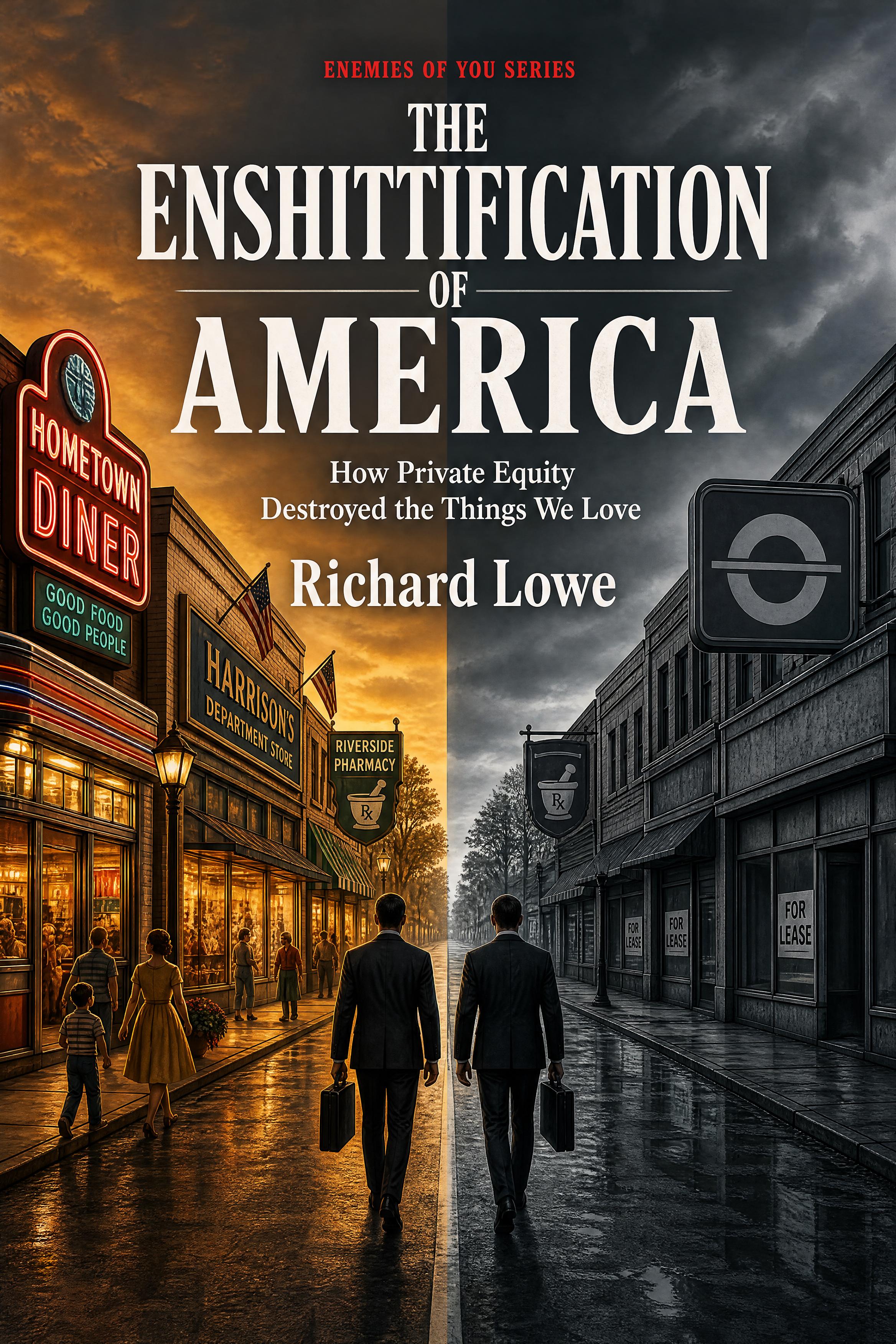
The stores I shop in are small versions of a bigger pattern. My book follows how good businesses get bought, squeezed and taken apart across thirteen industries.
