
Walk into almost any supermarket in America and the first thing you see is flowers. Buckets of roses, potted orchids, bright mixed bouquets in plastic sleeves. Most people walk right past them, since almost nobody came in for flowers.
So why are they always the first thing you see? Because the store wants you to feel something before you’ve picked up a single can.
A grocery store is a stage, and it runs on a script. The flowers are the opening scene. Every turn you take after that, from the produce to the deli to the dairy case in the far back corner, was planned before you ever pulled into the parking lot. You walk the store thinking you’re choosing your own way through it, and mostly you’re reading lines somebody else wrote.
I’ve known the plan for years, and once you know it, you can’t stop seeing it. I’m simplifying greatly here, because the full version fills textbooks. But the outline is the same in nearly every store, and the most interesting part of it is who writes the lines.
Why do grocery stores put flowers at the entrance?
Flowers chill people out. They’re colorful, they smell good, and they make the place feel fresh and alive the second you walk through the door. That feeling carries into everything you see next.
There’s a second reason. When you first come in from the parking lot, you aren’t really seeing anything. Paco Underhill, who spent decades filming shoppers for his firm Envirosell and wrote Why We Buy, called the first few steps inside a store the decompression zone. Your eyes adjust to the light and your ears adjust to the sound, and half your mind is still out in traffic. Anything a store puts in that zone gets mostly ignored, so smart stores put something there that works on mood.
Flowers do that job perfectly. You don’t have to look at them closely.
You only have to pass them.
Underhill found something else on all that video. Nearly everyone who walks into a store pauses and then drifts to the right. He called it the invariant right, and nobody’s quite sure why it happens. Most supermarkets are laid out to use it. You turn right, and the path carries you counterclockwise around the store.
The route a supermarket plans for you, from the flowers at the door to the candy at the register.
Produce first, then the deli
Right after the flowers comes produce. That’s no accident either.
Produce is the healthy part of the store. You pick up a bag of apples and some lettuce, maybe a few bananas, and you feel good about yourself. You’ve done something responsible. The colors are bright, the misters are running, and the whole section looks like a farm stand.
Then you hit the deli.
Now you’ve earned something. You bought the lettuce, so you buy the fried chicken. You picked up the apples, so a sub sandwich doesn’t feel so bad, and neither does the potato salad or the cheese tray. Psychologists call this licensing: one good choice gives people permission for a less virtuous one. The store doesn’t need to know the term. It only needs to put the deli where you’ll reach it right after you’ve felt healthy.
The order matters. Put the deli first and you’d feel a little guilty by the time you reached the produce. Put the produce first and the deli becomes a reward. Same food, same prices, a different script, and the store sells more.
You bought the lettuce, so you buy the fried chicken. The store put them in that order on purpose.
Why is the milk always in the back of the store?
The things people buy every week, in volume, sit around the outside of the store. Milk, eggs, bread, meat, produce. The inside of the store holds everything else.
There are two explanations for this, and both are true. The plain one is logistics. Refrigerated cases need power and plumbing along the walls, and the loading docks are at the back, so milk and meat end up near the back where the trucks unload. The other explanation is the walk. If you came in for a gallon of milk, the store wants you to pass a few hundred other products on your way to it and a few hundred more on your way out.
You came in for milk. You left with milk, a bag of chips, a new flavor of coffee creamer and a box of cookies that was sitting on the end of an aisle.
The plan worked. How many times has that happened to you?
And those ends of the aisles are their own story. The end caps, as the industry calls them, are the most visible shelves in the store. You walk past them whether you turn down the aisle or not. That makes them valuable, and at most chains the products on them are there because somebody paid for the spot.
Eye level is buy level
Inside the aisles, the shelves themselves follow a plan.
The industry has a saying for it: eye level is buy level. Whatever sits at an adult’s eye level gets seen first and bought most. The children’s products sit lower, at a child’s eye level, where the kid in the cart can spot them and start asking. The sugary cereal with the cartoon on the box sits low on purpose. The shelf was picked to match the eyes of a six-year-old in a shopping cart seat.
The top and bottom shelves get the bulk sizes, the store brands and the products the store is less interested in pushing. You have to reach or bend for those. Most people won’t.
Real planograms, the charts that tell a store exactly where every product goes, run to hundreds of pages, and they’re built from sales data, research and money. But the shape of it is simple. The store decides what you see first, and what you see first is what you buy.
Then there’s the checkout lane. Candy, gum, magazines, cold drinks, batteries. Who needs a pack of batteries at the exact moment they’re paying for groceries? Nobody, until they’re standing there with nothing to do and the shelves right at hand level. Every store in America knows those few feet of shelf are some of its most profitable.
Why do grocery stores rearrange the aisles?
Every regular shopper knows the feeling. You walk to where the peanut butter has been for three years, and it’s gone.
Most of the time the reason is boring. Stores reset their shelves on a schedule, when a new planogram comes down from headquarters, when a vendor deal changes or when the seasons turn and the sunscreen gives way to the Halloween candy. A brand that paid for better placement gets moved up. A product that stopped selling gets moved out.
The side effect helps the store. A shopper who knows exactly where everything is can get in and out in ten minutes and buy only what’s on the list. A shopper hunting for the peanut butter walks two extra aisles and sees a few hundred products on the way.
Nobody has to plan the hunt for it to pay.
How does music in a grocery store affect what you buy?
The music in a supermarket is carefully defined. It isn’t whatever the manager likes.
In 1982 a marketing professor named Ronald Milliman tested background music in a supermarket. On days the store played slow music, shoppers moved through the aisles more slowly, and sales ran about 38% higher than on days with fast music. Slow music slows your feet, and slower feet see more shelves.
A team of British psychologists ran another test in a wine shop in the 1990s. They put French and German wines side by side at similar prices and alternated the music between French accordion tunes and German beer hall songs. On French days, French wine outsold German by about five to one. On German days, German wine won by about two to one. When the researchers asked customers afterward, almost none of them said the music had anything to do with their choice.
The music changed what people bought, and the people had no idea. If a few accordion songs can move wine, what do you think a whole store full of planned music does to your cart?
The six things a supermarket sets on purpose to slow you down and change what you buy.
Why do grocery prices end in 99 cents?
The prices on the shelf follow the plan too. A box of crackers is $3.99 instead of $4.00 for a reason.
Researchers call it the left-digit effect. People read a price from left to right and give the first digit far more weight than the rest, so $3.99 registers as “three dollars and change” even though it’s a penny short of four. Marketing professors Manoj Thomas and Vicki Morwitz showed in 2005 that shoppers judged a $2.99 item as meaningfully cheaper than a $3.00 one, even though the gap was a single penny. Stores have known it for a century, and almost nothing in a supermarket ends in a round number.
Then there are the deals. In Florida, a Publix buy-one-get-one sale means you buy two to get the deal. In some other states, you can buy one at half price. Same chain, same sale tag, and in Florida the store has decided you’re walking out with two. Who wrote that line?
The yellow tags, the red tags and the “limit 4 per customer” signs are all part of the script too. A limit makes an ordinary price look like a bargain worth grabbing before the shelf empties.
Smells and samples
Then there’s the smell. Bakeries vent the smell of bread into the store. Coffee gets ground where you can smell it. The rotisserie chickens sit where their smell reaches the aisles. None of that is an accident. Smell works on you before you’ve thought about anything, and it’s hard to smell fresh bread and walk out without any.
Samples are the other big one, and at Trader Joe’s they’re a very big deal. A sample does two things at once. It puts the food in your hand, and Underhill found that people who touch or handle a product are far more likely to buy it. And it puts a small debt on you. Somebody handed you something for free. You feel like you ought to at least pick up a box.
Put all of it together and you get a store that slows you down, relaxes you, rewards you, makes you hungry and hands you food. Then it lines the exit with candy. Every piece of that is planned. It’s a science, and you could research it for years and never run out of studies.
Walmart runs the same plan at Supercenter scale
A Walmart Supercenter is the plan blown up to the size of a small airport.
Groceries take one side of the building and general merchandise takes the other, and the wide main aisle that runs between them is stacked with pallets of whatever Walmart wants to move that week. Store staff call it Action Alley. You can’t cross the store without walking it. The pharmacy, the milk and the eggs sit far enough from the door that you pass televisions, lawn chairs and Halloween candy to reach them.
The two Walmarts near me are spotless and well organized, and the plan inside them works the same way it does at Publix. The difference is distance. A small grocery store makes you walk past a few hundred products. A Supercenter can make you walk past thousands.
I don’t walk it much anymore. Delivery is one reason, and I’ll come back to it.
Who owns the shelf at Publix?
Most shoppers never notice this part. At most big chains, the store doesn’t fully control its own shelves.
I see vendors in my Publix all the time. Watch any Publix for an hour and you’ll see them walking the aisles. The Pepsi guy comes in and fills the Pepsi shelves. The Frito-Lay person comes in and fills the Lay’s. The bread truck driver stocks the bread. The industry calls this direct store delivery. The manufacturer sends its own people to stock its own space, and in practice that space belongs to the manufacturer.
Then there are slotting fees. Manufacturers pay the chain to get a new product onto the shelf at all. The Federal Trade Commission looked into this in 2003, and trade press reported that the fees for a national product launch could top $2 million. Better placement costs more. Eye level costs more. The end cap costs more. A store that sells its shelf space is renting out lines in its own script.
The FTC found one more wrinkle. Fees tended to be lower for products the manufacturer delivered and stocked itself, since the vendor was doing the store’s labor for it. So the brands that send their own people into the aisles get a discount on the shelf they then control. It’s a neat arrangement for everybody except the shopper.
Big chains often go one step further and name a category captain. That’s usually the dominant brand in an aisle, and the chain lets it help plan the whole category, competitors included. So the biggest chip company may have a say in where the store-brand chips go. Who do you think that arrangement favors?
My take
The flowers, the music and the shelf heights don’t bother me much. Every store does them, and they’re part of running a store well. What bothers me is a store selling its shelves to the brands. Once a vendor owns the space, the store is reading somebody else’s script, and so are you.
What makes Trader Joe’s different from other grocery stores?
You would never see a Pepsi vendor stocking shelves at a Trader Joe’s. That’s the biggest thing that sets it apart from almost every other store in the country.
Trader Joe’s doesn’t rent vendor space. Its own crew stocks every shelf. It doesn’t charge slotting fees, so no brand pays its way onto a Trader Joe’s shelf. The store carries about 4,000 items, against 30,000 or more at a typical supermarket, and most of them carry the Trader Joe’s label. There are no coupons, no loyalty card, no weekly sales and no online ordering.
Every one of those choices takes away a lever an outside company could pull. That gives Trader Joe’s a freedom other stores gave away. Nobody pays to change its mind about what goes on the shelf.
The private label is a big part of that freedom. A lot of what you find under the Trader Joe’s label is made by the same companies whose brands you’d buy at any other store. Underneath the covers, it might be the same product you already know, with a different label on it. A lot of the rest comes from small vendors and local suppliers, the kind of company that could never afford a slotting fee at a national chain.
And then there are the hand-drawn signs. I worked in the IT department at Trader Joe’s for years, and the company stressed those signs constantly. Each store used to have its own artists for them. Somebody in that store drew the sign by hand for that store’s shelf. That’s a store writing its own script, in its own handwriting.
At most big chains the Pepsi guy stocks the Pepsi shelf and the Lay’s guy stocks the chips. You’ll never see that at Trader Joe’s. The store that doesn’t rent its shelves gets to decide what’s on them. – Richard LoweShare on X
Why is the Aldi layout so confusing?
Aldi is the cousin of Trader Joe’s, and it runs a completely different script. I went into an Aldi once, and the layout confused me from the moment I walked through the door.
Looking back, I know why. Aldi throws out most of the standard plan. There’s no big floral display to relax you, no deli counter, no bakery smell pumped into the aisles and no sample table. The store is a single loop with products stacked in the cardboard cases they shipped in. The middle aisle holds the weekly “Aldi Finds,” a rotating pile of everything from kitchen gadgets to garden hoses that’s gone when it’s gone. Fans call it the aisle of shame.
That aisle is the one piece of showmanship Aldi keeps, and it works on the same principle as the end cap. You came for bread and you left with a kayak.
Everything else in an Aldi is built to cut cost, and the shopper does a lot of the work. You rent the cart for a quarter. You bag your own groceries at a counter by the door. With fewer than 2,000 items on the shelves, most of them Aldi’s own brands, there’s less to see and less to compare.
For a lot of people that’s a relief. For me it was disorienting. Every other store I’d ever shopped in had taught me the standard script, and Aldi handed me a different one with no explanation. I haven’t been back.
Is Publix copying Trader Joe’s?
To me, Publix seems to be trying to be a Trader Joe’s look-alike in a lot of ways, only bigger.
The plan is nearly the same now. Publix starts you with flowers. It moves you into produce, then pulls you toward the deli, and the Publix deli has the famous Pub Sub, the reward after the lettuce. Publix pushes its own label hard, too, with the Publix brand and the GreenWise line. The staff are friendly, the way Trader Joe’s crew is friendly.
The difference is the shelf. Publix is a giant chain with more than 1,400 stores across the Southeast, and it runs like one. The vendors come in and fill their own space. National brands pay for placement. Publix has copied the friendliness and the flowers. It hasn’t copied the freedom.
I wrote about how Publix, Walmart, Aldi and the rest compare as places to shop in The Stores That Still Care. The same plan runs through all of them.
Who controls the shelf at Trader Joe's and at Publix and most big chains.
Does knowing the grocery store plan help you spend less?
Some. Once you know the script, you can stop reading your lines.
Go in with a list, and walk straight to what’s on it. Look above and below eye level, because the better deal is often up top or down by your shoes. Treat the end caps as advertising. If you’re hungry, eat first, because the bakery smell is coming for you. And notice the music. If it’s slow and soothing, the store wants you to take your time.
Or skip the stage entirely. I order my groceries from Walmart and they show up at my door twice a week.
No flowers, no music, no bakery smell, no candy at the register. That’s one of the things I like about delivery.
The website has its own script, of course. Sponsored products sit at the top of the search results the same way the paid brands sit at eye level, and the “you might also like” row is the end cap of the internet. The stage moved. The plan didn’t.
The script and the stage
None of this makes a store evil. A good store should be pleasant, well lit and easy to walk through, with fresh food where you can see it. Flowers at the door are a nice thing to walk past. Samples are a nice thing to eat. Music beats silence.
The question is who writes the script. When the store writes it, the store has to answer to you, because you’re the only one paying. When the brands write it by renting the shelves, the store answers to them first. The plan looks the same either way. The flowers are still at the door. But the lines you’re reading belong to somebody else.
There’s more on how good businesses get taken over by the people who pay them in my Enemies of You hub, and on the gas station giveaways that came before all this in Free With a Fill-Up. If you’ve got a book of your own to write, my writing services are the place to start.
Next time you walk into a supermarket, look at the flowers. Then turn right, and watch where the store takes you.
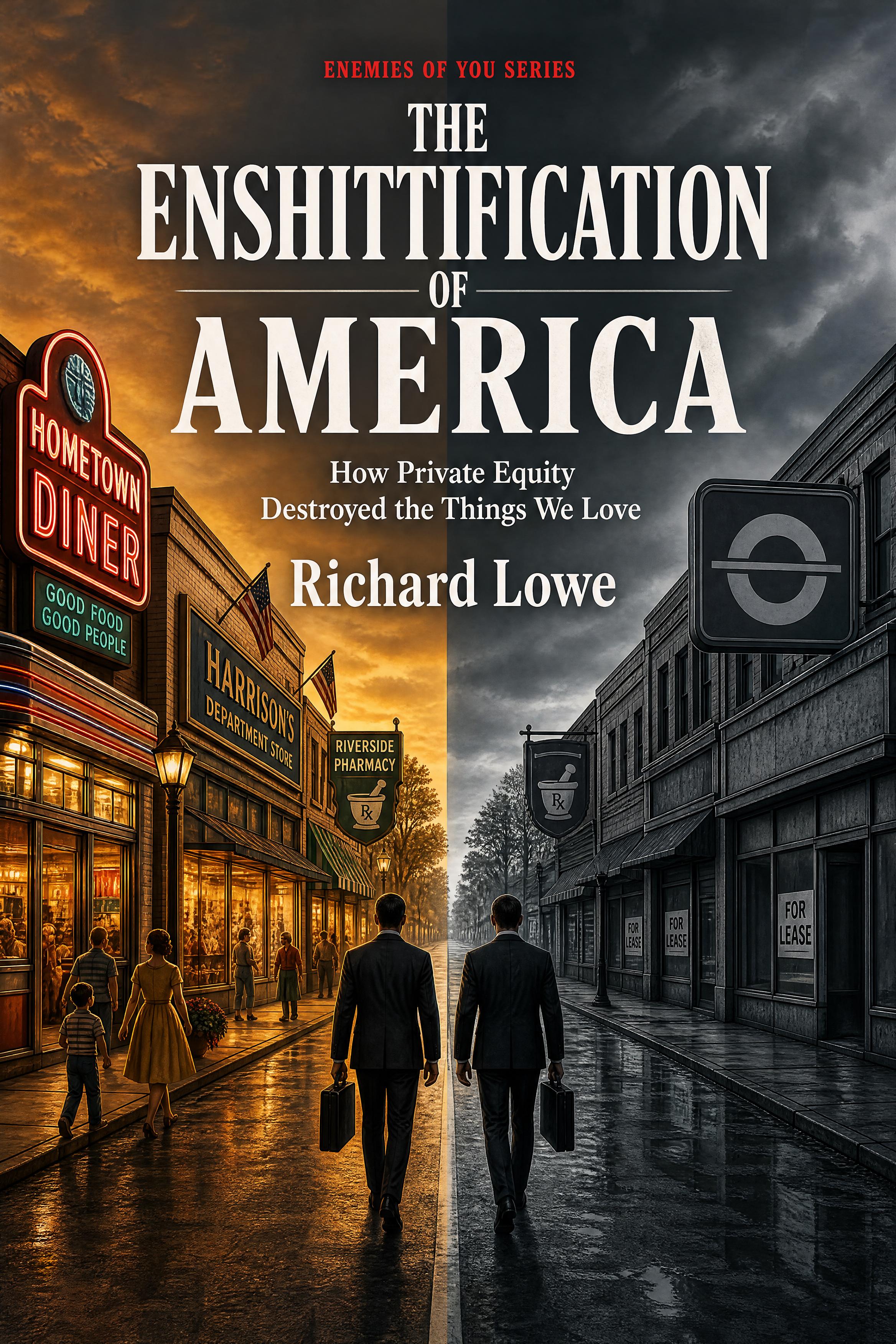
Rented shelves are one small version of a bigger pattern. My book follows how good businesses get bought, squeezed and taken apart across thirteen industries.



