
Two romantasy authors just nuked their careers.
K.C. Crowne. Lena McDonald. Both top-ranked on Amazon. Both caught with AI prompts sitting right there in their published novels.
Readers found revision notes embedded in the text. Instructions meant for ChatGPT that never got deleted. One passage read: “I’ve rewritten the passage to align more with J. Bree’s style, which features more tension, gritty undertones, and raw emotional subtext beneath the supernatural elements.” That’s not a writing note. That’s a prompt. Now it’s a screenshot circulating on Reddit, Goodreads, and Bluesky. Both authors defended themselves. Said AI doesn’t take away from their craft. Readers aren’t buying it. I don’t have much sympathy here. An author who publishes a novel without reading it closely enough to catch a leftover prompt has let down every reader who paid for it. Those readers handed over money and hours, and they got a book its own author never finished checking. They got lazy. Not with the AI, with the cleanup.
Using AI as a brainstorming partner, a research tool, a developmental editor in your pocket? Fine. Smart. I teach it. But the moment you stop treating AI output as a rough draft, the moment you copy-paste without reading every word, you’re gambling with your reputation. These authors didn’t get caught using AI. They got caught not caring enough to check their work.
The sloppiness is the problem, and it would’ve been a problem with a human assistant too. I’d be embarrassed to hand a client a manuscript with my own notes to myself still sitting in it. Forty-five percent of authors now use some form of generative AI. Research, marketing, plotting, drafting. It’s not going away. Whether you use it isn’t the question. The question is whether you use it like a professional or like someone who thinks readers won’t notice. Readers always notice.
Which Writers Are Worth Reading on AI and Publishing?
David Shams: “You have to make space for your creativity. Writing doesn’t happen in a vacuum. It needs room to breathe.”
Robbin Marx: “Stop writing for the algorithm. Start writing like no one’s watching. That’s when your gifts really start to shine.”
Andrea Bartz: “I wrote 9,526 words yesterday. My hands are literally sore. I have no idea what’s going on, but I’m acutely aware this might never happen again, and I won’t take it for granted.”
That last one hits. When the words come, you ride them. You don’t question it. You don’t take a break. You write until your hands hurt and you’re grateful for the pain.
Write Your Ass Off publishes Monday, Wednesday, and Friday.
The Writing Library: writing courses
My take
I don’t blame the AI for this. I blame authors who never read their own books closely before publishing them. A leftover prompt in a novel means nobody checked the work, and a human assistant’s notes left in the text would be equally bad. Use AI however you like. Then read every word before it ships, and search the file for prompt language and notes to yourself. Readers always notice, and they don’t forgive sloppiness.
Will AI Break Writing?
The answer isn’t what either side is selling you.
Seventy authors just signed an open letter demanding publishers promise to never release books created by machines. Dennis Lehane. Lauren Groff. Gregory Maguire. Heavy hitters. A Cambridge study found 51% of UK novelists believe AI could replace their work entirely. Fifty-nine percent say their writing has already trained AI models without permission. Eighty-five percent expect their income to drop because of AI.
Most UK novelists in the Cambridge study expect AI to cut their income, and over half say it already trained on their work.
The anti-AI crowd says theft and existential threat. The pro-AI crowd says just another tool. Both are partially right. Both miss the point.
What AI Threatens
Not writers. Writing factories.
The authors most at risk are the ones producing interchangeable content at volume. Ghost-written business books nobody reads. Formulaic genre fiction optimized for keywords. Content-mill blog posts dressed up as thought leadership. AI produces that stuff now. Faster. Cheaper. Without complaining about deadlines.
As a ghostwriter, I’ll own part of that. A business book stitched together from generic advice was always replaceable, and AI can have it. The books worth paying a ghostwriter for come out of long interviews with one person about their own life and work, and no model can hear what a client isn’t saying yet. If your entire value is “I put words in the right order quickly,” you’re competing with software. That’s not AI’s fault. That’s the market correcting for work that was never about craft.
The Cambridge study flags genre authors as most vulnerable.
Partially true, if you write to a strict formula without any personal stamp. AI can approximate that output. But genre authors with distinctive voices? The ones whose readers accept no substitutes? They’re safer than literary fiction writers producing prose that sounds like everyone else’s MFA thesis.
The threat lands on work that was replaceable to begin with. I don’t mourn the keyword-stuffed filler. I do worry about the working writers who took those jobs to pay rent while they learned the craft, because that ladder’s getting pulled up behind them.
What AI Can’t Touch
The Cambridge study asked the wrong question. “Could AI replace your work?” assumes writing is a product. Something manufactured. Something with a spec sheet.
Readers don’t buy products. They buy connection. They buy the experience of being inside someone else’s mind. They buy the weird way you see the world.
AI can imitate style. It can’t originate perspective. It can produce text that sounds like a thriller. It can’t produce the particular obsessions that make your thriller yours. Why do readers follow specific authors for decades? Not because those authors produce competent prose. Competent prose is everywhere. They follow because Lee Child’s version of justice feels different from Michael Connelly’s. Because Nora Roberts delivers an emotional experience no algorithm can reverse-engineer.
The fastest producers won’t be the authors who thrive. They’ll be the ones readers follow because nobody else thinks quite like them.
The Copyright War
Nobody is winning this fight yet.
AI companies trained their models on copyrighted books. Millions of them. Without permission. Without payment. The Books3 dataset alone contained nearly 200,000 books scraped from piracy sites.
Authors are pissed. Lawsuits are flying. The open letter demands publishers refuse to work with AI companies that trained on copyrighted material without consent.
The UK government floated a “rights reservation” model where AI companies could scrape anything unless authors explicitly opted out. Eighty-three percent of publishing professionals called that a disaster. Ninety-three percent of novelists said they’d opt out if given the chance. The legal battles will take years. Your books are probably already in training datasets. That horse left the barn.
What you control: how you use the tools, and whether your work stays distinctive enough that an AI approximation isn’t a substitute.
The Audiobook Problem
Audible just announced expanded AI narration partnerships. They’re selling it as “every book in every language.” What they’re really saying: human narrators cost money.
I think that’s a lousy trade for listeners. A good narrator makes a hundred small choices about pacing and how each character sounds, and a synthesized voice reads everything at the same temperature.
Many authors narrate their own audiobooks. Extra income. Connection with readers. That revenue stream now competes with software that doesn’t need breaks, doesn’t flub takes, and doesn’t negotiate rates.
The open letter demands publishers hire human narrators. Whether publishers listen depends on whether readers care, and whether they can tell the difference as AI voice synthesis improves. If audiobook income matters to you, pay attention to this fight.
The Legitimate Uses of AI for Writers
Now I’ll piss off both camps. AI is a tool. Like spell-check. Like a thesaurus. Like that craft book you reference when you’re stuck. Tools don’t write books. Writers write books. But writers who refuse available tools handicap themselves for no reason.
Research acceleration. You need to know how 1920s Chicago speakeasies worked. AI gives you a starting structure in thirty seconds: key locations, typical drink prices, what the raids looked like, how payoffs worked. You still verify. You still dig deeper. You still find the weird details that make the scene feel lived-in. But you’re not starting from zero, and you didn’t spend three hours in a Wikipedia rabbit hole before writing a word.
Brainstorming partner. You’re stuck on a plot problem. Your detective needs to find the connection between two murders, and you’ve written yourself into a corner. AI generates fifteen possible directions in a minute. Fourteen will be garbage: too obvious, too convoluted, doesn’t fit the characters. One might unlock something. That’s not cheating. That’s using a sounding board that doesn’t get tired.
Consistency checking. You have a 400-page manuscript. Your protagonist’s eyes were green in chapter three and blue in chapter seventeen. The Thursday timeline doesn’t work because you forgot Monday was a holiday. AI can scan for continuity errors, timeline problems, character details that contradict earlier chapters. It’s not editing. It’s catching mistakes before your editor has to.
Developmental questions. “What’s weak about this scene?” AI won’t give you the right answer. But it might ask the right question. “The protagonist makes a decision here, but the stakes aren’t clear yet.” Sometimes you just need something to push against. Something that isn’t your own brain going in circles.
World-building logic. You’re building a fantasy economy. Does the trade route make sense given the geography you’ve established? AI stress-tests your systems faster than you can, flagging inconsistencies you’d miss until a reader’s angry email. The World Builder’s Handbook goes deeper on this.
Query letters and blurbs. The marketing copy that makes authors want to die. AI generates twenty versions of your blurb in five minutes. None will be perfect. But one might nail the hook, another might nail the voice, and you can Frankenstein them into something that doesn’t make you cringe.
How to Position Yourself
The publishing industry is splitting into two camps. Neither has it right.
Camp One refuses to touch AI. Morally pure and increasingly inefficient. They spend four hours on research AI could accelerate. They miss deadlines competitors hit. They write query letters that take a week instead of an afternoon. Correct about the ethics. Irrelevant in the market. I understand the impulse. AI companies did steal content. The training data issue is real. But boycotting AI won’t unscramble that egg. It just leaves you working harder for the same output while others work smarter. Camp Two uses AI as a crutch. They generate content at volume without craft. They flood Amazon with forgettable books that sell briefly and disappear. They make money until readers learn to spot the pattern. Readers are learning faster than these authors expect.
The K.C. Crowne and Lena McDonald disasters are early warning shots. Readers are looking now. They’re suspicious. The backlash against low-effort AI content is building. The winning position is Camp Three, where AI gets used as a tool and the writer keeps the job. That’s where I sit, and it’s where I’d push any writer who asked me. You’re still the writer. The voice is yours. The ideas are yours. The weird obsessions that make your work matter are yours. AI handles the mechanical parts so you can focus on the parts that require a human.
The Camp Three Workflow
Brainstorm with AI, decide as a human. Generate options. Evaluate them against your vision. Pick what fits. Discard what doesn’t. The AI proposes; you dispose.
Research with AI, verify as a human. Get the structure fast. Then check the facts. AI hallucinates. It states nonsense with total confidence. Never trust a detail you haven’t confirmed.
Draft as a human, analyze with AI. Write your scenes. Then ask AI what’s working and what isn’t. Take its feedback as input. You know your story better than any model.
Clean obsessively. Every word that came from AI gets rewritten or deleted. No exceptions. Your manuscript should survive the question: “Did a human write this?” with an unqualified yes.
Never skip the artifact check. Run the scanner. Search for leftover prompts. Read every page before publish. The authors who got caught used AI the right way and got sloppy about cleanup.
| Step | AI’s role | Your role |
|---|---|---|
| Brainstorm | Generates options | Evaluate against your vision; pick what fits |
| Research | Gives you the structure fast | Verify every detail; AI hallucinates |
| Draft | Analyzes what is working and what isn’t | Write the scenes; take feedback as input |
| Clean | Nothing it wrote survives untouched | Rewrite or delete every word that came from AI |
| Artifact check | None | Run the scanner, search for leftover prompts, read every page |
I’d put that step ahead of everything else on this list. It’s the cheapest one, it takes an afternoon, and skipping it is how two top-ranked authors ended up as a cautionary tale on Reddit. This is what I teach in every handbook. AI as analytical partner. Not as ghostwriter. The AI Writing Partner guide covers the full system.
The Next Five Years
The legal battles over training data will settle into some licensing regime. Authors will get paid. Eventually. Probably not enough, but something.
AI-generated content will flood the market for another year or two, then readers will develop immunity. They’ll learn to spot it. They’ll actively avoid it. Being human-written will become a selling point.
Authors who survive will use AI to sharpen their distinctiveness. They’ll get faster at the mechanical parts so they can invest more in the creative parts. They’ll never forget that the point of writing is connecting one human mind to another. AI can accelerate your process. It can catch your mistakes. It can brainstorm when you’re stuck. It can’t be you. And that’s the only thing readers want. Neither purists nor prompt-jockeys will be the authors who dominate the next decade. They’ll be craftspeople who use every available tool while never forgetting the work has to matter. I don’t care whether an author uses AI. I care whether they respect the reader enough to read their own book before charging for it. Skip that and you deserve the screenshots, the one-star reviews and the career damage that follows.
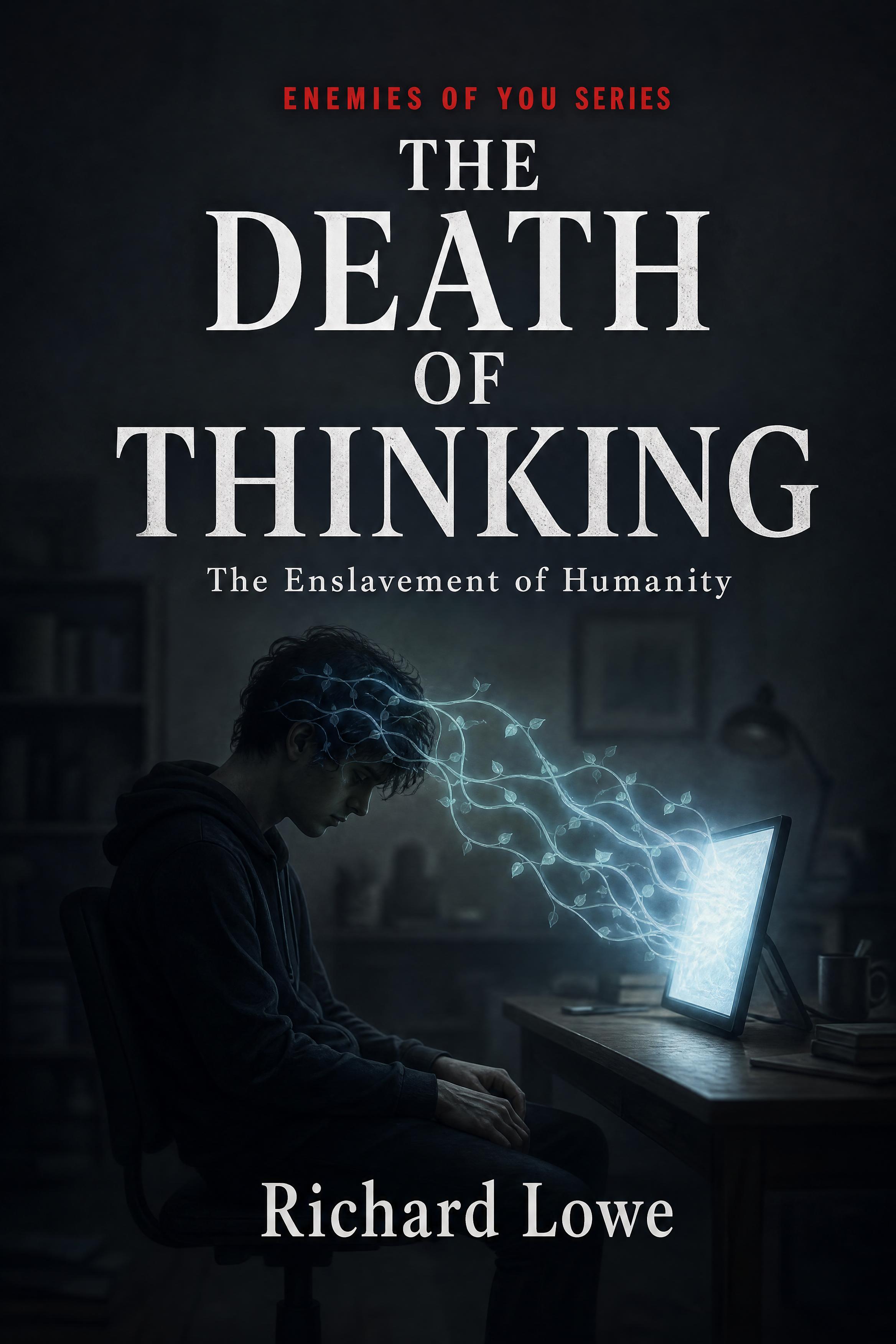
Those two authors handed their judgment to a machine and stopped checking. The Death of Thinking traces how reasonable shortcuts pile up into a pattern with consequences nobody decided on.
Frequently Asked Questions
- Authors slammed after AI prompts show up in published books: Opportunist hacks using a theft machine, The Daily Dot
- Half of UK novelists believe AI is likely to replace their work entirely, University of Cambridge
- Authors petition publishers to curtail their use of AI, NPR (via OPB)
- How Authors Are Thinking About AI (Survey of 1,200+ Authors), BookBub
