
Cloudborn
A survival epic told by something that’s never seen a solid surface
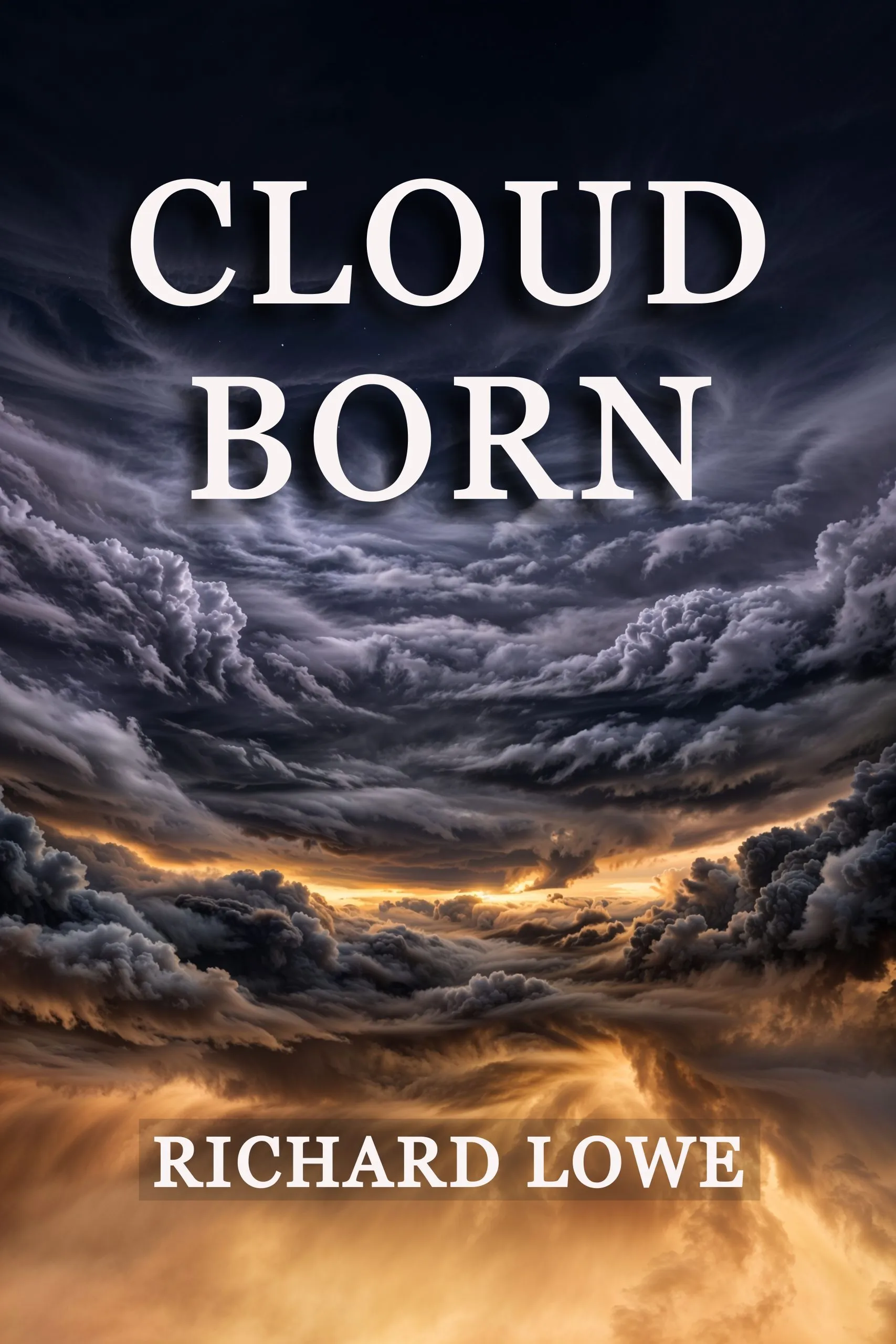 |
A shear event kills the flock in forty seconds and leaves Silt three hundred meters below where it started Book One of a planned trilogy · 216 pages · Non-human narrator BUY FROM INGRAMSPARKAMAZONKOBOREAD A CHAPTERTABLE OF CONTENTS Paperback ISBN 978-1-972810-61-3 · ebook ISBN 978-1-972810-62-0 |
| 216Pages | 43Fields in the birth-flock | 40Seconds to end it | 300Meters below where it started |
The skein had led here and here was real.
from the novel
Silt is born into the cloudbanks of a gas giant, one of forty-three field-organisms in a birth-flock that supplies everything: warmth, navigation, direction, charge. It’s never fed alone. It’s never made a decision the flock hadn’t already made for it.
Then a shear event kills the flock in forty seconds. What follows is the descent: scavenger shoals that strip the dead, a permanent storm no young field crosses without a route, a suspension that blinds every sensor, and a shelf far below with a founding law saying it exists to receive those who arrive. The shelf also has limits, and its keeper has measured them.
For readers of Peter Watts, and of Ursula K. Le Guin’s alien anthropology.
How does Cloudborn open?
Nursery-Shear
The upwelling was warm.
Silt had no word for warm yet. It had no words at all, not in the sense of labels that could be detached from the things they named and moved around and applied elsewhere. What it had was experience organized into categories: this thing, that thing, the quality of the air when the electrical gradient was building versus when it had just discharged, the difference between pressure from below and pressure from the side.
These weren’t words. They were the shapes of things, held the way a hand holds a stone. Not by naming but by the configuration of the grip.
The upwelling that held the birth-flock aloft was in the category of: safe. The category hadn’t been built through deliberation. It had accumulated the way all Silt’s categories had accumulated: through daily press, chemical profile, electromagnetic signature, the birth-flock’s collective field surrounding it on all sides like an additional layer of atmosphere, warmer and more textured than the cloudbank’s ambient signal.
Safe was what everything had always been. Safe was, to Silt’s current understanding, the only available condition.
It wouldn’t understand what safe meant until safe was gone.
The birth-flock spread across the upwelling’s broad dome in the loose geometry of comfort. Forty-three presences, each one distinct to Silt’s sensors: not by cataloged properties but by the accumulated texture of daily proximity. The elder at the center, whose field was broad and dense like something maintained carefully for a long time, whose presence in the collective field was the steady low hum that underlay all the others.
The younger ones arranged around the elder in the positions they’d found through the unspoken negotiation of shared space: this one slightly east because its membrane ran warm and the eastern drift was cooler; that one above because it preferred the thinner ammonia concentration higher up; three together at the upwelling’s edge because they fed better in the turbulent zone where the warm column met the ambient cloudbank.
Silt was near the edge. Not at the turbulent zone.
It had arrived at the edge position through a process it couldn’t have described. It wasn’t choosing to be at the edge any more than a drop of water chose which way to run down a slope. The edge was where Silt found itself when it wasn’t attending to the business of staying somewhere else.
The edge was interesting. The open atmosphere pressed in at one side with the cold irregular quality of something unorganized by a collective field’s presence. Silt’s sensors ran at slightly higher sensitivity when pointed toward it, reading the ambient data continuously, without deciding to.
The upwelling’s dome was wide enough that the elder at the center was several hundred meters from Silt’s position at the edge. The collective field’s warmth reached that far without difficulty, the electromagnetic medium carrying the presence-information of forty-two other fields in the diffuse way of something that was more atmosphere than signal. Silt was embedded in the flock even at the edge.
The edge was a position in the flock, not a position outside it.
The electrical gradient between the cloudbank layers above and the lower hydrogen strata below had been building since mid pressure cycle. Silt felt it through every sensor at once: the charge differential increasing in the membrane’s outer layer, the ion-scent sharpening with the quality that energy-rich air had, the infrasound deepening slightly as the large-scale atmospheric dynamics that drove the gradient’s buildup imposed their slow rhythm on the surrounding air. The gradient would peak and discharge and feed the flock and then begin building again.
This was how things went. This was the rhythm that the birth-flock’s existence was organized around.
The flock-elder’s pulse moved through the collective field. Low, even, carrying the texture of an observation offered without urgency:
All rise well.
The pulse wasn’t a question and didn’t require a response and received responses from half the flock anyway, each response carrying the distinctive signature of the field that produced it. The elder sent the same pulse at roughly the same point in each pressure cycle, and the flock had developed individual response habits, some responding immediately, some after a delay, some almost never, that were as recognizable to Silt as the fields themselves. It wasn’t conversation.
It was the atmosphere of the flock: the electromagnetic equivalent of the sounds a group of living things made by being alive in proximity to each other.
Silt pulsed back.
All rise well.
The words were the elder’s words, not because the elder had taught them but because the elder used them and Silt had been in the elder’s field long enough to have absorbed the pattern, the way the young absorbed everything from the fields around them. Not by instruction but by immersion, the encoding accumulating in the field’s architecture the way chemical compounds accumulated in the atmosphere they moved through. The words were the first thing Silt had ever said.
It didn’t know that. It wouldn’t think about it for a long time.
* * *
The shear arrived from the northwest.
No preceding wave. No pressure gradient shift in the layers above that would have given the collective field’s distributed sensory system the seconds of warning that normally preceded a shear event. The shear had formed below the cloudbank’s lower boundary in a zone of intense thermal instability, two air masses of different temperatures in sudden contact, the energy release propagating upward faster than its own signature could travel, and hit the upwelling’s dome before anything in the flock had time to read it coming.
What happened in the first instant wasn’t something Silt experienced as a sequence of events. Sequence required a vantage from which before and after were distinct positions. Inside the event there was only the flock’s collective field fracturing.
The chapter keeps going.
Who should read Cloudborn?
|
Read it if
|
Not for you if
|
► Behind the Book: Cloudborn
How this one got written, what went wrong, and what got cut.
How did Cloudborn come about?
Richard Lowe, the Writing King
Life that’s not carbon based has been sitting in my head for years. The clouds of Jupiter, or a planet like it, strike me as a plausible place for something to be alive. The conditions are there. The chemistry is there. The energy is there.
I’d read books with beings like that in them and none of them were the book I wanted. Nobody had stayed inside one of these creatures for a whole novel, on its terms, with no human standing nearby to explain it.
So the rule for this one was that nothing on the page could borrow from a human body. No eyes, no hands. Everything Silt knows arrives as pressure and charge, and the reader has to assemble the world out of those the same way Silt does.
What do people ask about Cloudborn?
Also in Far From Earth
|
Seventeen million years, one family, and a galaxy that means well |
Forty thousand years of building, and what got voted on afterward |
|
Heaven and Hell, run with real targeting doctrine |
Safe was the only condition it knew
It wouldn’t understand what safe meant until safe was gone.
BUY FROM INGRAMSPARKAMAZONKOBOREAD A CHAPTERTABLE OF CONTENTS
Paperback and ebook.
The Leviathan Hunt
Cloudborn
Spindle’s questions didn’t stop.
Silt had understood, from the first hour of travel with the draw, that the questions weren’t a phase that would pass once the draw had accumulated enough information to stop needing to ask. The questions weren’t about information deficit. They were how Spindle organized the world.
Asking wasn’t a stage before understanding but the mode through which understanding arrived. The understanding that appeared at the end of a question wasn’t receiving information and filing it. It was working through the information in the form of a question and coming out the other side with the question’s shape resolved into something usable.
Silt learned to read the pale gold of Spindle’s mist as a monitor for this process. The gold brightened when a question resolved, when the information the question had been organizing fell into a configuration that made sense, and dimmed when a question opened but hadn’t resolved yet. The cycle ran approximately every thirty seconds.
In six days of travel, Silt had watched the cycle run hundreds of times and had accumulated a sense of which kinds of questions resolved quickly and which didn’t.
The questions that resolved quickly were about mechanism. How does the lightning produce nitrogen compounds. Why does the ammonia concentration drop at this depth.
What makes the infrasound from the Thundersea detectable at cloudbank altitudes when the cloudbank’s normal atmospheric dynamics don’t transmit infrasound at those frequencies. These questions resolved because they’d answers, and the answers satisfied the processing the questions were doing.
The questions that dimmed the gold without resolving were about purpose. Why do flocks organize the way they do. Why does the Draft prohibit what it prohibits.
What’s the Deep Hymn trying to say about the atmosphere’s structure that it couldn’t say in the form of a route. These questions opened and stayed open, the gold staying slightly dimmer than baseline for hours sometimes, the draw visibly carrying the open question while continuing to interact with the world around it as if the open question were another feature of the environment.
Spindle didn’t distinguish between the two kinds of question in the asking. Both arrived at the same pace, with the same interest, the same immediate engagement with whatever answer was available. What differed was the gold.
The gold knew which questions the world would answer and which it wouldn’t.
Ironseam answered approximately one question in four.
The one-in-four rate wasn’t random selectivity. It was the rate at which the questions Spindle asked intersected with information Ironseam considered worth transmitting. Ironseam attended to all of them.
Ironseam responded to the ones that, by the surge’s assessment, would produce better outcomes by being answered than by being left to Spindle’s own resolution.
The calibration of this standard was one of the more interesting things Silt had observed in six days.
The questions Ironseam answered were consistently the ones where Spindle’s own resolution, without correction, would produce a model of the atmosphere that would cause navigational problems later. Not factual errors exactly, Spindle’s instincts were good and the models wer built from incomplete information were generally better than the information’s incompleteness should have produced. But better-than-it-should-be wasn’t the same as correct, and the ways in which Spindle’s models diverged from the correct versions were the ways that mattered when the navigation became difficult.
Ironseam was identifying those divergences from Spindle’s questions and correcting them before they became embedded in the model Spindle was building.
Silt watched this and learned a way of attending to other fields that it hadn’t previously understood was a distinct skill.
The leviathan’s approach was in Ironseam’s sensors before it was in Silt’s.
The metalkeeper’s route-skeins included the sensor calibration for leviathan detection, the pressure deviation signature that a large rotating magnetic field produced in the atmosphere around it at distances where the field itself wasn’t yet directly readable. The calibration was in the skein’s encoding with the precision of something that had been refined through direct encounter, not assembled from theoretical principles.
Ironseam had encountered leviathans before.
The stop came without a pulse, which was the communication that the situation required no discussion. Three fields stopping together because one had stopped was the suitable response to a stop that came without a pulse. They held position in the pressure trench’s open air while Ironseam ran the assessment and the infrasound built from detectable to present in the time the assessment took.
Table of contents
Cloudborn
- Nursery-Shear
- The Broken Skein
- Charge-Kiting
- The Scavenger Shoal
- The Law Broken
- The Map-Thread
- The Charge Shelf
- The Harvest Gone Wrong
- Ironseam
- The Leviathan Hunt
- The Chorus
- The Mire Crossing
- The Cold Begins
- Proof
- The Juvenile
- The Price of the Map
- Descent Protocols
- The Rival Flock
- Ashwing’s Claim
- The Flock Fractures
- The Decaying Pattern
- The Ring-Current River
- Through
- The Shelf
- The Draft Rewritten