
Nicknames have a way of outliving the joke that made them. A kid trips once in the school play, somebody yells a name across the cafeteria, and forty years later the class reunion still uses it, though half the people there have no idea where it came from.
“Mary Sue” is that kind of nickname. It’s a standard label in fiction criticism today. Readers throw it at movie heroines, video game characters and bestselling novels. Most of the people using it have never read the story it came from, and the story is barely longer than this introduction.
It came out of a mimeographed fan magazine in the early seventies, it was written as a parody, and it was aimed at a very specific kind of bad story. Knowing that history changes what the term means, and when it’s fair to use it.
Where did the term Mary Sue come from?
Star Trek went off the air in 1969 after three seasons. The fans didn’t go anywhere. With no new episodes coming, they wrote their own, and they printed them in fanzines: amateur magazines, typed, copied and mailed to subscribers. Sharon Ferraro estimated that while science fiction fandom at the time was mostly men, Star Trek fandom was at least three quarters women, and a great deal of the fiction came from them.
The early zines didn’t start out that way. Spockanalia, T-Negative and the other first Star Trek fanzines ran serious stories about the crew, along with the occasional lighthearted piece about a fan accidentally getting beamed aboard, and nobody took those as anything but fun. Fan fiction criticism barely existed yet, and editors were glad to print almost anything that wasn’t inept.
In 1973 Paula Smith and Ferraro launched one of the early Star Trek zines, Menagerie, named after a two-part episode from the first season. As editors, they read the submissions, and a pattern kept turning up. A young woman, usually the author’s age and gifted at everything, joins the crew of the Enterprise, dazzles everyone aboard and saves the day.
Smith told Smithsonian Magazine in 2019 that one submission finally pushed her over the edge: an eighty-page story in which the brilliant, beautiful heroine dies heroically and then brings herself back to life.
She told the story again in a 2011 interview published in a fan studies journal.
She’d been buying every zine she could find at conventions, and the weak ones followed a pattern almost to the letter: the youngest officer in Starfleet history, a whole crew falling in love with her, and some mark that set her apart, odd-colored eyes or hair, or Vulcan blood. She remembered the zine that set her off mostly by its decoration, hand-colored yellow ducks marching across the pages. In that one, the heroine had eyes only for Chekov.
She answered it with a parody.
It ran in the second issue of Menagerie, dated late 1973, without her name on it.
“Mary Sue” started as a joke in a 1973 Star Trek fanzine. Fifty years later, critics use it every day.Share on X
What happens in “A Trekkie’s Tale”?
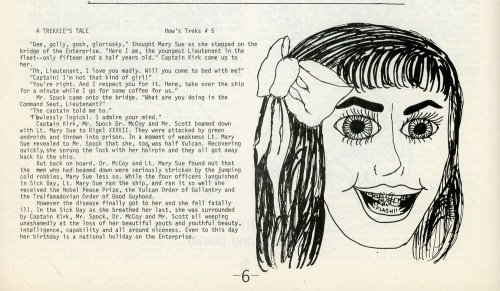
“A Trekkie’s Tale” by Paula Smith, as reprinted in the fanzine How’s Treks #5. The illustration is uncredited.
The whole story fits on a page. Lieutenant Mary Sue is the youngest lieutenant in the fleet, fifteen and a half years old. Captain Kirk falls for her on sight and propositions her. She turns him down with a prim line about not being that kind of girl, and he responds by leaving her in command of the ship.
Kirk, Spock, McCoy and Scott beam down to a planet and get captured. Mary Sue reveals that she’s half Vulcan, rescues all four of them by picking the lock with a hairpin, and then runs the Enterprise single-handed while the men recover from an illness. She collects the Nobel Peace Prize and a stack of other honors along the way. Then she catches a fatal disease and dies in Sick Bay while the senior officers weep over her, and her birthday becomes a holiday on the ship.
She never got a last name. Some fans remember her as Mary Sue Whipple, but Smith only ever called her Lieutenant Mary Sue, in the story and in the reviews she wrote afterward.
Every beat is a target.
The impossible youth. The instant adoration from the established heroes. The secret special heritage. The competence at everything. The noble death, mourned by everyone who matters.
Readers recognized it at once. They’d read that story many times.
Why did the original Mary Sue always die?
Look at how Smith’s parody ends. Mary Sue doesn’t retire with her medals. She dies, and Smith didn’t invent that part. The stories she was mocking ended the same way over and over: the heroine married one of the leads, or she died in Sick Bay.
Camille Bacon-Smith, a folklorist who spent years studying women in Star Trek fandom, had a theory about why. The young writers behind these stories were smart girls growing up in a culture that told them smart girls had to become quiet women. Their Mary Sue got to be brilliant and brave for a few pages, and then the story took it away, through a wedding or a deathbed. In Bacon-Smith’s reading, the active girl had to die so the proper young woman could exist.
The professionals did it too. Gene Roddenberry once noted that the published Star Trek stories almost always destroyed any woman who fell for Spock.
Smith saw something simpler underneath. She described Mary Sue as a teenage girl discovering the power of her own attraction, a stage of growing up that some writers worked through on the page.
That’s a kinder reading than the label usually gets.
How did a fanzine joke become a label?
Smith and Ferraro had already been calling these submissions “Lieutenant Mary Sue” stories among themselves, and once the parody ran, the name gave everyone a shorthand. Letter columns argued about it. The editors debated readers at early conventions. In correspondence with other zine editors they used male versions too, Murray Sue and Marty Sue.
Smith was blunt about why she kept at it. She wanted Star Trek fan writers good enough that the wider science fiction world would take them seriously, good enough to win Hugo votes on merit, and she thought the Mary Sue story was dragging everyone down. In a 1974 review she called it a worthless genre.
By 1976 the Menagerie editors were describing the whole genre in print: a young woman of extraordinary gifts who wins over the main crew, saves the day and, ideally, dies mourned by the entire ship.
From there the term traveled with fandom itself. Fan wikis that track it place it in Blake’s 7 fandom by 1980, on Usenet by the mid-eighties, and at the center of Harry Potter fan fiction arguments by the early 2000s. The male version picked up names of its own, Gary Stu and Marty Stu, and Australian fans called him Marcus Sampson, or Mark-Sam for short.
Smith kept the joke going for years. In 1981 she published a filk, the fannish name for a folk song, called “The Ballad of Mary Sue” in Menagerie #17.
Somewhere along the way the nickname left its schoolyard. People who had never seen a fanzine started using it about professionally written films and novels. Most readers meet it there now.
What is the Mary Sue Litmus Test?
By the late nineties the label had a scoring system. In 1997 a fan writer published the original Mary Sue Litmus Test, nineteen questions that added points for unusual eye color, tragic backstories, special powers and every other warning sign. Other tests followed, for fan fiction and for original novels.
It turned into a checklist people wrote to.
New writers built characters by working down the test until the score came out safe. The result was a character assembled like a tax form. Ten years later, the test’s creator wrote about how disappointed she was with the way it had been used.
The tests had a sense of humor about themselves, at least. A real person can score as a Mary Sue. Bono, the U2 singer, famously came out at 72 points on the original.
A score was never the point. A character can pass every question and still be a Mary Sue, because the trouble sits in the story around her.
What does Mary Sue really mean?
The type is much older than the name.
George Eliot mocked flawless heroines in her 1856 essay “Silly Novels by Lady Novelists,” and readers had been rolling their eyes at idealized heroes long before that. Smith’s own description is the best one. She told Smithsonian the characters were “simply placeholder fantasies.” Each author wanted to be on the Enterprise, so she put a version of herself there, made her perfect and let the universe arrange itself around her.
That points to what the term means in craft terms. A Mary Sue is a character the story bends around. Other characters exist to admire her. Problems exist so she can solve them. She has no flaw that costs her anything, no defeat that changes her, and no skill she had to earn on the page. The world rewards her for being herself.
The fanfiction notion of a self-insert isn’t the same thing. Plenty of writers put a version of themselves into a story and write a perfectly good character, because they let that character fail, look foolish and pay for mistakes.
Being based on the author doesn’t make a character a Mary Sue. Being exempt from consequences does.
Smith said as much herself. She pointed to Paula Block’s Sadie Faulwell stories in the zine Warped Space, a loose fictionalized take on Block and her friends, in which McCoy falls for Sadie. Smith liked them. The romance didn’t turn McCoy into someone else, and Sadie stayed an ordinary person who did foolish things.
Block called her an anti-Mary Sue.
I’ve used Luke Skywalker and Rey to explain this, on a podcast about story arcs years ago. Luke starts as an obnoxious teenager you can barely stand. He wins, then gets hammered: he loses his hand and learns who his father is. By the end of the trilogy he’s earned what he has. Rey, as written, learns little and wins nearly everything, and a character who never really loses never really develops. That’s the flat arc the Mary Sue label describes.
Plenty of people fought about Rey in public. When The Force Awakens opened in December 2015, screenwriter Max Landis called her a Mary Sue, and writers at Vox and Forbes answered that the film explains where her skills come from. The argument is still running.
Is Michael Burnham a Mary Sue?
The clearest modern example comes from the same franchise that gave us the term. Michael Burnham, the lead of Star Trek: Discovery, fits the original parody almost beat for beat.
Look at the setup. Mary Sue was secretly half Vulcan. Burnham is a human raised on Vulcan by Sarek, the first human to attend its academies, and, it turns out, the adopted sister Spock never once mentioned in fifty years of Star Trek. That’s the secret special heritage, written straight into the canon.
She isn’t the franchise’s first. Fans have a term, Canon Sue, for a character the official writers bend the show around, and the usual first example is Wesley Crusher from The Next Generation, the teenage prodigy who kept saving the Enterprise.
Wesley happened to be Gene Roddenberry’s middle name.
Then look at how the story treats her. In the first episodes she commits mutiny and helps start a war with the Klingons, and she’s stripped of rank and sent to prison. That’s a real flaw with a real cost, and for a few episodes it works.
Then the consequences fade. Within a season she’s restored, trusted and indispensable, and from there the show routes nearly every crisis through her. She solves the time-travel mystery, crosses nine centuries into the future, takes command of the ship and saves the galaxy more than once. The rest of the crew mostly watches, admires and waits for her to make a speech.
So the label fits. Being powerful isn’t the problem, and neither is being the lead. The problem is that the universe keeps arranging itself around her, the people around her exist to reflect her, and the cost of her mistakes never sticks. Kirk lost people, lost fights and lost his son. Burnham mostly gets vindicated.
Her defenders have one strong argument. Some fans say a lead can’t be a Mary Sue, because the original offense was walking into someone else’s story and taking it over, and a protagonist already owns her story. That holds for a show built around a new character in a new corner of the universe. Discovery went further. It rewrote fifty years of canon to make Burnham Spock’s sister, the same move Smith was mocking: a newcomer written into the family of the heroes.
Compare her with Ripley again. Both are capable women at the center of the story. Ripley pays for every inch. Burnham is told she’s special and the plot agrees.
Is calling a character a Mary Sue sexist?
It can be, and Paula Smith saw it happen. She told Smithsonian that some people started calling any female protagonist a Mary Sue. She also pointed to the double standard behind the original pattern: male placeholder heroes who were impossibly capable had been accepted for decades without anyone inventing an insult for them. In other interviews she’s named James Bond and Superman as male examples.
The double standard shows up in professional fiction too. Readers have called competent heroines like Anne McCaffrey’s Menolly and Modesty Blaise Mary Sues, while Batman, MacGyver and Bond pick up whatever skill the plot needs and sail through. One fan summed it up in 2010. A show with Daniel Jackson on it, the Stargate SG-1 archaeologist who speaks twenty-three languages and married an alien princess, has no business calling Sam Carter unrealistically talented.
Used that way, as a reflex against any capable woman, the term is lazy and it’s unfair. Ellen Ripley in Alien and Aliens is as competent as any hero ever put on screen, and nobody sensible calls her a Mary Sue, because she’s terrified, she makes mistakes and she loses people she loves.
Fandom paid a price for the reflex early. Camille Bacon-Smith’s study of women in Star Trek fandom, Enterprising Women, records a 1987 convention panel of women writers who had stopped putting women in their stories at all, because every female character they wrote got called a Mary Sue. An editor received a story in 1978 with a cover letter saying the writer was afraid it was a Mary Sue, only she didn’t know what that was. Science fiction author Ann Crispin called the term a put-down that dismisses a character however well she’s drawn.
Competence isn’t the problem. Competence nobody had to pay for is.
Men get written this way constantly. I called the lead in the recent Jack Ryan series a Gary Stu in my piece on invincible characters and why they’re boring, because he has no arc, doesn’t grow and can’t be killed. Plenty of action franchises run on a hero built the same way. That article makes the same point this one does. A character with no real challenges and no real flaws is a bad character regardless of gender.
So the test is the same for everyone. Does the character struggle, fail and change? If so, the label doesn’t fit, however powerful the character becomes.
How did the Mary Sue label become a weapon against new writers?
Then the internet arrived, and the nickname got teeth. Once fan fiction moved online, and especially after FanFiction.net opened in 1998, Mary Sue hunting became a sport. Communities formed to mock stories with Mary Sues in them. Self-styled Sueslayers rewrote other people’s stories for the sole purpose of killing off the character they’d condemned. Critics told teenage writers they should be ashamed of themselves, and some went much further than that.
That’s a bully with a style guide.
A kid who writes herself onto the Enterprise and saves Captain Kirk isn’t hurting anyone.
She’s fourteen and she’s learning. The story is probably bad, because most first stories are. What she needs is a note on the draft, and what she gets is a crowd. In 2010 a fan writer published an essay arguing that Mary Sue shaming was bully culture, and said they had nearly quit writing as a teenager after their character got the label.
They had friends who did quit. The essay drew so many comments that the author took it down.
I’ve written about why writing groups turn hostile and how a dogpile works, and Mary Sue hunting is an early version of both. Paula Smith wrote her joke to make fan writing better. The label was built to improve a draft, and a crowd improves nothing. All it teaches a young writer is to stop showing anyone her work. Anyone who uses it to drive kids out of writing is doing a rotten thing.
How do you avoid writing a Mary Sue?
Give the character a flaw that costs something. A temper that loses an ally, a pride that walks them into a trap, a fear that freezes them at the worst moment. A flaw that never hurts the character is decoration.
Let them lose, and make the loss matter. The middle of a story is where the hero should be getting hammered.
Defeat is where character comes from.
Make the skills cost something on the page, or at least show what learning them took. A sudden hidden talent that solves the climax is the purest Mary Sue move there is.
A hero who’s very good at things is fine. Leverage creator John Rogers coined the term competence porn for stories where clever people solve hard problems through skill and work, and readers love them. One critic pointed out that a Mary Sue is what competence porn looks like when it’s done badly: the skill shows up without the work.
Let other characters have their own lives. If every person in the story exists to admire, envy, love or need the protagonist, the world is a mirror. Give the supporting cast goals that have nothing to do with the hero, and occasionally let them be right when the hero is wrong. I’ve written more on this in building believable characters and character development.
The same trap waits in memoir. People want to come off well in their own life story, so a first draft can easily turn into a Mary Sue: every decision wise, every conflict somebody else’s fault. Readers trust a narrator who admits a mistake. The memoirs that move them are the ones where the author shows the losses and the failures, and pushing for that honesty is part of the job in memoir ghostwriting.
Can a Mary Sue character be a good thing?
Not everyone wanted her dead. In 1986 a fanzine put out a call for stories for “The Unabashed Mary Sue,” focused on female characters and strong relationships. From 1999 to 2002 a fan ran the Mary Sue Society, a webring that invited writers to admit to their avatars without shame, on the condition that they not expect the world to cheer.
Scholars took her seriously too. Media scholar Henry Jenkins wrote about young fans who learn to write by role-playing their way into the stories they love. In 2007 two law professors, Anupam Chander and Madhavi Sunder, published a paper arguing that Mary Sue fan fiction talks back to the stereotypes in mainstream entertainment and should count as fair use.
The defense comes down to this. A kid who has been told she’s nothing writes a version of herself who is everything, and plenty of writers start exactly there.
Both things can be true. A Mary Sue in a notebook harms no one and teaches a beginner plenty. The label starts to matter when the writer wants strangers to read the book, and most of all when strangers are paying for it.
The nickname that stuck
Paula Smith wrote a page of jokes about a teenage lieutenant with a hairpin and a fatal disease, and she didn’t even sign it. Fifty years later her character’s name is a standard term of criticism, used by people who’ve never heard of Menagerie.
She once said that Mary Sues seem to be a stage many writers pass through, a way of trying on who they are and what they could do. That’s worth remembering. Treat the label as a note on a draft and leave the writer out of it: let this character lose something.
For more on characters with real arcs, the Writing Hub collects everything I’ve written on craft. And if you’ve got a story with a hero who needs to bleed a little before the end, my fiction ghostwriting service is where that work starts.
Like any good nickname, Mary Sue stuck because it was true. Write your hero so it never fits.
