
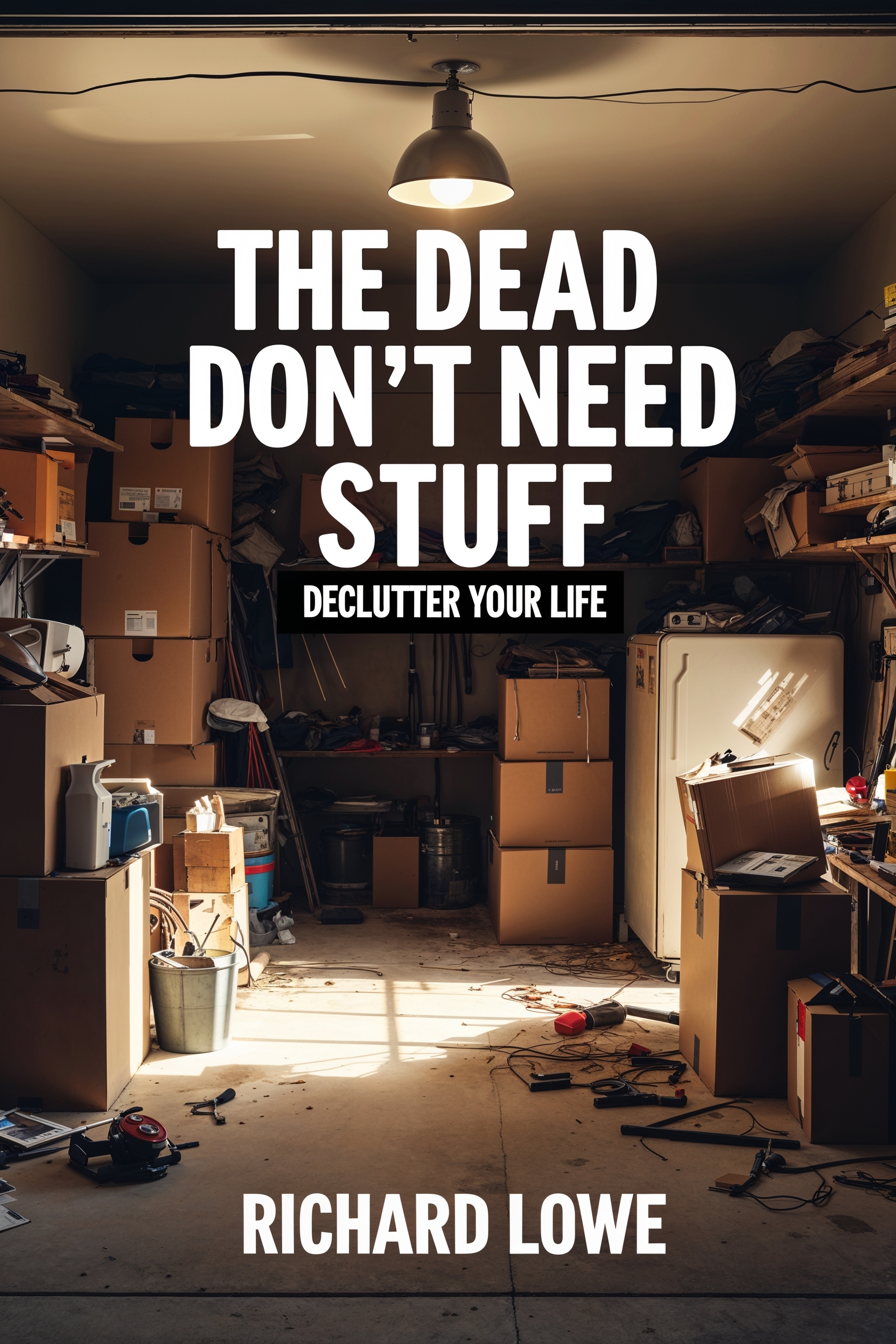
The Dead Don’t Need Stuff
Decluttering Without Destroying What Matters
 |
I’m not a hoarder. I’m a collector. Most advice misses the difference. BUY FROM INGRAMSPARKAMAZONKOBOREAD A CHAPTERTABLE OF CONTENTS 168 pages · Paperback ISBN 978-1-946458-33-9 · ebook ISBN 978-1-946458-78-0 |
| 168Pages | $35,000First eBay purge | 12Age he started collecting | 80%Of the stamps, gone |
I am not a hoarder. I am a collector. Most advice misses the difference.
Hoarders keep everything because they cannot decide what to release. Collectors keep specific things because those things matter. The damage happens when a collector gets overwhelmed by the volume and purges everything, throwing out the collection along with the accumulation.
I’ve collected stamps since I was twelve. At one point they filled an entire wall of albums. During an earlier purge I got rid of about eighty percent, then picked up my Tonga stamps and my Disney collection and stopped cold. Those weren’t clutter. The rest was.
Books were the same. Thousands of paperbacks and pulp magazines stacked three deep on shelves that had become a fire hazard. Most had served their purpose. Scattered through them were the ones I referenced, the authors I loved, and vintage pulps that connect me to the history of the genre.
The first time I sold on eBay I made thirty-five thousand dollars. That’s not a typo. Every purge since has yielded less.
What is inside The Dead Don’t Need Stuff?
|
The psychology
|
Sorting
|
|
Doing it
|
Afterward
|
Who should read The Dead Don’t Need Stuff?
|
Read it if
|
Not for you if
|
Why did I write The Dead Don’t Need Stuff?
Richard Lowe, the Writing King
A collector since I was twelve, with the stamp albums, the pulp magazines and the purges to prove it, including the ones I did badly. Thirty-five thousand dollars from the first eBay sale and steadily less from each one after. I’ve made every mistake this book warns about, on my own shelves.
► Behind the Book: The Dead Don’t Need Stuff
How this one got written, what went wrong, and what got cut.
► The Rose Parade Pins That Stopped Me Decluttering
One story from behind this book.
What do people ask about The Dead Don’t Need Stuff?
Also in Real Life, Handled
|
Hosting Without Being Drained by It |
The Relationship BULLSHIT Men Fall For What Thirty Years Taught Me |
Somebody is going to deal with all of it
The only question is who it falls to: you or the people you leave behind.
BUY FROM INGRAMSPARKAMAZONKOBOREAD A CHAPTERTABLE OF CONTENTS
Paperback and ebook.
A chapter
The Dead Don’t Need Stuff
Welcome to the part of the book where we talk about feelings. I know, I know. You thought this was going to be a practical guide about sorting boxes and labeling bins. That voice telling you to skip this chapter? It’s not your practical side talking. It’s the voice of a hoarder who has taken up residence in your skull and convinced you that keeping seventeen extension cords is just sensible preparation.
Getting rid of your stuff is going to mess with your head in ways that Instagram decluttering influencers don’t warn you about. They show you the satisfying before-and-after photos, but they skip the part where you spend forty-five minutes arguing with yourself about whether to keep a broken lamp “just in case.”
Your possessions aren’t just objects sitting around taking up space. They’re emotional support systems, security blankets, trophies, insurance policies, and time machines. No wonder most people make it through one closet and then give up. Their brain starts screaming, and they surrender.
Every item in your house comes with a story. Not the boring story about where you bought it or how much it cost, but the elaborate fiction your brain has constructed about what it means that you own it.
Take Michael’s collection of computer manuals from the 1990s. He had an entire bookshelf dedicated to software that stopped existing during the Clinton administration. He knew he’d never use them again. But getting rid of them felt like admitting something he wasn’t ready to admit.
The manuals represented Michael’s expertise. They were proof that he was a serious computer person who understood technology. Getting rid of them felt like getting rid of that identity. The manuals weren’t preserving his expertise. They were preserving his anxiety about not being an expert anymore.
I had the same problem with my photography equipment graveyard. I’d gone through a phase where I was convinced I was the next Ansel Adams, portrait sessions, wedding gigs, gallery exhibitions. I invested $4,000 in serious equipment. The portrait sessions never materialized. Neither did the wedding gigs. What materialized was a closet full of expensive cameras and lenses and lighting equipment that I shuffled around every time I needed something else.
For years, I kept all that equipment because getting rid of it would mean accepting that I’d wasted $4,000 on a fantasy. But keeping it wasn’t saving me from that truth. It was just making me look at the evidence of it every single day. When I finally sold everything, I got maybe $1,200 for gear that had cost me $4,000. It hurt, but it was $1,200 more than I’d when the stuff was taking up space, and the closet was suddenly useful again.
Table of contents
The Dead Don’t Need Stuff
- Prologue: The Rose Parade Pins That Saved My Sanity
- Introduction: Welcome to Clutter Anonymous
- Chapter 1: The Psychology of Stuff (Or: Why We’re All Crazy)
- Chapter 3: The Four Piles of Destiny
- Chapter 4: The Emergency Purge: Get Rid of This Stuff FIRST
- Chapter 5: The 20 Sacred Excuses (And Why They’re All Bullshit)
- Chapter 6: The Master Plan: How to Declutter (Without Losing Your Mind)
- Chapter 7: Room-by-Room Combat (Or: How Every Space in Your House Became a Hoarder’s Paradise)
- Chapter 8: The Psychology of Letting Go (Or: Why Your Brain is a Hoarder’s Best Friend)
- Chapter 9: Digital Decluttering (Your Computer is Also a Hoarder)
- Chapter 10: Maintaining Your Sanity (How to Stay Decluttered)
- Chapter 11: Life After Clutter (What to Do with All This Space)
- Conclusion: Your Stuff Will Outlive You (Make Peace with That)