
A kid in my neighborhood built a kite out of garbage bags and sticks and flew it higher than anything I’d ever seen. I was out there the same day with a real kite, store-bought, proper frame and everything. His was better. It flew better, it looked better against the sky, and he ran across that field with this ridiculous homemade thing soaring above him like it was the most natural thing in the world. That’s a story about refusing to be limited by what you’re given. Sometimes the garbage bag flies higher than the silk.
The wind came to Idris on the night he was born, howling through the village of Keth-Amara like a living thing, tearing thatch from rooftops and scattering goats into the ravine. His mother, a weaver named Senna, delivered him in the back room of her workshop while the gale battered the walls, and the midwife said later that the baby didn’t cry. He opened his mouth, and the wind stopped.
Not gradually. Not a dying gust. The air went still in a single instant, as if someone had closed a door. The silence lasted exactly as long as the baby held his breath. Then he exhaled, and a gentle breeze stirred the curtains.
The midwife told Senna’s mother. Senna’s mother told the village elder. The village elder consulted the old texts, the ones kept in the stone vault beneath the council hall, and found a passage that hadn’t been read in three hundred years.
“When the wind finds its keeper, the keeper will know. He’ll speak and the air will answer. He’ll walk and the gale will follow. Give him nothing, for he already owns everything that moves.”
Idris grew up knowing he was different. The other children sensed it the way animals sense a storm. They didn’t bully him or exclude him. They circled him at a distance, wary and fascinated, the way you’d circle a fire that burned without fuel.
He could call the wind. Not with words, not with gestures. With intention. If he wanted a breeze, the air moved. If he wanted a gale, the trees bent. By the time he was ten, he could direct the wind with precision, threading it through the narrow streets of Keth-Amara to turn a specific windmill or fill a specific sail on the fishing boats in the harbor below the cliffs.

The village prospered. Keth-Amara sat on a plateau above the Indigo Sea, exposed to weather from every direction, and for generations its people had been at the mercy of seasonal storms that destroyed crops, sank boats, and collapsed homes. With Idris, the destructive winds never reached the village. He deflected them, split them, turned them aside like a shepherd directing an unruly flock.
In return, the village gave him nothing, as the old text instructed. No wages, no special treatment, no title. He lived with his mother in the weaver’s workshop, ate what everyone else ate, wore what everyone else wore. The only concession to his gift was that no one asked him to do anything else. He didn’t fish, didn’t farm, didn’t apprentice to a trade. His trade was the wind, and it was enough.
The trouble began when the Merchant Prince of Thaladon learned about him.
Thaladon was a city-state three days’ sail south of Keth-Amara, a sprawling port that controlled trade across the Indigo Sea. Its wealth came from shipping, and shipping depended on wind. The Merchant Prince, a calculating man named Verek Solan, had built his fortune on the ability to predict wind patterns and position his fleet accordingly. A boy who could control the wind wasn’t a curiosity to Verek. He was a strategic asset.
The emissary arrived in Keth-Amara on a summer afternoon, riding a horse too fine for the village’s dirt roads. He was a slender man with manicured hands and a voice like oiled leather. His name was Pallister, and he carried a letter sealed with the Merchant Prince’s sigil.
“My lord Verek Solan extends his compliments to the village of Keth-Amara,” Pallister said, standing in the council hall before the village elder and a dozen wary fishermen. “And his particular compliments to the young man known as Idris. My lord proposes a partnership. In exchange for Idris’s services, Thaladon will provide Keth-Amara with preferential trade terms, reduced port fees, and military protection against pirates.”
The elder, a woman named Asa Thornwall who’d governed Keth-Amara for thirty years with the diplomatic finesse of a glacier, listened to the proposal and then looked at Idris, who was sitting in the back of the hall, fifteen years old, with his mother’s dark eyes and his father’s angular jaw. (His father had been a sailor who drowned when Idris was two. The irony of a wind-keeper’s father dying at sea wasn’t lost on anyone.)
“What do you think?” Asa asked him.
“I think the Merchant Prince wants to own the wind,” Idris said.
“The wind can’t be owned,” Pallister said smoothly. “But it can be directed. Commercially.”
“I already direct it. For my village.”
“Your village has twelve hundred people and a fishing fleet of forty boats. Thaladon has three hundred thousand people and a fleet of two thousand. The scale of good you could do is exponentially greater.”
Idris looked at his mother, who’d come to the meeting and was sitting near the door with her arms crossed. Senna had the expression she wore when merchants tried to underprice her textiles. Closed, evaluative, giving nothing away.
“I’ll think about it,” Idris said.
He thought about it for a week. Then he said no.
Pallister left. Verek Solan received the refusal with the patience of a man who was used to getting what he wanted eventually. He sent another emissary three months later with a better offer. Then another, six months after that, with threats woven so delicately into the diplomatic language that you had to read the letter twice to notice them.
The fourth time, Verek didn’t send an emissary. He sent ships.
Three war galleys appeared off the coast of Keth-Amara at dawn, bristling with soldiers and siege equipment. They anchored in the harbor and sent a longboat ashore with a final message: Idris would come to Thaladon voluntarily, or Keth-Amara would be sacked.
The village had no army. No walls. No weapons beyond fishing gaffs and the axes used to split firewood. The forty fishing boats in the harbor were sturdy craft built for the open sea, but they carried no armament and couldn’t outrun war galleys.
Idris stood on the cliff above the harbor and looked down at the three ships. The morning wind tugged at his clothes, familiar and responsive, waiting for his direction.
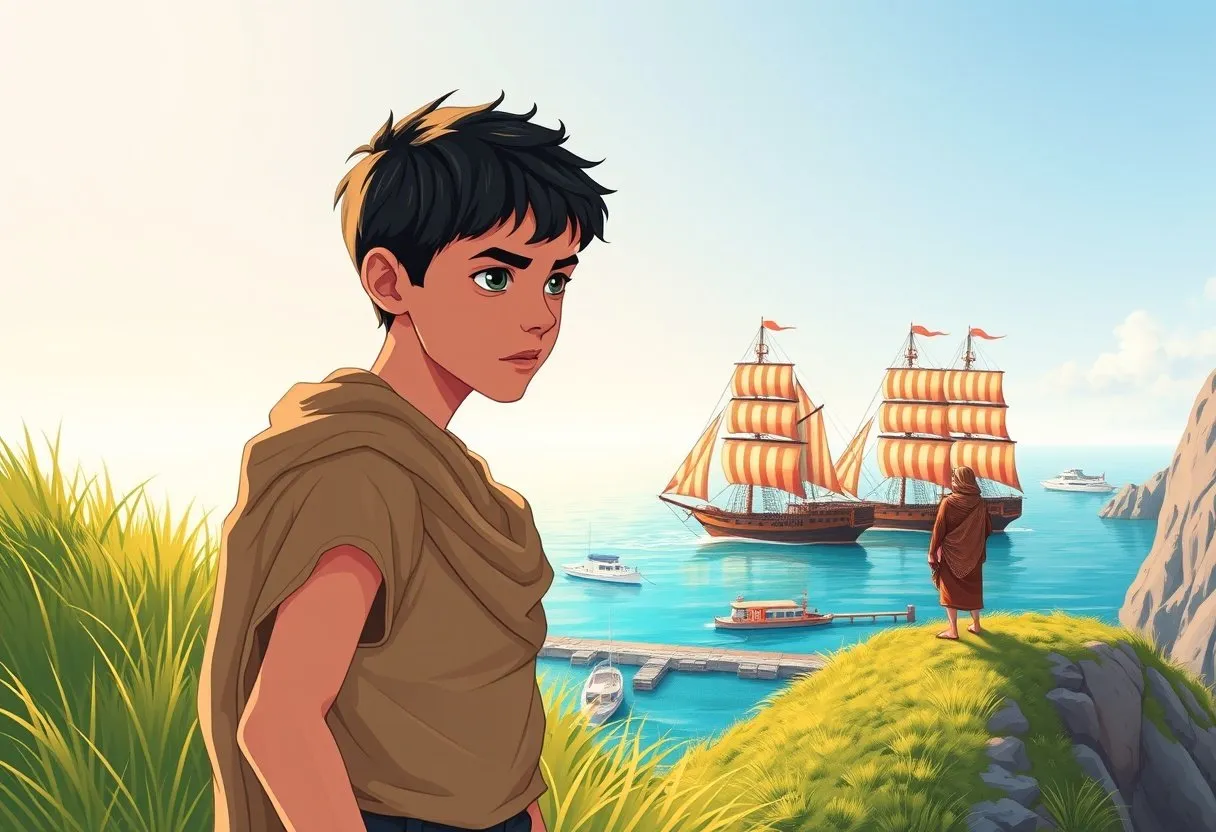
He could sink them. He’d never directed the wind with destructive intent, but he knew he could. A sustained gale driven into the harbor mouth, combined with a downdraft to push the ships onto the rocks below the cliffs, would break their hulls and scatter them. The soldiers aboard would drown or swim to shore, where twelve hundred angry villagers with fishing gaffs would be waiting.
Senna stood beside him. She put a hand on his shoulder. “Don’t.”
“They’ll burn the village.”
“Maybe. But if you kill those men, the Merchant Prince will send more. And then you’ll kill more. And then killing becomes what the wind is for, and you become a weapon instead of a keeper.”
“What’s the alternative?”
“Go.”
He looked at her. She was crying, which he’d never seen before, not when his father drowned, not when she’d broken her arm falling from a loom, not in any of the thousand small catastrophes that punctuated life in a village on a cliff above the sea. She was crying now, and the wind around them softened in response, dropping to a whisper.
“Go to Thaladon,” she said. “Give them what they want. Fill their sails. Move their ships. But remember who you are. The wind can’t be owned. Neither can you.”
He went. He boarded the longboat and was rowed to the flagship, where a captain in polished armor escorted him to a cabin that was nicer than any room in Keth-Amara. The fleet weighed anchor and sailed south with a wind so perfect and steady that the three-day voyage took thirty-six hours.
In Thaladon, Verek Solan treated Idris like a prince. He was given apartments in the palace, servants, tutors, fine clothing, food he’d never imagined. He was introduced to the court, the merchants, the admirals of the fleet. He was shown the shipyards, the warehouses, the vast harbor where two thousand vessels rode at anchor.
“All of this depends on wind,” Verek told him. “Good wind, and we prosper. Bad wind, and we starve. You’re the most valuable person in this city, Idris. I hope you understand that.”
“I understand that you need me,” Idris said. “That’s not the same as being valuable.”
For two years, he served Thaladon. He filled sails, calmed storms, directed breezes through the harbor to keep the ships moving in and out with clockwork efficiency. Trade boomed. Thaladon’s wealth doubled. Verek Solan became the richest man on the Indigo Sea.
And Idris grew hollow.
It happened gradually, the way erosion works, imperceptible in the short term but devastating across seasons. The first month in Thaladon, he’d felt the wind respond to his intentions with its usual eagerness, a gust arriving almost before he’d finished wanting it. By the third month, there was a lag, a fraction of a second between his intention and the air’s response, as if the wind was translating his commands through a language it was forgetting. By the sixth month, calling a breeze felt like pulling a rope through sand, the effort disproportionate to the result, the connection fraying under the strain of relentless use.
He missed the sound of Keth-Amara’s wind through the cliffside grasses. In Thaladon, the wind he summoned for the harbor smelled of tar and commerce. It carried no memory of salt or rosemary or the particular whistle that the sea breeze made passing through the gaps in his mother’s loom.
The wind obeyed him, but it did so with less enthusiasm. Where once it had responded to his intentions with the joy of a living thing, it now moved sluggishly, like a draft animal yoked to a plow. He felt the difference in his chest, a tightness that grew worse each month, as if the connection between himself and the air was being stretched thin.
He realized what was happening on the night of the autumn equinox, alone on the palace roof, watching the stars. The wind wasn’t a tool. It was a relationship. And like any relationship, it could be damaged by exploitation. By treating it as a resource to be extracted instead of a force to be partnered with, Verek had poisoned the bond.
Idris left Thaladon on a moonless night. He stole a small sailboat from the outer harbor, set a course north, and opened himself to the wind for the first time in two years. Not directing it. Not commanding it. Just asking.
The wind answered with a gust that nearly capsized the boat, then settled into a fierce, joyful blow that sent him racing across the Indigo Sea faster than any ship in Verek’s fleet. It was angry with him, he could feel that, angry and hurt and relieved, the way a friend might be after a long estrangement.

He reached Keth-Amara at dawn. His mother was at the harbor, as if she’d known he was coming, standing on the stone quay with her arms crossed and the wind pulling at her hair.
“The Merchant Prince will send ships again,” she said.
“Let him.”
This time, when the war galleys came, Idris didn’t sink them. He did something worse. He stopped the wind. Completely. For every ship within a hundred miles of Keth-Amara, the air went dead. Sails hung limp. Oars were useless against the current. Verek’s fleet sat motionless on a glass-smooth sea for three days, while their water ran low and their soldiers baked in the sun.
On the fourth day, Idris sent a breeze to the flagship. Just enough to carry a message.
“The wind isn’t for sale. Go home.”
They went. Verek Solan raged and plotted and schemed, but he never sent ships north again. The wind around Keth-Amara became legendary, a zone of unpredictable, violent weather that no navigator would enter without the village’s permission.
Idris lived to be very old. He never left the village again. He tended the wind the way a gardener tends a grove, with patience and respect and the understanding that what grows wild cannot be owned, only honored.
When he died, the wind howled for three days straight, and then it found a new keeper.
Got a story of your own that needs writing properly?
