TL;DR
6/10. Part of the Howdunit series, a crime-writer’s reference on the real private investigator, replacing the romanticized fictional PI with the methodical reality of surveillance, records, and patient legwork, with the insight that real practice is richer material than the myth. Its early-1990s methods are dated by the digital era, but the grounding on the nature of the work holds.
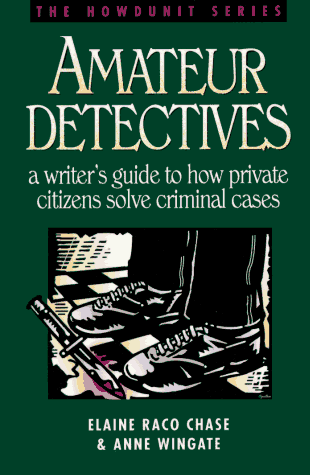
Private Eyes by Hal Blythe is part of Writer’s Digest’s Howdunit series, the line of crime-writer references written by professionals in their fields, and it focuses on the private investigator, supplying the inside details a writer needs to make a fictional PI credible. The private eye is among crime fiction’s most lasting figures, and among its most thoroughly mythologized. An accurate account of how the work really happens is valuable corrective grounding. Reviewed as the specialized craft reference it is, it does a focused job, with the familiar caveats.
The lens, as always, is craft: the value is authentic detail for writing a believable private investigator, and this review treats it as that tool, focused on what it gives a storyteller.
The real private eye
The book’s value is the gap it closes between the fictional and the real private investigator. The PI of fiction is a hard-drinking loner solving murders the police can’t. The reality is far more mundane and methodical. Surveillance. Background checks. Insurance work. Locating people, serving papers, the patient and often tedious accumulation of information.
As a Howdunit volume written by someone who knows the field, it gives a writer the inside details of how private investigation works. A fictional PI can then stand on real practice instead of on the accumulated myths of a century of detective stories. That’s a lot of junk to clear out, and this book clears a good chunk of it.
Keep reading
Writing a mystery that plays fair and still surprises: Blythe’s real-PI grounding, in the craft of the believable investigator.
Reality as richer material
A useful insight here is that the mundane reality of private investigation can be richer dramatic material than the myth. The real constraints, what a PI can legally do, the tedium and patience the work requires, the actual methods and their limits, give a writer authentic detail and real obstacles to build a story around, often more interesting than the implausibly capable fictional detective.
A PI who’s bored stiff on surveillance and can’t legally do half of what he wants is more interesting than a superhero in a trench coat. That’s the smartest idea in the book, and Blythe’s inside details give a writer the raw material to pull it off.
Keep reading
Believable fiction: the research that keeps readers from bailing: the real, mundane work over the myth, the heart of a credible PI.
What are the weaknesses of Private Eyes?
The standard limitations apply. The book dates from the early 1990s, and the digital era (databases, online records, electronic surveillance, the digital footprint everyone leaves) has transformed private investigation, like all investigative work, so the specific methods are considerably dated and a writer must update them against current practice for a contemporary story. The fundamentals, the legal limits, the patience, the nature of the work, hold better than the techniques.
As with all such references, it’s grounding for fiction, not a manual, and it’s a narrow specialist reference overlapping with the other PI and investigation books in the genre. Dated in particulars, like its shelfmates.
Is Private Eyes worth reading?
It’s a useful Howdunit-series reference on the private investigator, valuable for replacing the romanticized fictional PI with the methodical reality, and for the insight that real practice makes richer, more credible material than the myth. It loses ground for its early-1990s vintage, significant because the digital era has so transformed investigative work, so the methods need updating against current practice.
Treat it as authentic grounding on the nature of the work and a dated starting point on the techniques. The methods belong to the early 1990s. The point about real work beating the myth doesn’t expire, and it’s why this one gets a 6 from me instead of something lower.
Explore the hub
The Writing Hub: crime writing, research, and the rest of the craft, gathered in one place.
Frequently Asked Questions
Other Books in the Howdunit Series





Other Books From – Being an Author