TL;DR
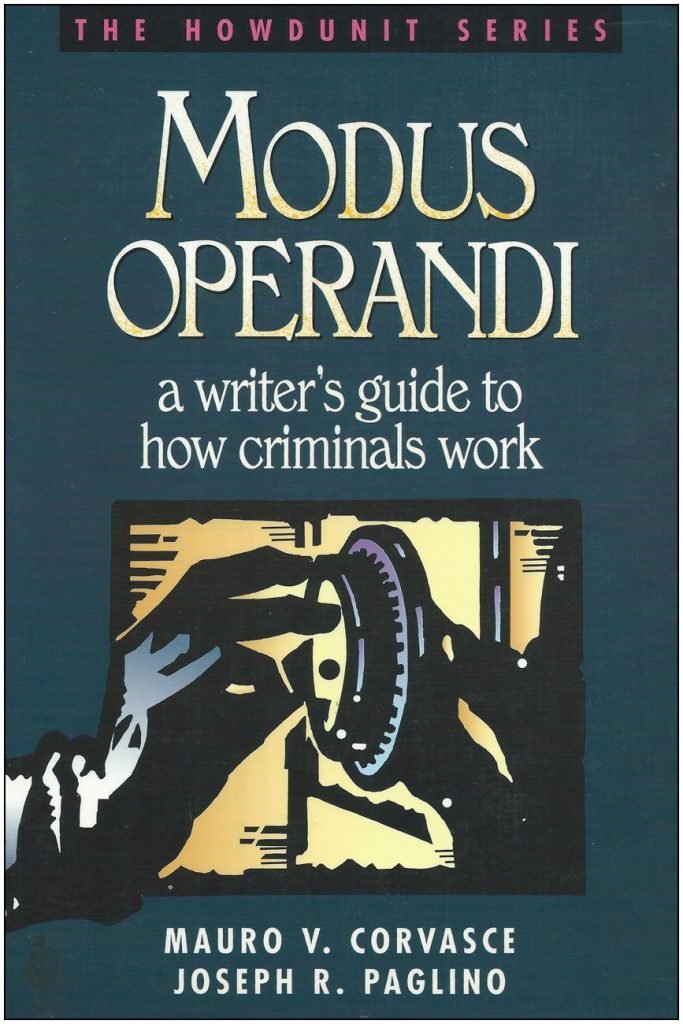
6/10. A crime-writer’s reference on how crimes are really committed. The methods and patterns that give mystery fiction its authenticity. Its most useful angle is that a criminal’s method works as both character signature and clue. Its mid-1990s specifics are dated, and it works best as part of a set, but it’s a capable niche tool for grounding believable crime.
Modus Operandi by Mauro V. Corvasce is a crime-writer’s reference aimed at giving mystery and detective fiction the grit of authenticity, focusing on how crimes are committed, the methods, techniques, and patterns of real criminal activity that separate a convincing crime story from a vague one. Among the crime-writer’s shelf, this one specializes in the mechanics of the crime itself, the offender’s method, which complements the references on forensics, investigation, and criminal psychology. My take on it is mixed. The idea of method as a criminal’s signature is sharp, and the mid-1990s specifics are stale enough to make me wince.
The lens, as always, is craft: the value is authentic procedural detail for writing believable crime, and this review keeps strictly to what the book gives a storyteller.
The grit of authenticity
The value is specific, realistic detail on how crimes are carried out. Vague crime scenes irritate me, because they’re the first thing a knowledgeable reader catches, and this book is a decent cure for them.
A writer can then depict criminal activity accurately, instead of the vague hand-waving that makes a crime scene feel fake. Know the realistic methods, the patterns and signatures real offenders use, and the practical realities of how a crime unfolds. That’s what lets a writer build a believable criminal and a credible investigation that reads as authentic to knowledgeable readers.
For mystery and detective fiction, where the crime drives the plot, this grounding in real method is exactly what gives a story the feel of reality the genre’s readers expect.
Keep reading
Writing a mystery that plays fair and still surprises: Corvasce’s authentic criminal methods, in the craft of the believable mystery.
Method as character signature
One subtler value worth drawing out: a criminal’s modus operandi is a signature, in fiction and in life, and understanding how real offenders develop and reveal patterns helps a writer use method as characterization and as a clue. The way a fictional criminal works can express who they are and can be the thread an investigator follows, so realistic detail about criminal method feeds directly into both character and plot.
Corvasce’s focus on the how of crime gives a writer raw material for authenticity and for the kind of patterned, clue-bearing crime that drives a satisfying mystery.
Keep reading
Writing villains whose methods reveal who they are: criminal method as signature, feeding both character and plot.
What are the weaknesses of Modus Operandi?
The standard limitations apply, with the usual note of care. The book dates from the mid-1990s, and criminal methods, and especially the investigative responses to them, have evolved with technology, so a writer should treat specifics as a starting point and verify against current understanding for a contemporary story. As with all such references, it’s grounding for fiction, not a manual, and the value is strictly in creating believable crime stories. It’s also a narrow specialist reference, useful to the crime writer and irrelevant to others.
And it’s one of several overlapping Corvasce crime references, valuable as part of a set more than as a standalone authority. Dated in its particulars, like its shelfmates. Three overlapping books to get one full picture is a damn clumsy way to build a reference shelf.
Is Modus Operandi worth reading?
It’s a useful specialized crime-writer’s reference on the methods of crime, valuable for grounding criminal activity in realistic detail and for the way method can work as both authenticity and characterization. It loses ground for its mid-1990s vintage, which dates specifics in an area technology keeps changing, and for the inherent narrowness of a single-focus reference that works best alongside its companions on forensics, investigation, and psychology.
Treat it as authentic grounding for believable crime fiction, to be verified against current practice. It’s a solid tool with a short shelf life, and I can’t call it more than that.
Explore the hub
The Writing Hub: crime writing, research, and the rest of the craft, gathered in one place.
Frequently Asked Questions
Other Books in the Howdunit Series






Other Books From – Being an Author