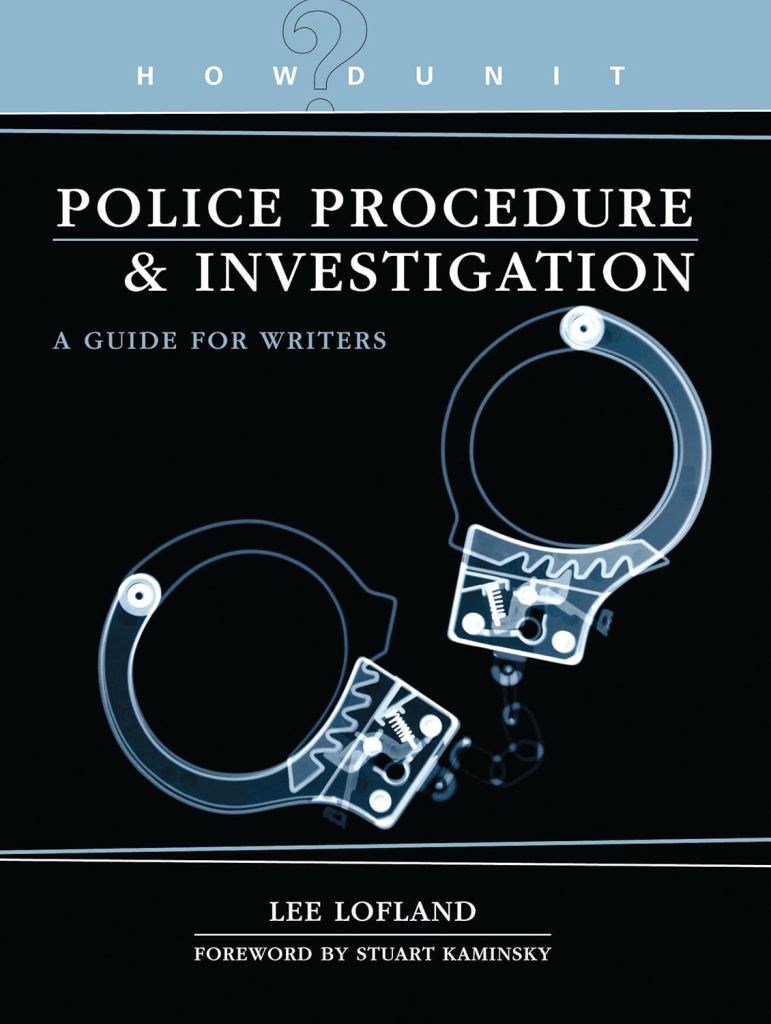
TL;DR
8/10. The standout crime-writer’s reference, correcting the confident myths fiction inherits from television, written by a veteran investigator with a teacher’s clarity. It captures the feel of real police work beyond procedure. More current than its shelfmates at 2007; jurisdictional variation and some drift the only caveats. Close to essential for crime writers.
Almost everything you think you know about police work, you learned from television, and almost all of it is wrong. That’s the premise of the Book of Police Procedure and Investigation by Lee Lofland, and it puts the book among the most valuable references a crime writer can own, because it corrects the confident errors that TV has planted in every writer’s head. Among the crime-writer’s reference shelf, this is the standout, and it deserves that standing.
Lofland is a veteran police investigator turned writer, and the book carries the authority of someone who did the job for years and then learned to explain it to authors. That combination, real experience plus a teacher’s clarity, is exactly what the subject needs. TV cop shows have done more damage to crime writing than any bad editor ever could, in my view. Writers copy the shows and other writers copy them, and the errors breed. A book written by someone who did the work is the cure, and Lofland wrote it.
Correcting what television taught you
The book’s great value is that it directly targets the myths fiction repeats endlessly. How investigations proceed, what police can and can’t legally do, how police really collect and process evidence, how arrests, interrogations, and crime scenes work, all corrected against the dramatic shortcuts that film and television have made writers believe are true. Because writers copy so much fictional police work from other fiction instead of from reality, errors compound, and Lofland breaks the cycle by going to the source.
For a writer whose sense of police procedure comes secondhand from crime drama, this is the necessary corrective.
The fiction-copying-fiction cycle does the most damage. A writer who researches from other novels is just inheriting someone else’s mistakes, and a reader who knows the job spots it on page one.
Keep reading
Believable fiction: the research that keeps readers from bailing: Lofland corrects the TV myths; the article shows how procedural accuracy holds a reader’s trust.
Watch: Fiction Forensics: Self-Edit Your Book with a Forensic Eye, AutoCrit
The insider authority
What separates this from the older references on the same shelf is that Lofland writes from direct experience and writes for novelists.
He knows both the procedure and the culture, how officers talk, what the work feels like, the details a writer needs to make a police character ring true instead of reading like a TV cop. He also runs a well-known resource connecting writers with law-enforcement expertise, so the book reflects an ongoing engagement with exactly the questions crime writers ask. That practical, writer-facing authority is the book’s defining strength.
The insider detail is what puts this above the pure procedure references for me. The rule for an arrest is useful to know. How officers talk and what the work feels like is what makes a reader believe the character carries a badge.
Keep reading
Writing a mystery that plays fair and still surprises: accurate procedure grounds the mystery; here’s the craft of the puzzle itself.
What are the weaknesses of Book of Police Procedure and Investigation?
The caveats are real but milder than for its shelfmates. Published in 2007, it’s more current than the early-1990s references around it, though policing, technology, and law have still moved since, so a careful writer verifies specifics, especially anything touching technology or recent legal change. Procedure also varies by jurisdiction, and a book describing general American practice can’t capture the local specifics of every department, so a writer setting a story in a particular place still needs local detail.
The 2007 date is a reason to double-check the technology, and I wouldn’t let it keep anyone from the book. A detail is quick to verify. The hard part is unlearning a lifetime of television, and that’s the job Lofland does. And it’s a procedural reference, not a craft guide, so it grounds the police side without teaching storytelling.
Is Book of Police Procedure and Investigation worth reading?
It’s the best of the crime-writer’s procedural references, valuable because it corrects the confident misinformation that television has installed in every writer’s mind, written by someone who did the work and knows how to teach it. For any writer whose story involves police, investigation, or the criminal justice system, it’s close to essential, the first place to fix the errors you don’t know you’re making. It loses only a little for the inevitable drift since 2007 and for jurisdictional variation.
If your story has a cop in it, buy this before you write another scene. I think it’s the standout of the crime-writer’s shelf, and the only things keeping it off a 9 are the drift since 2007 and the way no general book can cover every department.
Explore the hub
The Writing Hub: crime writing, research, and the rest of the craft, gathered in one place.
Frequently Asked Questions
Other Books in the Howdunit Series






Other Books From – Crime


About the author