TL;DR
6/10. A Writer’s Digest forensic reference by a physician, covering death, autopsy, and the procedures that follow, the complement to a wounding guide. Competent on the timeless basics, but its early-1990s forensic detail is badly dated in a field transformed by DNA and new technology. A foundation to check against current sources.
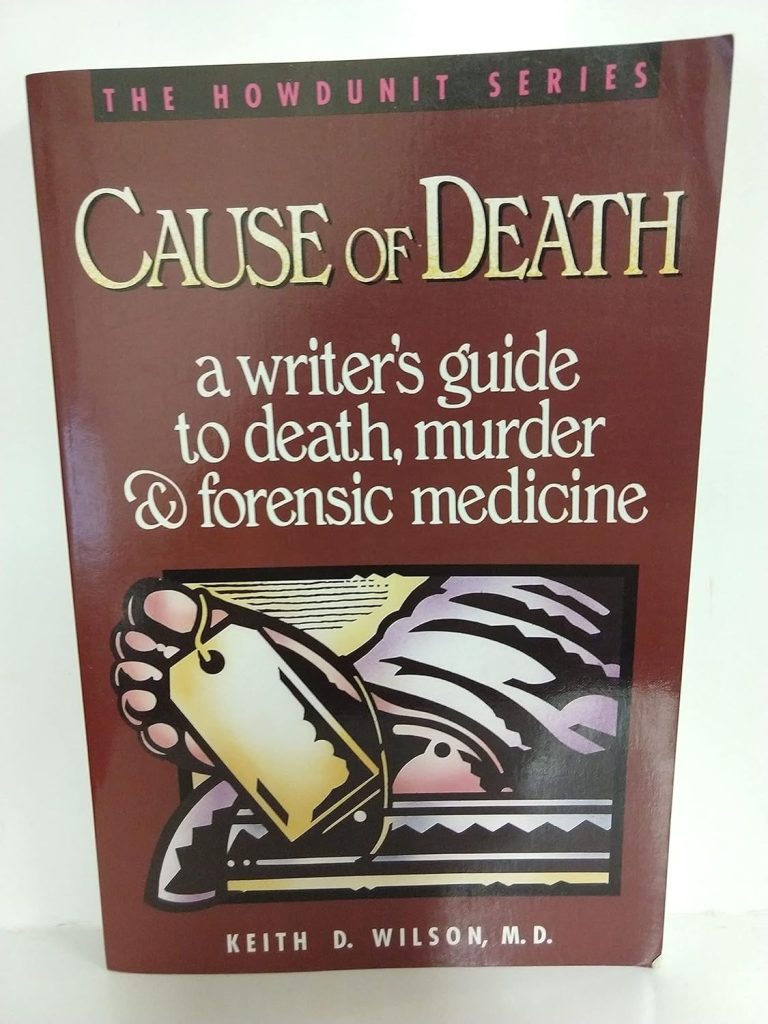
Cause of Death by Keith D. Wilson is the forensic companion to the injury references on the crime writer’s shelf: where one book covers wounding, this one covers what comes after, death, the body afterward, the autopsy, and the official machinery that processes a corpse. It’s a Writer’s Digest reference aimed at mystery, crime, and thriller writers who need their death scenes and investigations to survive scrutiny from readers who know how these things work.
Wilson is a physician, so the medical material has a baseline credibility. Fiction fudges the procedural reality of death constantly, with coroners announcing time of death to the minute over a cooling body. Competent is the word I keep coming back to here: solid, useful, and nothing that made me sit up.
What it documents
The book walks a writer through what happens to a body, from the moment of trauma through to burial. How a body changes after death. How pathologists conduct autopsies. The paperwork and legal procedures a death sets in motion, and the laws governing how authorities handle and investigate deaths. For a mystery writer whose plot turns on a body, a time of death, a cause, an autopsy finding, this is the factual grounding that keeps the procedural spine of the story believable.
It answers the practical questions most people, thankfully, never have to ask. A mystery that gets the autopsy wrong has no business asking readers to trust its clues.
Keep reading
Writing a mystery that plays fair and still surprises: accurate forensics ground a fair-play mystery; here’s the craft around the clues.
Where it sits among its shelfmates
This one doesn’t stand out from its shelfmates, and I won’t dress it up.
The crime-writer’s reference shelf is crowded with overlapping titles. Cause of Death is the death-and-forensics specialist, complementary to a wounding-focused book instead of redundant with it, and a writer doing serious crime work might reasonably own both. On its own subject it’s competent and useful. No single standout feature lifts it above the category. It’s a solid, workmanlike reference instead of an exceptional one.
Its value is proportional to how central death investigation is to what you’re writing.
Keep reading
Research for fiction: how much, and how to hide it: forensic facts matter only if worn lightly; the article shows how to deploy research invisibly.
Is Cause of Death still current?
The familiar caveat applies and is sharper here than for anatomy, because forensic science is one of the fastest-moving fields touching crime fiction. The book is from the early 1990s, and DNA analysis, forensic technology, and investigative procedure have advanced dramatically since, so the specific procedural and forensic detail is considerably dated. A contemporary crime writer can’t rely on it for current accuracy and must supplement it heavily; the broad realities of death and autopsy endure, but the current forensics that often drive modern mysteries aren’t here.
Is Cause of Death worth reading?
It’s a competent, useful forensic reference for crime writers, the death-and-autopsy complement to a wounding guide, grounded by a physician author. But its early-1990s vintage leaves its forensic and procedural detail significantly out of date in a field that’s transformed, so it works as a foundation to be checked and updated instead of a current authority. It has a modest place on the serious crime writer’s shelf, useful for the timeless basics of death and its handling, unreliable for the modern forensics a contemporary mystery often needs.
Solid but dated. A contemporary mystery built on this book’s forensics alone would fall apart in front of any reader who follows true crime, and a writer shouldn’t have to learn that the hard way.
Explore the hub
The Writing Hub: mystery, research, and the rest of the craft, gathered in one place.
Frequently Asked Questions
Other Books in the Howdunit Series





Other Books From – Crime



About the author