
Andromeda is about 2.5 million light years away and closing at roughly a hundred kilometers a second. Two hundred and twenty thousand miles an hour, give or take, and it’s been doing this since before anyone knew what a galaxy was. Astronomers noticed the approach in 1912, when Andromeda was still cataloged as a nebula and nobody was certain there was anything outside our own galaxy at all. The measurement came first and the understanding of what had been measured came second. That happens more often in astronomy than people expect.
This story is worth telling, and the best part is that the certainty went away. For thirteen years the collision was presented as settled fact, and I think a lot of popular science writing did the public a disservice by dropping the error bars to get a cleaner headline. The researchers attached their uncertainties, and the retellings left them out.
What was the old prediction for the Milky Way and Andromeda collision?
In 2012 a team at the Space Telescope Science Institute did something hard. They measured Andromeda’s sideways motion. Anything approaching you is easy to measure, because the light shifts. Motion across your line of sight isn’t, especially at two and a half million light years. Years of Hubble observation produced a number: about 17 kilometers per second sideways, against 109 straight at us.
That ratio is what settled it. Seventeen against a hundred and nine is very nearly head-on.
The conclusion followed cleanly. First close pass at 3.75 billion years. Tidal forces warping the Milky Way’s disk and pulling Andromeda into long streamers of stars by four billion. One or two more passes, then a single merged galaxy at around six billion years. Somebody named the result Milkomeda and it stuck.
NASA produced visualizations and textbooks carried it, and for over a decade this was simply what was going to happen. I don’t blame anyone for believing it. I do think science communicators owe people the uncertainty along with the pretty pictures, because a probability sold as a certainty leaves readers feeling misled when the number moves.
Why did the Andromeda collision prediction change?
Because the two galaxies aren’t alone, and the old calculation treated them almost as if they were. The Local Group contains something like a hundred known galaxies. Two of them are big enough to matter here. M33, the Triangulum galaxy, and the Large Magellanic Cloud. It’s close enough to us to have a real gravitational say in where we go.
A team led by Till Sawala at the University of Helsinki, with colleagues at Durham and Toulouse, put those into the model. They used newer data from Hubble and from Gaia, the European star-mapping mission that’s measured the positions and motions of well over a billion stars. Then they accounted for twenty-two separate variables including the ones nobody knows precisely, the masses and positions and velocities that earlier work had filled in with best guesses.
And they ran it a hundred thousand times. The result, published in Nature Astronomy in June 2025: roughly a fifty percent chance of a merger within the next ten billion years. And only about two percent for the head-on collision in the four to five billion year window everyone had learned.
I think that’s among the most admirable things a research team can do. Running a hundred thousand simulations to find out that your field’s favorite prediction is closer to a coin flip earns you no applause and a lot of awkward interviews, and they published it anyway.
What changed the odds of the Milky Way colliding with Andromeda?
Two galaxies pulling in opposite directions. That’s a satisfying answer because it’s so mechanical.
M33 makes a merger more likely. It travels with Andromeda and adds mass to that side of the problem.
The Large Magellanic Cloud makes it less likely. It pulls the Milky Way off the orbital plane and away from Andromeda. Sawala’s phrasing is careful: it doesn’t mean the LMC saves us, it means it makes the merger somewhat less probable.
The larger point is about error. Every one of those twenty-two variables carries an uncertainty, and uncertainties compound. Enough of them stacked together turn a confident prediction into a coin flip. Nothing was discovered to be wrong in the 2012 work. It was a correct calculation performed on a simplified system with the unknowns pinned to their likeliest values, and that’s a different thing from a prediction.
What happens when galaxies collide?
Almost nothing hits anything, and most people have that backwards.
The nearest star to the Sun is about four light years away. Scale the Sun down to a grain of sand and the next grain is fifty kilometers off. A galaxy isn’t a crowd of objects, it’s a small number of specks in an enormous volume of nothing, and when two galaxies pass through each other the odds of any two stars striking are close to zero.
What does interact is gravity and gas. Tidal forces pull long streams of stars out into tails hundreds of thousands of light years long. Gas clouds, which are enormous and diffuse, do collide, and the shock triggers a burst of star formation. The two central black holes eventually spiral together and merge. That takes a very long time and releases gravitational waves.
The stars themselves survive and get rearranged. The orderly spiral disk becomes a shapeless elliptical blob. As one astronomer put it, the milky band across the sky becomes a milky blob.
Our own Sun is likely to be flung outward into a wider, more distant orbit. Nothing dramatic happens to it. It simply ends up somewhere else, in a galaxy that no longer looks like anything on any star chart.
How do you measure a galaxy moving sideways?
This deserves its own section because it’s the most impressive thing in the story and it never gets explained. Motion toward or away from you is easy to measure. Light from an approaching object shifts blue, from a receding one shifts red, and the size of the shift gives you the speed. Andromeda’s blueshift has been known since 1912.
Motion across your line of sight gives you no shift at all. You have to watch the object physically change position against more distant background objects, and at 2.5 million light years the apparent movement of an entire galaxy is smaller than almost anything else astronomers try to measure.
The 2012 team did it by imaging the same star fields in Andromeda years apart with Hubble and measuring how they’d shifted against faraway galaxies behind them. The answer, 17 kilometers per second, came with real uncertainty attached, and that uncertainty is one of the twenty-two variables the 2025 study refused to pin down.
Gaia changed the picture again. It’s measured positions and motions for well over a billion stars, which gives a far better handle on the Milky Way’s own mass and movement, and our own galaxy turns out to be one of the harder things to measure precisely because we’re inside it.
Have other galaxies collided and merged?
Constantly, and we can watch it.
The Antennae Galaxies are two spirals partway through a merger, with the tidal tails that give them their name stretched hundreds of thousands of light years out. NGC 2207 and IC 2163 are in an earlier stage. There are enough examples at enough points in the process to assemble the sequence the way a biologist assembles a life cycle from specimens.
Astronomers believe large galaxies are built this way. The Milky Way has absorbed smaller galaxies repeatedly, and the streams of stars left over from those events are still detectable, moving through the halo on their own orbits.
Andromeda wouldn’t be the first galaxy we have eaten. It would be the first one big enough to change what we are.
Would a galaxy collision matter for Earth?
No, and the reason is bleak in a way that puts the whole question in perspective.
The Sun brightens as it ages. In roughly a billion years the increase is enough to end the conditions life needs here. That’s three to four billion years before the earliest collision scenario. In about five billion years the Sun becomes a red giant and the inner solar system stops being a place.
Whatever the galaxies do, nobody on this planet is watching. The collision is only a question about the sky.
Which is exactly why it’s such good material. It’s one of the very few catastrophic events we can describe in detail and be entirely safe from. The stakes are pure curiosity.
Whatever the galaxies do, nobody on this planet is watching.
That freedom is what hooked me as a novelist. I get to write about the end of everything a galaxy knows without a single reader needing to fear for themselves, and that lets the story go to places a disaster aimed at Earth never could.
Why write about the Andromeda collision as fiction?
Collision With Andromeda began with one question. What would the Milky Way do if it understood it was going to collide with Andromeda and lose its consciousness?
Not a human talking to a galaxy. The galaxy itself, aware, and afraid of its own ending. I wrote a few chapters eight years ago, enough to know the shape, and then it went into a pile of half-finished books and sat there. It got finished in 2026 as part of clearing that pile, and of everything in it, this turned into the most ambitious thing I’ve written.
What it grew into is a story about a lonely galaxy that murders the sister it loved, a humanity used as the murder weapon, and the difference between knowing what you’ve done and understanding it.
The method that got it there is one I think of as dropping inkblots. I don’t take a single concept and expand it. I drop several separate concepts on the page and let each one grow arms until the arms touch. Galaxies are alive and conscious. Humans have to interact with that. The galaxy uses them. The humans find out they helped murder an entire galaxy. Other galaxies find out what was done. The book is what forms where the blots finally meet. That’s why the threads only connect late.
The real physics matters to a book like that because of scale. Invent the numbers and the reader has nothing to stand on. Keep them real and the strangeness takes care of itself.
What the revision teaches a writer
This is the second Book Background article where the science moved after the book was written, and the lesson repeats.
The 2012 prediction was in every popular account for thirteen years. Any novel that built its plot on a certain collision in four billion years would now be arguing for something the field has stepped back from. What hasn’t moved: the distance, the approach velocity, stars not hitting each other, the behavior of gas and tidal tails, the shape of the merged result, and the Sun’s own timeline. Those are measurements and mechanisms. What moved was a probability derived from them. The rule is the same one Toba teaches. Build on the mechanism and the physical experience, and a revised probability leaves the work standing. Build on the headline number and the work has an expiry date printed on it that you can’t see while you’re writing.
Novels that hang the whole plot on a headline number are a poor bet. The writer who does that gives readers a book with a hidden expiration date, and when the science moves, it’s the reader who’s left holding a story that no longer works.
My take
Never hang a novel on a headline number. The Andromeda prediction sat in every popular account for thirteen years, and then a hundred thousand simulations cut it to a coin flip. The distances, the speeds and the empty space between stars didn’t move. Build your story on mechanisms like those and the science can shift under you without touching the book. Build it on the date and you’ve written something with an expiry stamp you can’t see.
Will the Milky Way collide with Andromeda?
If someone asks whether the Milky Way and Andromeda will collide, the accurate response in 2026 is that nobody knows, and that this is a recent development.
Fifty percent within ten billion years. Two percent for the version everyone learned. The Finnish team’s own summary was that reports of our galaxy’s impending demise appear greatly exaggerated, and their published line is blunter: the fate of our galaxy is still completely open.
That’s a better sentence than the certainty it replaced. A galaxy whose future is undecided is more interesting than one on rails, and I’m delighted the field finally says so out loud. I’d much prefer an open question told truthfully over a tidy ending that was never as solid as the textbooks made it look. The novel is Collision With Andromeda. More of the research behind the fiction is in the writing hub. The writing side of it is in how the book came together.
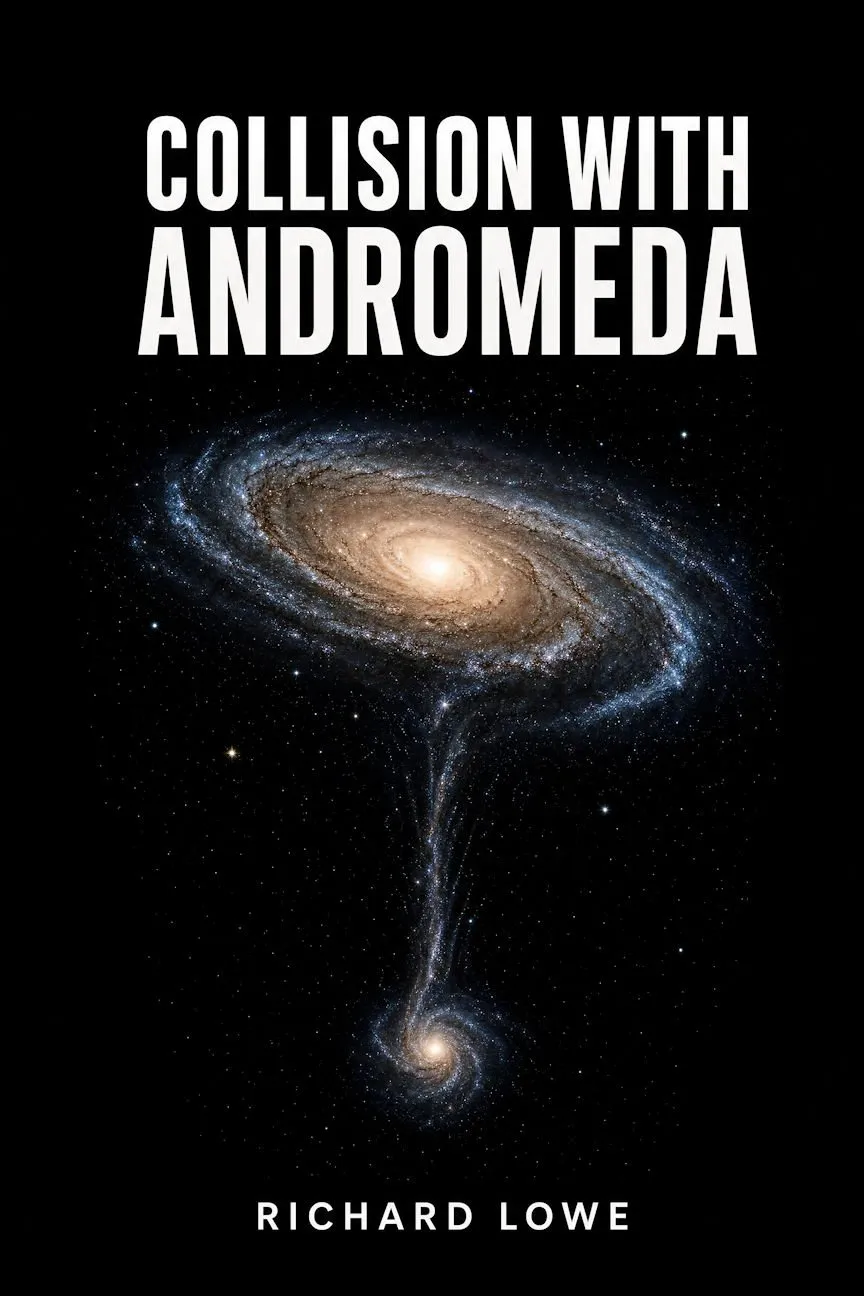
Collision With Andromeda spans seventeen million years and one family, narrated in part by a conscious Milky Way that is thirteen billion years old and means well.
