
Fifty years of flying, and it’s gone one day.
That’s the strange arithmetic of Voyager 1. It launched in 1977, it’s been moving at tens of thousands of miles an hour ever since, and on November 18, 2026 it reaches the distance light covers in twenty-four hours. Nothing humans have built has ever been that far from home. Light from the Sun reaches Earth in about eight minutes. Light from Voyager now takes a day.
I write science fiction, and Voyager outruns anything I could make up.
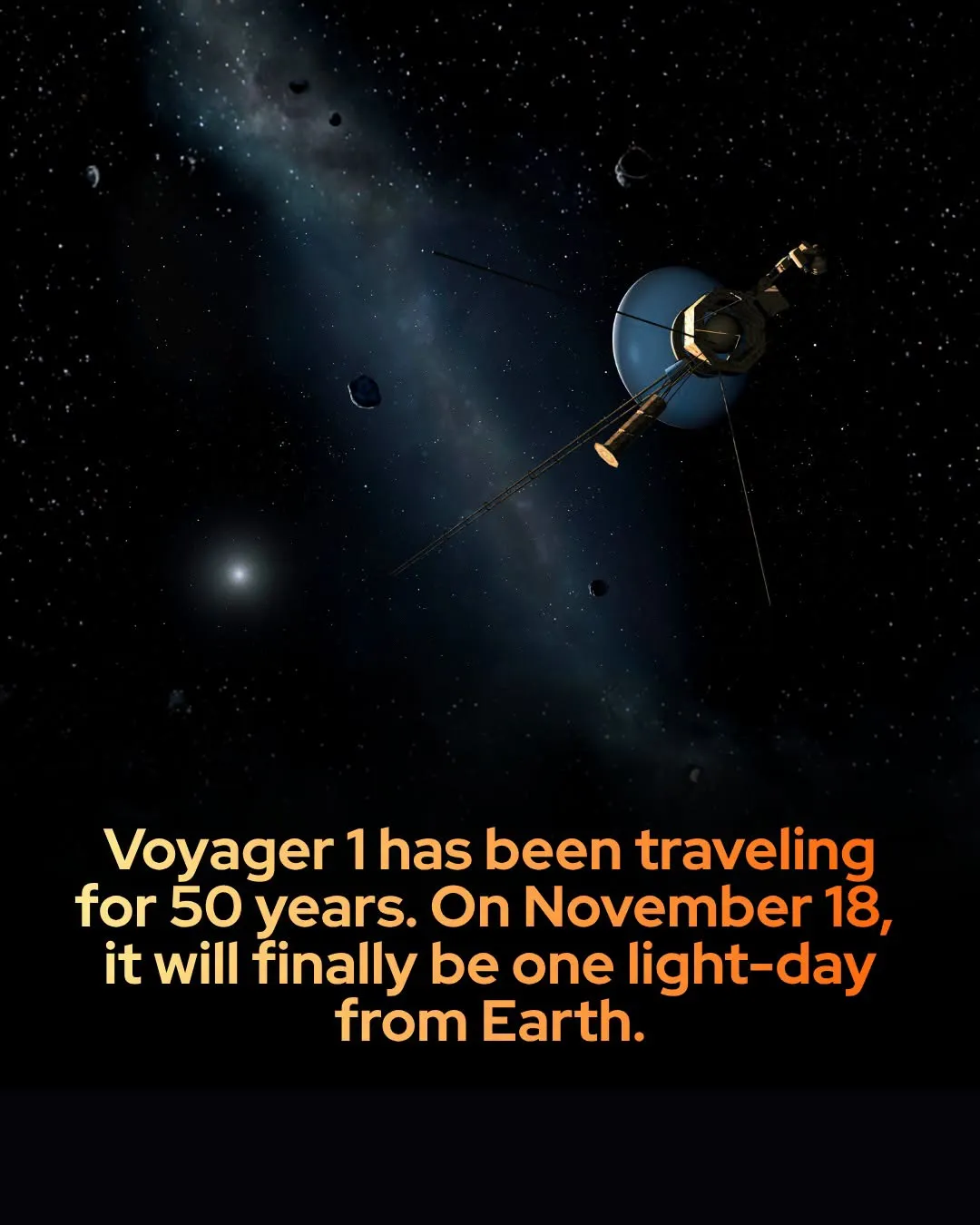
What is Voyager 1 One Light-Day Day?
It marks November 18, 2026, the day NASA’s Voyager 1 reaches one light-day from Earth: about 16.09 billion miles, or 25.9 billion kilometers. No other spacecraft has gone that far. Its twin, Voyager 2, is about 2 billion miles closer and won’t reach the same mark until around November 2035.
What does a light-day feel like? Drive at highway speed without stopping and you’d need more than twenty-five thousand years to cover it. Voyager did it in under fifty, and it’s still nowhere near another star.
It isn’t an official holiday. I’ve put it on the calendar because it’s one of those milestones that should be remembered every year, the way people remember the Moon landing.
Why does a two-day round trip make Voyager 1 so hard to run?
Because every conversation takes two days.
The engineers at NASA’s Jet Propulsion Laboratory talk to Voyager by radio, and radio travels at the speed of light. At one light-day, a command needs a full day to reach the probe, and the reply needs another day to come back. Project manager Suzanne Dodd summed it up: if you want to say hello to Voyager, you send your message, go home and wait two days.
Try running a machine that way. You can’t watch it, and you can’t fix anything fast. Every decision gets made a day before it takes effect, on information that’s a day old, and the machine is older than most of the people working on it.
Voyager 1 from launch to one light-day, nearly fifty years later.
How long did it take Voyager 1 to reach one light-day?
Almost forty-nine years. Voyager 1 launched on September 5, 1977, and it’s now cruising at about 38,000 miles an hour.
Along the way it flew past Jupiter in 1979 and Saturn in 1980, then turned outward. In 1990, at Carl Sagan’s urging, it turned its camera back and took the photo now called the Pale Blue Dot: Earth as a speck, a fraction of a pixel, caught in a beam of scattered sunlight. In 2012 it crossed the heliopause, the edge of the bubble the Sun’s wind blows around the planets, and became the first spacecraft in interstellar space.
And still, by one measure NASA’s lab gives, the solar system is more than 2,300 light-days across once you count the far cloud of icy bodies around it. Fifty years in, Voyager hasn’t left the neighborhood. Space is big in a way the mind refuses to hold.
Fifty years in, Voyager hasn’t left the neighborhood.
Why does the Pale Blue Dot still matter?
Because it’s the one photo that shows how small we are.
On Valentine’s Day 1990, Voyager 1 was about 3.7 billion miles out when it turned around and photographed the planets behind it. Earth came out as a single bluish point in a streak of sunlight. Sagan wrote a book around it, and his line about every human being who ever lived doing so on “a mote of dust suspended in a sunbeam” has outlived most of what anybody wrote that decade.
I keep coming back to that photo when a project feels enormous. You’re on that speck. So is everybody you’ve ever argued with. It puts the fight in a comment thread in its place.
The distance has more than quadrupled since that picture. Voyager can’t take another one; the cameras were shut off soon after to save power. So the Pale Blue Dot is the last look back we’ll ever get from it. It gets to be a better picture every year.
How do engineers keep a fifty-year-old probe alive?
With patience and a lot of switching things off.
Voyager runs on plutonium-powered generators that lose about four watts of power every year. There’s no way to refuel. So the team has been turning off what the probe can live without, including two science instruments already. In September 2026 engineers at JPL moved three onboard devices to lower-power settings to keep the remaining instruments running longer.
It still keeps them on their toes. In October, contact dropped for two days, until the engineers found the probe had switched itself over to its backup thrusters. Picture that: two days of silence from a machine sixteen billion miles away, with a two-day round trip on every question you ask it.
I spent years running computer operations, and I know the feeling of nursing an old system that nobody can replace. Nobody I ever worked with had to do it across a light-day.
What is on Voyager’s Golden Record?
Writers should love this part. Both Voyagers carry a gold-plated copper record, a message for whoever finds the spacecraft someday. A committee chaired by Carl Sagan chose what went on it: greetings in 55 languages, sounds of Earth, about ninety minutes of music and more than a hundred images, along with instructions for playing it.
It’s a letter with no address and no expected reply, written for a reader nobody knows exists, and it’ll still be out there when everybody who made it is gone. Has anyone ever written anything with a longer deadline?
Voyager’s Golden Record is a letter to a reader nobody knows exists, mailed to an address nobody knows. That’s still the most hopeful thing we ever wrote. – Richard LoweShare on X
Science fiction got there first, sort of. In Star Trek: The Motion Picture, the menace turns out to be V’Ger, a Voyager probe that came back after a machine civilization built it up into something vast and lonely, looking for its creator. The movie had its problems. The idea still sticks with me.
My take
Voyager 1 is the best thing we ever threw. A machine built in the 1970s is still sending data home from interstellar space, kept alive by people who weren’t born when it launched. And it carries a record of who we were, addressed to nobody in particular. Spend a minute on November 18 looking at the Pale Blue Dot photo. Then go write something that’ll outlast you.
How to mark the day
Look up the Pale Blue Dot photo and read what Carl Sagan wrote about it. Listen to a little of the Golden Record. NASA has put it online. If you write science fiction, spend an hour with the scale problem Voyager gives you for free: a day for light, fifty years for us, and thousands of light-days still to the edge of the solar system.
For more on the shows and stories that made a generation look up, see Star Trek Day and First Contact Day. If you’re writing a book about the long view, of science, of a career or of a life, my book coaching service is a good place to start. Voyager is still talking. We should be listening.
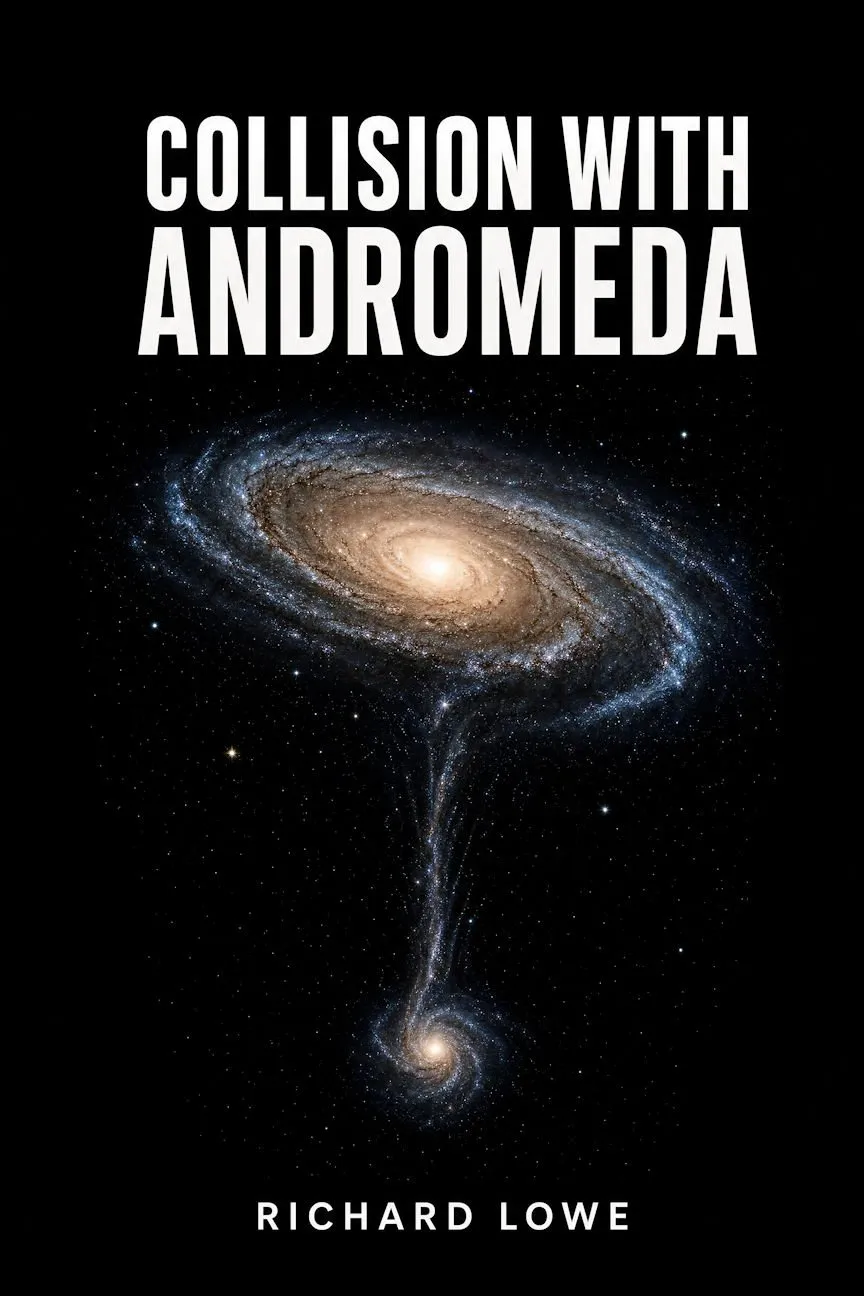
If Voyager makes you think about scale, my novel goes much further out. Its narrator is the galaxy itself, awake for thirteen billion years, watching one family across seventeen million.
Frequently Asked Questions
- Voyager 1: What Is a Light-Day?, NASA
- Voyager 1 reaches 1 light-day from Earth, EarthSky
- NASA Jet Propulsion Laboratory. (2026, November 3). NASA's Voyager 1 is about to reach a historic one-light-day milestone. ScienceDaily.