
Ask anybody to draw Frankenstein’s monster, and you’ll get a flat head, a scar across the forehead and two bolts in the neck.
Mary Shelley never wrote any of it. The flat head, the bolts, the green skin and the stiff-armed shuffle all came later. Her creature, in the novel she published anonymously in 1818, looks nothing like the one on every Halloween mask. He also talks, reads and argues better than most of the humans in the book.
The creature has worn a lot of faces in two hundred years, and each one says something about the people who drew it. Here are four of them, all public domain, laid side by side, starting with the only one that came out while Mary Shelley was alive to see it.
What does Frankenstein’s creature look like in the novel?
Beautiful, almost.
That’s the horror of it.
Victor Frankenstein chose the parts carefully. He meant the creature to be handsome, and he built him eight feet tall because large parts were easier to work with. Then the thing opened its eyes, and Victor saw what he’d made. In his own words: “His yellow skin scarcely covered the work of muscles and arteries beneath; his hair was of a lustrous black, and flowing; his teeth of a pearly whiteness.”
The beautiful pieces only made the rest worse. The watery eyes, the shriveled complexion, the straight black lips. Victor ran from the room, and he spent the rest of the novel running.
And then the creature learned to speak. Hiding in a hovel beside a cottage, he watched a family for months and taught himself language. He found a satchel of books and read Paradise Lost, Plutarch’s Lives and The Sorrows of Young Werther. When he finally confronts his maker on a glacier, he argues his case with the skill of a lawyer and the grief of an abandoned child. He asks for one thing, a companion, and he makes a better argument for it than Victor ever manages against it.
Nobody remembers that version.
The movies took his voice away.
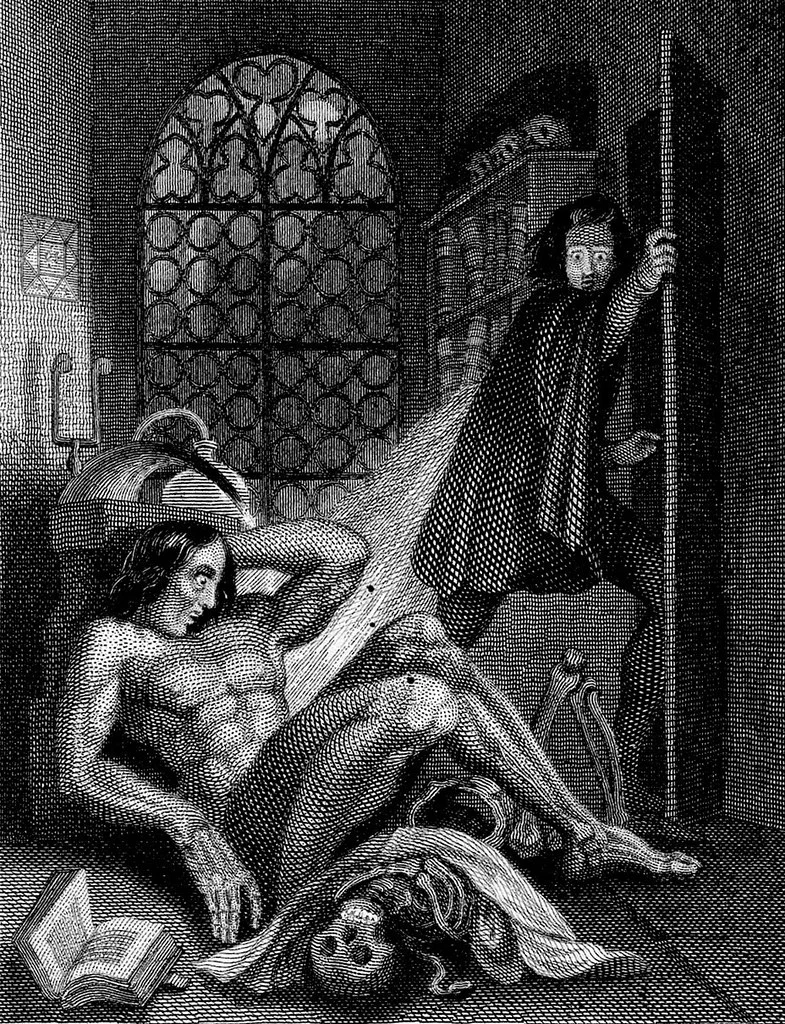
Frontispiece to the 1831 edition of Frankenstein, engraved after Theodor von Holst. Public domain.
What was the first picture of Frankenstein’s creature?
Mary Shelley revised the novel for a single-volume edition in 1831, and the publisher added an engraved frontispiece by the painter Theodor von Holst. It’s the first published picture of the creature.
Look at it. The creature is a man. Naked, muscular, with long dark hair, half sitting up on the floor among bones and an open book, staring at the world with an expression closer to shock than menace. Behind him, Victor flees through the door with his cloak over his shoulder.
Holst read the book. His creature is newborn, confused and alone, and the coward in the picture is the one who made him. That’s the moral of the novel in one image, and it’s the last time for a hundred years that anybody drew him that way.
Frankenstein on the stage, 1823
The creature lost his voice almost immediately, and he lost it to the theater.
In 1823, five years after the novel came out, Richard Brinsley Peake put it on the London stage as Presumption; or, the Fate of Frankenstein. It was a hit. Peake made changes that stuck for two centuries. He gave Victor a comic assistant named Fritz, the ancestor of every hunchbacked lab helper since. And he made the creature mute. No speeches, no Paradise Lost, no argument on the glacier. Just a huge actor named T. P. Cooke lurching across the stage in makeup.
Mary Shelley went to see it and was amused by the playbill, where the creature’s role was listed only as a blank line. She liked the idea of naming the nameless that way. She doesn’t seem to have minded that the play cut out the creature’s mind, but that cut turned out to be the most important change anyone ever made to her story.
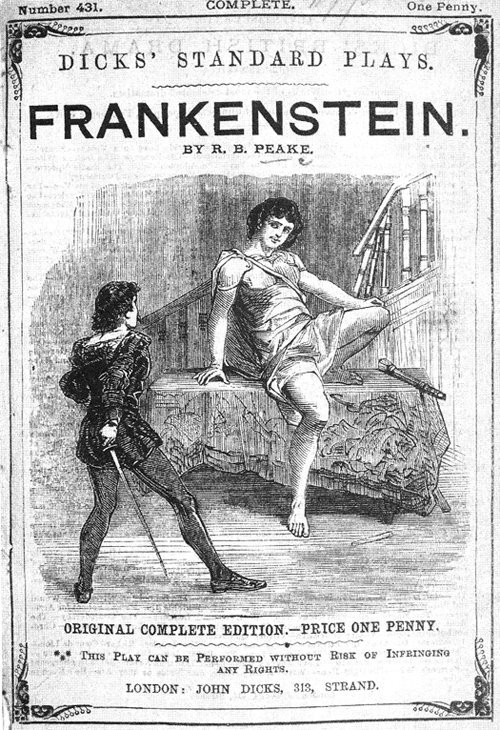
Peake’s Frankenstein in the Dicks’ Standard Plays penny edition, London, nineteenth century. Public domain.
Peake’s play stayed popular for decades. Later in the century, John Dicks of the Strand printed it as a penny play, and the cover shows how far the creature had drifted. He sits on a table in a toga, like a classical statue that’s come to life, while Frankenstein faces him with a drawn sword. No horror at all. A Victorian stage spectacle with a giant in a bedsheet.
Mary Shelley’s creature reads Paradise Lost and argues like a lawyer. The stage took his voice in 1823 and the movies never gave it back. Nobody remembers the version that could talk. – Richard LoweShare on X
How did Boris Karloff change Frankenstein’s monster?
He made the face everyone knows, and he made it so well that it replaced the book.
Edison’s studio filmed the first Frankenstein in 1910, with Charles Ogle as a shaggy, wild-haired creature. But the version that defined the twentieth century came from Universal in 1931. Director James Whale cast Boris Karloff, and makeup artist Jack Pierce built the look in hours of work every morning: the flat-topped skull, the heavy brow, the scars, the electrodes on the neck that everybody calls bolts, the sunken eyes and the boots that gave him that heavy, stiff walk.
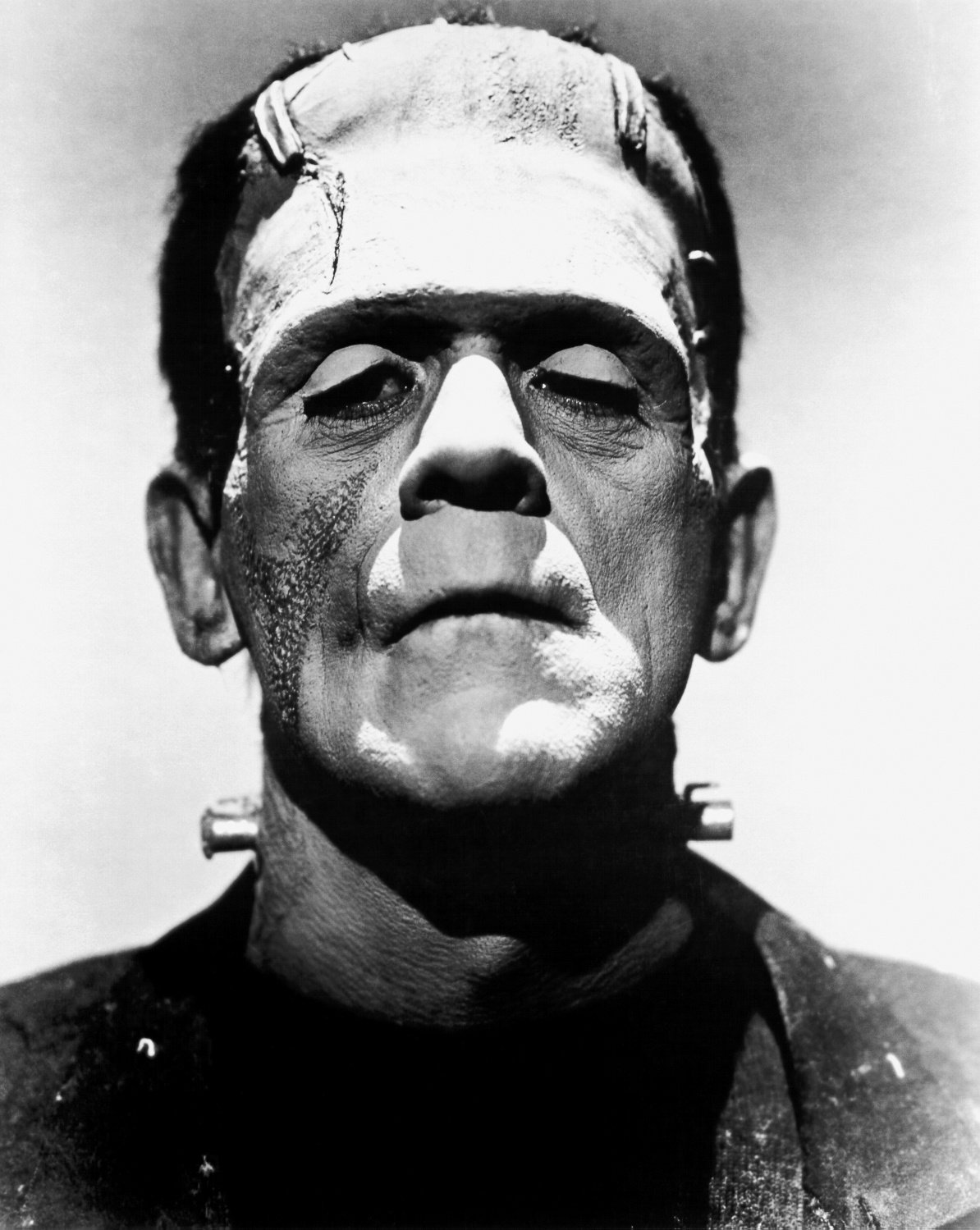
Boris Karloff in a publicity portrait for Bride of Frankenstein, 1935. Public domain.
Karloff’s creature, like Peake’s, is mostly mute. He grunts, he reaches for the light, he drowns a little girl by accident because he doesn’t understand. Karloff played him with enormous sympathy, and in Bride of Frankenstein he finally gets a few words. But they’re halting words, a child’s words. The articulate philosopher on the glacier is gone. I gave both Frankenstein and Bride a nine out of ten, and they earn it. They just tell a different story from the book.
The films did one more thing. They moved the name. Ask most people who Frankenstein is, and they’ll point at Karloff. In the novel, Frankenstein is the man who ran away.
Bernie Wrightson and the house at Laval
The most beautiful attempt to put the book’s creature back on the page came from a comic book artist.
Bernie Wrightson spent years in the late 1970s and early 1980s drawing an illustrated edition of the novel, published in 1983. He worked in dense pen and ink, the way the great Victorian illustrators did, and his creature is closer to Shelley’s than any film: lean, long-haired, ragged, terrifying and sad. Those plates are still under copyright, so I won’t reproduce them here, but they’re worth seeking out.
In one of Wrightson’s plates, the creature tears through a crowded European street, and the building behind him is a timbered house with two pointed dormers and a shopfront at street level. That house is real. Or at least, it’s a real drawing.

“Old House at Laval, France,” drawn by J. C. Halden, from Arthur Guptill’s pen-and-ink instruction book. Public domain.
It’s “Old House at Laval, France,” drawn by J. C. Halden for Arthur Guptill’s classic instruction book on pen-and-ink drawing. Guptill printed it as an example of the detailed studies students should make from existing work. Put Halden’s drawing next to Wrightson’s plate and the dormers, the cross-braced timbers and the shop windows line up. Wrightson took a study of a real building in a real French town and set Frankenstein’s creature loose in front of it.
Writers do the same thing with research. Every convincing invented world is built from real details somebody went and found. The best fantasy rests on something true.
Why does the creature’s face matter?
Because every version shows what its audience was afraid of.
Peake’s audience wanted a spectacle, so they got a giant. Holst’s readers had the book in their hands, so they got an abandoned newborn. The 1930s, a decade of factories and electricity and breadlines, got a creature made in a lab, stitched together and bolted shut, a man-machine who couldn’t explain himself. Wrightson, in the age of the counterculture, went back to the book and found a tragic outcast.
The novel’s version is still the most frightening of all of them, and the reason is the voice. A mute monster is a force of nature. You run from it, or you kill it. A creature who reads Milton, understands exactly what was done to him and asks his maker why he was abandoned is a moral problem. You can’t shoot your way out of a moral problem.
That question drives a lot of my own fiction. I wrote about it for Frankenstein Day: the made thing that asks why its creator gets to be the good guy runs through The Eternal War, where Lucifer and a grieving AI are both created beings with grievances against their makers. Guillermo del Toro has been chasing the same idea for decades, and I wrote about his advice to love your monsters. His Frankenstein is one more attempt to give the creature back his voice.
Read the book
Two hundred years of faces, and the best one is still the one you build in your own head from Mary Shelley’s words. Yellow skin, black hair, pearly teeth, and a mind sharper than his maker’s.
If all you know is the movies, read the novel. It’s short, it’s free in the public domain and the creature will surprise you. For more on the monsters and makers that shape fiction, start at the Writing Hub. And if you’re building a creature of your own and want help giving it a voice, my book coaching is built for that.
