
“You’re listening to WKVT Pittsburgh, it’s twelve minutes past midnight, and my guest tonight passed away in 1961. Sir, thank you for coming back.”
“Thank you for having me, Danny.”
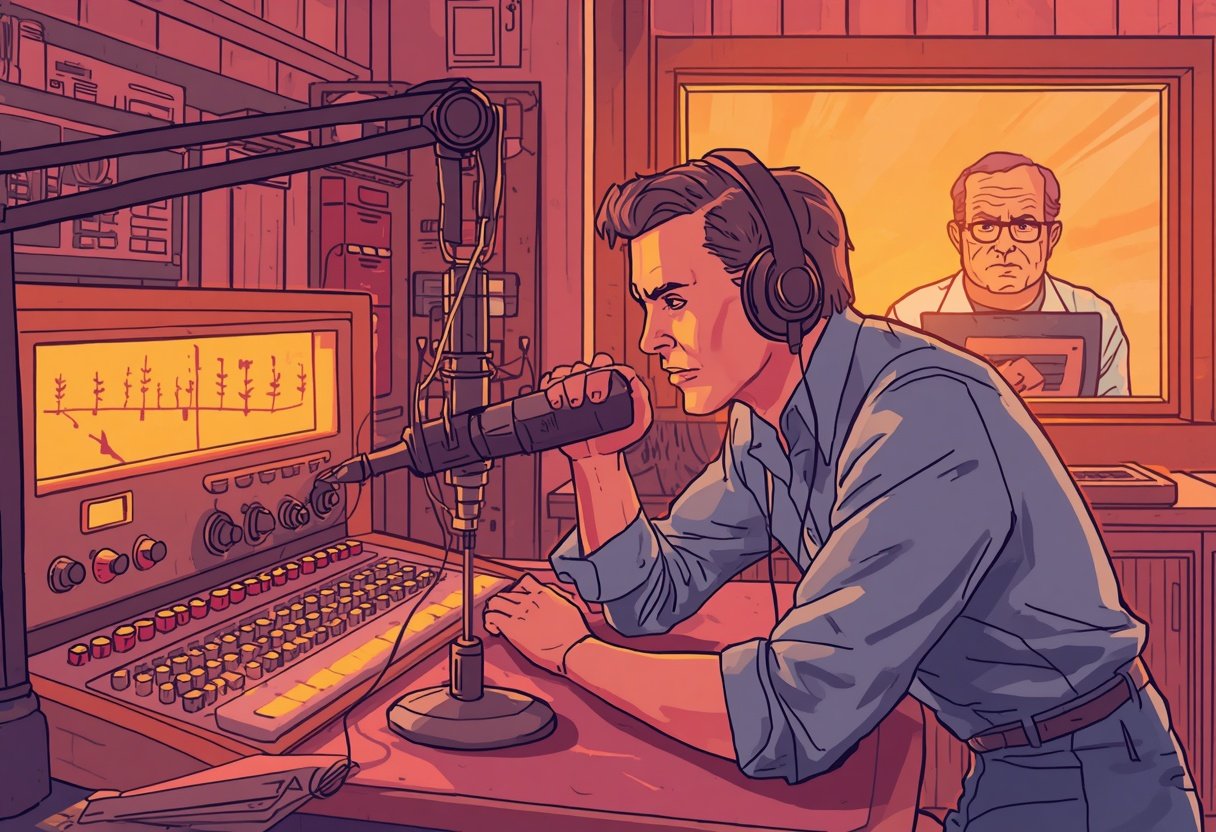
The needle on the VU meter swung with the dead man’s voice the same as it would for any caller, and that was the part the engineers could never explain. Danny Voss watched it move through the glass of the booth and kept his face still. The whole bit only worked if he played it straight, and after eleven years the bit was the only thing he had.
The switchboard was lit up like a Christmas tree. It always was, this segment. People called to hear him talk to the dead and to decide for themselves whether he was a liar. The station sold the ad time at a premium and didn’t ask Danny how he did it. The general manager, a man named Pesci who chewed antacids like candy, had told him exactly once: I don’t care if it’s real, I care if it rates, and it rates, so shut up and keep doing it.
It was real. Danny had stopped trying to convince anyone of that around year three.
“You were a steelworker,” Danny said into the microphone. “J&L, down on the South Side. You want to tell the folks what happened?”
“Cable snapped. Ladle car. I was standing where a man shouldn’t stand.” The voice had the flat patient quality they all had, the dead, like long distance on a bad line. “Quick, though. I’ll say that. Quick.”
“Your wife still listens to this station. Marie.”
A pause. The dead took their time. “She does?”
“Every night. She wrote us a letter.”
The board flashed. Danny held up a finger to the engineer, Coyle, who was staring through the glass with the expression he always got, the one that said he wanted to believe it was a trick because the alternative kept him up at night. Coyle had wired the booth himself. He knew there was no second feed, no hidden tape, no actor in a back room. He knew it the way you know a thing you refuse to know.
“Marie wants me to ask you something,” Danny said. “She says you’ll know what it means. She says: where did you put it.”
The dead man laughed, soft and far away. “Behind the furnace. Loose brick, third from the floor. Tell her I’m sorry I never said. I meant to. There wasn’t time.”
“Behind the furnace. Third brick from the floor.”
“Tell her it’s enough to fix the porch and have some left. Tell her to fix the porch. She always hated that porch.”
Danny wrote it on the pad in front of him, the way he wrote everything, because in the morning he’d call Marie and read it back and she’d go and look, and either there would be money behind a loose brick that nobody living had known about, or there wouldn’t, and Danny had been doing this long enough to know which.
“We’ll pass it along, sir. Thank you for coming back.”
“Danny.” The voice changed. They sometimes did this, at the end, when the line was about to go. “How do you do it? How do you reach us?”
It was the question everyone asked, the living and the dead both, and Danny had the same answer for all of them, which was no answer.
“I just open the line,” he said. “You’re the ones who call.”
The meter dropped to nothing. The dead man was gone. Coyle reached for his cigarettes with a hand that wasn’t steady.
Danny took the next call. A woman wanting her mother. He found the mother the way he always found them, by opening the line and waiting, and the mother came on with news about a wedding ring and a sister who’d taken it. The woman on the phone started crying and the meter swung and Coyle smoked and the ad time sold at a premium.
At two he signed off. WKVT went to the network feed. Danny sat in the dark booth and didn’t turn on the lights, because the dark was when they were closest, and sometimes, in the dark, after the mic was off and the building was empty, the line opened on its own.

It opened now.
“Danny.”
He knew the voice. He’d known it his whole life. He had been waiting eleven years to hear it come through, and dreading it, because if his own father came through the line then the thing was real in a way Danny could no longer call a job.
“Hi, Pop,” Danny said.
“You do good work, son. Talking to all these people. Giving them their loose bricks and their wedding rings.” A pause, long distance, bad line. “When are you going to ask about me? I’ve been on the line a long time, waiting for you to ask.”
Danny looked at the dead board, the unlit meter, the empty booth. Eleven years of other people’s dead. He’d opened the line for every steelworker and every grandmother in western Pennsylvania and he’d never once opened it for the one voice he wanted, because some questions a man would rather keep than answer.
“I know, Pop,” he said. “I know you have.”
The meter swung, all by itself, in the dark, for no one but him.
“Ask me, Danny,” his father said. “I’ve got something behind a loose brick too.”
Danny reached for the mic. His hand wasn’t steady either. Outside the booth the building was dark and the city was asleep, and the only light in the world was the small red glow of a meter measuring a voice no machine should have been able to hear. Danny Voss, who talked to the dead for a living and had never once believed it would cost him anything, opened the line for his father and asked.
- ►20 Horror Writing Exercises with Craft Mechanics
- ►20 Dialogue Writing Exercises with Craft Mechanics
- ►20 Literary Fiction Writing Exercises with Craft Mechanics
Got a story of your own that needs writing properly?
