
I spent 33 years in enterprise IT watching people treat email like a filing cabinet. It isn’t one, and the day the account goes away, everything in it goes too.
The way providers set people up is the worst part of this subject. The storage is free, it grows every year, search finds anything, and nowhere on any screen does it say the whole pile can vanish on the say-so of a classifier. The people who get hurt aren’t reckless. They trusted every signal they were given, and the company that sent those signals carries none of the loss.
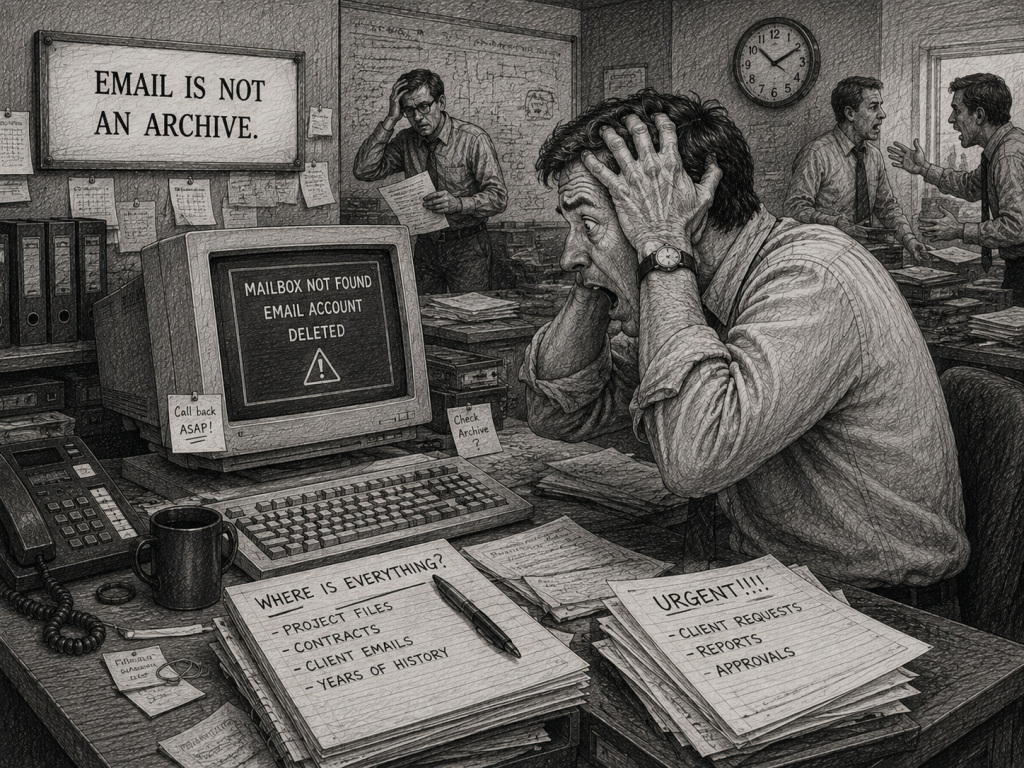
One of my help desk techs called me about a full disk. Ordinary call, ordinary fix. A user at a major national retailer had run out of space on her Mac and couldn’t save anything, so he did what any competent technician does in that situation. He emptied her trash and gave her back the room she needed. She had been storing her legal documents in the trash bin.
Not by accident. She’d worked out that she could right-click a file, send it to the trash, and it would sit there indefinitely without her having to open a folder, go to another folder, and drag anything anywhere. Fewer clicks. Same result, as far as she could tell. She had been doing it for a long time and it had worked every single time.
We’re talking about tens of thousands of documents. Legal files and accounting records. Nothing recoverable, because the trash is the one location on a Mac that backup software is told to leave alone. Why would you back up the place where deleted things go?
Nobody in that story did anything wrong in the moment. The tech applied the correct fix. She’d found a workaround that saved her time and never failed. The machine did exactly what it was designed to do. And a decade of records stopped existing on a Tuesday afternoon.
The same mistake with a different container
I saw a screenshot recently that made me think about her for the first time in years.
A Google account, disabled. No warning, no specific accusation, no human being to talk to. The notice said the account looked like it was being used in a way that violated policy, which is a classifier speaking. There’s a link to appeal, and the appeal goes to another automated system.
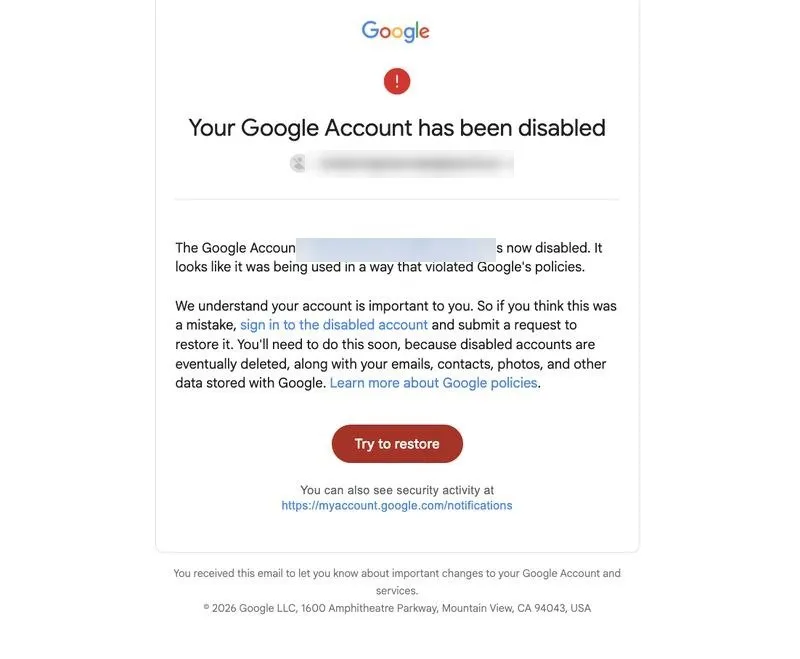
The person on the other end of that notice had been using Gmail as a document archive.
Different container, identical error. Both of them put material they couldn’t replace into a place that was never built to hold it, and both of them had years of successful use telling them it was fine. Neither had any reason to doubt it, right up until the day the system did exactly what it was built to do.
Why does storing documents in email fail?
An inbox is a delivery mechanism. People started treating it as storage because it never asked them to stop, and because search made retrieval good enough that filing seemed unnecessary. Twenty years of that habit builds an archive nobody ever decided to create.
Nothing about a mail service is built for retention. There’s no integrity check. There’s no version history for an attachment. There’s no export you’d want to bet on. Attachments get stripped, links to cloud files rot, and the whole structure hangs off one credential controlled by a company that has no contractual obligation to keep you. I wouldn’t hand anything I cared about to an arrangement like that.
The storage keeps getting bigger and it stays free. That teaches exactly the wrong lesson. Every signal the product sends says permanent. None of the terms say permanent.
What happens when a Google account is disabled?
Three things happen at once, and most people only see one coming. The mail becomes unreachable. That’s the loss people picture, and it’s the smallest of the three.
Then everything authenticated against that account dies with it. Cloud storage, photos, contacts, calendar. A person who kept a second copy of their documents in Drive discovers that the second copy was never a second copy, because it lived behind the same login.
Then the slow part. Every other service in their life has that address as the recovery contact. Password resets go to a mailbox that no longer accepts mail.
Verification codes go nowhere. Banking, hosting, domain registration and social accounts start failing one at a time over the following weeks, and most people never connect those failures back to the original event.
A deletion clock is running through all of it. Disabled accounts are eventually purged along with everything in them, and nobody tells you how long you have.
I think that’s the cruelest part of the whole setup. A company can hold years of somebody’s life behind an automated appeal and never owe them a date.
The tools only work in advance
I keep a local copy of my email in Thunderbird, and it’s worth being precise about what that does and doesn’t protect against, because it’s easy to set up in a way that fails silently.
An IMAP connection is a mirror. It syncs state, so delete something on the server and Thunderbird removes the local copy on the next pass. And IMAP logs in with the same account, so when the account goes dark, so does your way in. There’s no separate credential and no separate door.
Which means the sync is a window that’s open while the account is alive. What survives is whatever happened to be on your disk when it closed.
Getting a real local copy takes two steps.
Turn on message synchronization for every folder instead of accepting the default. That leaves plenty of folders as headers only. On a Gmail account the All Mail folder is the one that matters, because that’s where the archive is. Then let it finish. Mine took two days, and most people who start that download close the laptop halfway through and never realize they have a partial archive.
The same constraint applies to Google Takeout. You can’t request an export from an account you can no longer sign into. Every mechanism that would save you requires an account that still works. That’s why none of them are available at the moment you’d think to use them.
The backup that was not running
This next part caught me, and it’s why I’m writing this instead of nodding along at somebody else’s misfortune.
My mail store sits inside my Documents folder. That’s covered by an offsite backup. That should be the end of the problem. It wasn’t. Backblaze doesn’t support Volume Shadow Copy, so when another application locks a file it can’t read it. It skips the file and tries again about an hour later. Their own documentation names mail clients and says to close the application at least daily if you leave it running.
I leave Thunderbird running permanently. So the single most important folder on my machine had been in a skip loop, and the backup client kept reporting success the entire time, because from its point of view nothing had failed.
That’s what a silent failure looks like. Not an error, not an alert, just a thing not happening while every indicator stays green. The fix is either closing the client daily, which depends on remembering, or a scheduled task that copies the profile folder somewhere the backup can read it. I prefer not to depend on my own habits.
Why is your email recovery address a security risk?
The archive question is about losing data. This one is about losing the ability to recover anything else, and it’s both worse and cheaper to fix.
If your password reset emails arrive in the account you’re trying to recover, you’ve built a loop, and it only reveals itself on the day the loop breaks. I’d put this near the top of the mistakes I see smart people make, because the fix is cheap and the failure drags every other account down with it.
I’m guilty of this and I’m correcting it. The move is a separate mailbox at a different provider, used for nothing except account recovery. Different company, different jurisdiction, different enforcement regime. A Google policy decision has no reach into it.
Keeping it empty is risk reduction. A quiet mailbox with no attachments and no forwarding rules gives the robots almost nothing to flag, and that’s what you want. You’ve removed the surface for the exact thing that happened in that screenshot.
The same reasoning applies to your second factor. If verification codes land in the dead account, or the authenticator backup lives in the same cloud storage, you’ve built the loop twice. Recovery codes printed and filed somewhere physical is the version that survives.
How long does an email account security audit take?
Longer than an afternoon. If you have eighty accounts, which is common, moving all of them to a separate recovery address will take weeks. Each one is a login, a settings page buried in a different place, a verification step, and occasionally a support ticket because the provider won’t let you change it cleanly.
The saving grace is that you’re doing it before anything is wrong. Nothing forces you to finish. Nothing breaks while it’s half done. You can stop for a fortnight and pick it up again.
What makes eighty accounts tractable isn’t doing them in whatever order your password manager lists them.
Work in three tiers. First the accounts that own everything else: domain registrar, hosting, the mail providers themselves, anything holding business payment details. That’s maybe eight accounts and it carries most of the risk. Then the accounts with money or identity attached, meaning banking, brokerage, tax and insurance. Then everything else. That’s the bulk of the eighty and matters least. A forum login with a dead recovery address is an inconvenience.
An evening on the first tier gets you most of the protection available. The remaining seventy can take a year.
What should you do about your email archive this week?
I’m not going to hand you a backup regime. A regime is something people intend to do, and I’ve watched far too many of them die in a drawer. A five-minute task is something people finish.
Name the three things in your email you couldn’t reconstruct from anywhere else. Everybody has an answer within about a minute, and it’s usually a tax document, a signed contract, or photographs somebody sent years ago that exist nowhere else. Those three things are the entire problem, and downloading them takes five minutes instead of becoming a project.
Then check your recovery address on the four or five accounts that would hurt most to lose. If any of them point at the mailbox you’re worried about, that’s the loop, and moving one of them takes about two minutes.
Everything after that’s optional and can wait for the audit.
The system worked as designed
What stays with me about the woman with the trash bin is that she wasn’t careless.
She was efficient. She found a shortcut, tested it against reality every day for years, and reality agreed with her every time. The failure was a gap between what the container was built for and what she was using it for, and nothing in the design of the machine ever revealed that gap.
The guy whose Google account got disabled is stuck in the same hole, with nobody at Google to call.
They almost certainly never considered that this could happen, because the category didn’t exist for them. We all plan for the failures we can picture. A dead drive, a stolen laptop, a fire. Those have been in the culture for fifty years. Nobody has a story about the account still existing and simply refusing to know them.
In both cases the machinery worked perfectly. The trash emptied. The policy enforced. Nothing malfunctioned, and that’s exactly the problem. A system that fails loudly gets fixed. A system that works exactly as designed doesn’t look like a risk until it takes something from you.
If you want the longer version of this thinking applied to a whole household, I wrote Family Cybersecurity about exactly this, and the same reasoning shows up in my work on twenty years of disaster recovery and on the years when ransomware turned laptops into bricks. The rest of the material sits in the Cybersecurity Hub. And if you have a body of hard-won operational knowledge like this and no book to put it in, that’s what my ghostwriting service is for.
Go and look at your trash bin. Then look at what you’d lose if your inbox stopped answering tomorrow.
Get anything that matters out of your inbox and into a place you control, with a backup somewhere else. Companies that sell free storage as a home for your whole life and then lock the door on a classifier’s hunch with nobody behind it to answer are selling a bad deal. They won’t warn you first, so the job falls to you, and it’s worth doing this week.



