
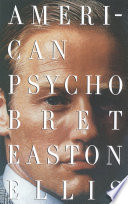
TL;DR
7/10. A polarizing satire of consumer emptiness narrated by Patrick Bateman, who describes murders and designer labels in the same flat voice. A sharp satire and an extreme experiment in unreliable narration, also punishing and self-defeating in its excess. Important and repellent at once. Note: extremely graphic violence, torture, and sexual assault.
Few novels divide serious readers as sharply as American Psycho, and few are as widely misread. Patrick Bateman narrates Bret Easton Ellis’s 1991 novel. He’s a wealthy Manhattan investment banker who catalogs his designer suits, his skincare regimen, and his restaurant reservations with the same flat, brand-obsessed attention he gives to the murders he may or may not be committing.
Whether you read it as a brilliant satire of consumer emptiness or as gratuitous shock fiction is the central question. I come down on satire, with a sour stomach, and the debate itself is part of what makes the book matter.
A content note first: this novel contains extremely graphic depictions of violence, torture, and sexual assault, among the most extreme in mainstream literary fiction. It was so controversial that its original publisher dropped it before release. Readers sensitive to such material should take that seriously. This review discusses the book’s construction and the argument around it and leaves out its specifics.
The satirical engine
Read as Ellis intended, the book is a satire of late-1980s consumer capitalism, and its method is its meaning. Bateman narrates his grooming routines, his colleagues’ business cards, and the labels on everything he owns in obsessive, deadening detail, and he delivers the violence in the exact same flat, brand-conscious tone. That equivalence is the argument: in Bateman’s hollow world, he describes a human being and a designer object with identical detachment, because consumer culture has eroded his capacity to distinguish them.
The famous line collapsing a person into meat is the thesis in miniature. The novel doesn’t endorse Bateman; it traps the reader inside his void to make the emptiness felt instead of merely stated. Readers who call it a celebration of Bateman missed the joke, and it’s a damn bleak joke.
Keep reading
Writing satire that lands without losing the reader: Ellis’s deadpan equivalence is the satirical method here. How tone carries an argument.
Watch: Bret Easton Ellis | American Psycho, Patrick Bateman, Childhood, Houellebecq, The Shard, Hollywood, Wolfgang Wee Uncut
The unreliable narrator, pushed to the edge
The book’s most interesting craft feature is its radical unreliability.
As it proceeds, reality destabilizes: bodies vanish, apartments change hands, people Bateman claims to have murdered reappear alive, and Bateman himself seems unsure what’s real. Ellis has said that even he doesn’t know whether Bateman commits the murders or hallucinates them, and that ambiguity is deliberate. For a writer, this is unreliable narration taken to an extreme most novels never attempt, where the reader can’t finally trust a single event.
It’s a high-risk technique, and Ellis pulls it off better than he has any right to. How he sustains it, the contradictions, the mistaken identities, the characters who can’t tell each other apart, is a lesson in destabilizing a narrative on purpose.
Keep reading
Unreliable narrators: how to make readers doubt the story: American Psycho is the technique at its most extreme. How ambiguity becomes the point.
The real case against it
The criticism is serious and was made loudly: that whatever Ellis intended, the relentless, lovingly detailed violence overwhelms the satire, that you can’t critique gratuitous brutality by rendering it this lavishly, and that the misogyny depicted bleeds into misogyny enacted on the page. I think the critics have a point. The torture passages run far past anything the argument needs, the book is repellent in long stretches, and a reader can finish it convinced the shock outran the point.
Where you land is a real judgment call, and even sympathetic critics concede the novel courts the very charge it defends against. That tension, between defensible intent and excessive execution, is unresolved and probably unresolvable.
Is American Psycho worth reading?
It’s an important novel, a sharp and prophetic satire of consumer culture and a bold experiment in unreliable narration, and it’s also punishing, repellent, and self-defeating in its excess. I rate it as a significant work whose craft and cultural insight are real while taking seriously the readers who find its violence indefensible. It’s not for everyone, and the content warning isn’t a formality.
I respect what Ellis attempted deeply and can’t stand big chunks of what he put on the page. That split is exactly why it gets a seven. Argue with it instead of simply enjoying it, and know that discomfort is the intended response.
Explore the hub
The Entertainment Hub: difficult, polarizing fiction and the debates around it, gathered in one place.
Frequently Asked Questions
Other Books From – Crime






About the author
