
It was either the third or fourth weekend of seven at the Irwindale Renaissance Faire when a life-changing event occurred. One seemingly minor incident led to eight years of beauty, photography, friendship, and joy.
This was the day I met Marjhani.
Heat and Hiding
The thermometer had crept past a hundred degrees by noon, and the heat pressed down on the fairgrounds like a physical weight. Sweat trickled down my back beneath my cotton shirt. My camera bag felt twice as heavy as it had that morning. Every shaded spot became precious real estate, fought over by exhausted fairgoers clutching turkey legs and bread bowls.
I’d spent the morning wandering the entire medieval town, visiting every show at least once, some of them twice. By midday my feet ached and my throat was parched despite the water I kept drinking. I found my way to the belly dance stage and claimed a spot in the back row center, on the straw bales arranged in concentric half-circles facing the performance area. There were about seven rows, and normally this show drew such crowds that finding any seat was a victory. But I’d arrived early, before the lunch rush brought the masses.
I chose the back row for practical reasons. I could shoot over the heads of everyone in front of me and had a clear view of the stage. But that wasn’t the only reason. I was still extremely introverted, still caved in from grief, and I didn’t feel like interfacing with people. The back row let me observe without participating. I could hide behind my camera and pretend I was just a spectator passing through.
A massive oak tree overhung the area where I sat, and I leaned back into its shade with something close to gratitude. In hundred-degree weather, you take what you can get.
The Dancers Gather
As I waited, the dancers gathered near the stage. About a dozen of them, both men and women, stood in a tight cluster having what looked like a heated discussion. They wore what I guessed were Moroccan outfits, bright fabrics catching the sunlight, coin belts glinting silver and gold. Their leader appeared to be a short, dark-skinned woman who gestured emphatically while the others nodded.
I photographed everything at the faire, but I loved the belly dance shows. There were two troupes performing that year, their shows staggered throughout the day on different stages. Something about the movement, the music, the obvious joy the dancers took in their art drew me back again and again.
People began wandering in as noon approached, carrying food from the nearby court. The smell of roasted turkey and fresh bread mixed with the dust and the heat. Children ran between the straw bale rows while their parents searched for seats. The energy shifted from quiet anticipation to something livelier.
The show began. The short woman I had been watching stepped forward and announced the name of the troupe. Oojahm. She introduced herself as Marjhani and gave the crowd the traditional story about their origins and purpose. Her voice carried easily across the space, warm and commanding. She told us to enjoy ourselves, and then the drums started.
The male dancers played live music on drums and other percussion instruments while the women danced. The rhythms were complex, layered, hypnotic. The dancers moved with precision and passion, their hip work creating shapes I could barely follow with my eyes, let alone my camera. I shot several hundred photographs during that twenty-minute show, losing myself in the work of capturing movement and light and joy.
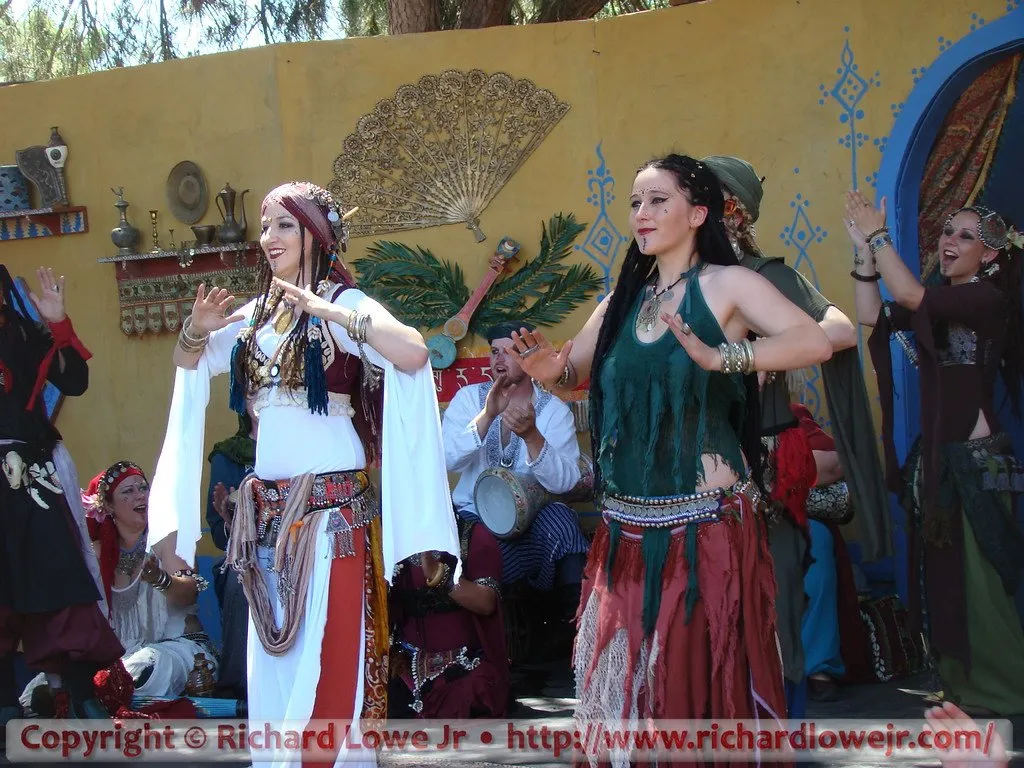
Oojahm on stage at Irwindale, with the drums right behind the dancers.
When the show ended, I sat for a moment longer, letting the heat wash back over me, preparing myself for the walk to the next performance. That was when I noticed Marjhani walking directly toward me.
A Force of Nature
Let me describe her. She was a short woman, dark-skinned, with a great smile and the kind of presence that made her seem ten feet tall when she danced. In performance she wore black from head to toe, her costume decorated with brass medallions and coins that caught the light with every movement. A hip belt heavy with fringe and more coins accentuated the precise isolations of her dancing. Her hair was styled in long braids adorned with decorations. A pure black tattoo ran up and down one arm in a detailed design. She’d piercings and other tattoos on various parts of her body.

Marjhani at Irwindale. That smile was the first thing anybody noticed.
When she danced, her arms extended with the kind of controlled grace that comes only from years of practice. Her hands shaped the air like a sculptor working clay. The other dancers stood behind her, watching, learning, waiting their turn on the Persian rug that was the stage floor. Everything about her radiated confidence and command.
She scared the crap out of me.
You have to understand where I was at that time. Grief-stricken. Caved in. Conservative, and by that I don’t mean politically. I mean the way I dressed, the way I acted, the way I moved through the world trying not to be noticed. I’d never met anyone like her before. She was forceful and didn’t hesitate to loudly make her opinion known. She occupied space unapologetically. She was everything I wasn’t.
Marjhani walked right up to me and introduced herself.
I stammered out my own name, confused about why she’d singled me out from the dispersing crowd.
She told me that she and her dancers enjoyed the pictures I took. The year before, I’d built a website and gotten into the habit of uploading all my photographs into albums as soon as I got home. I put them there and let people use them without charge. The dancers had found them.
Then she said something that changed everything.
She told me I was now officially part of the belly dance troupe. Their photographer. Before I could respond, before I could protest or deflect or retreat to the safety of my back-row anonymity, she put her arms around me and gave me a big hug.
For months I had been drifting through life like a ghost, barely present, barely connected to anyone or anything. Physical contact had become rare. Warmth had become rare. And here was this stranger, this force of nature, pulling me into an embrace like I was family.
She practically dragged me to the front of the stage where the other dancers were packing up their gear. She introduced me to each of them by name. Every single one gave me a hug. The women. The men. All of them welcomed me like I belonged there, like I’d always belonged there.
Something cracked open inside me. Some wall I’d built began to crumble.
Front Row Center
There was one more thing Marjhani told me that day. I was no longer allowed to sit in the back row. From now on, she expected to see me in the front row center for every show. The place of honor.
She’d reserve my spot by writing my name on a piece of paper and pinning it to a straw bale. This became a tradition that lasted years. I’d arrive at the belly dance stage and find my name waiting for me, a small paper flag marking my place in a community I hadn’t known I needed.
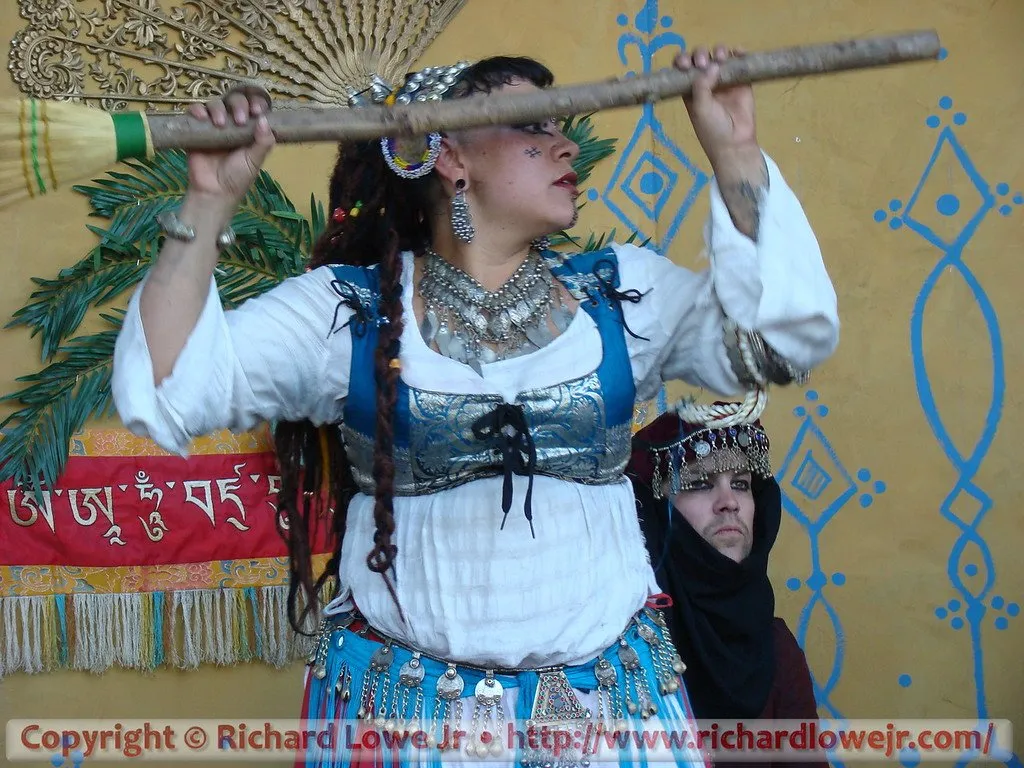
Marjhani on stage, the view from the front row.
Marjhani and I became great friends. Even now, more than twenty years later, we still stay in contact. Every once in a while I call her or send her a message on Facebook, and we both feel the same friendship and warmth we felt on that first day. Some connections don’t fade with time or distance.
Before we parted that afternoon, she invited me to attend other belly dance shows outside the faire. She recommended one coming up called Tribal Café.
I walked back out into the hundred-degree heat, but I didn’t feel it the same way. Something had shifted. For the first time in months, I felt like I might belong somewhere. Like I might matter to someone. Like the world might still hold unexpected gifts for a grieving man who had almost given up on finding them.
That chance encounter on a sweltering afternoon led to eight years of photographing dancers and performers across Southern California. It led to friendships that sustain me to this day. It led to a version of myself I couldn’t yet imagine.
All because a short woman with a radiant smile and a forceful personality decided I belonged in the front row.