
It was during one of the darkest stretches of my life, not long after my wife Claudia died following a nine-year illness, that I wandered up to two enormous wooden rocking horses at a Renaissance faire. One seemingly minor decision to stop and look led to a friendship that helped pull me back toward the living.
This was the day I met Cindy.
Just for Kids
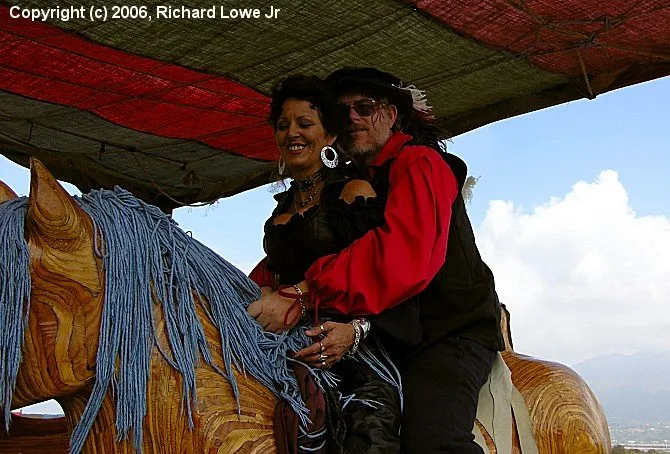
I’d seen the rocking horses at several faires before that day and walked past them every time. They were impossible to miss, two giant wooden horses, the largest in the world, built for riders to climb aboard. Each one weighed well over a thousand pounds and stood taller than a grown man. People said they couldn’t be tipped over no matter how hard you tried.
I ignored them anyway. Rocking horses are for kids, I told myself, and I was a grieving man in no mood to climb onto a child’s toy in front of a crowd. I was caved in from loss, moving through the fairgrounds trying not to be noticed, hiding behind my camera the way I hid behind everything in those months. The horses were somebody else’s fun. Not mine.
Then one day a woman perched on top of one of them changed my mind about that, and about a great many other things.
The Lady on the Horse
She sat up there like she owned the sky, waving and smiling at everyone who passed. She was the lovely lady on the upper horse, friendly and easy, always happy to call someone over or answer a question. There was nothing guarded about her. She took up her space on that horse and invited the whole world to come share it.

She caught me looking and waved me over, the way she waved everyone over, and before I quite knew how it happened she’d explained the secret of the horses to me. You didn’t ride them alone, and you didn’t ride them as a kid. You climbed on with a friend, or, failing that, you asked a stranger passing by, and chances were they’d say yes as long as you asked politely. Then you rocked together and you talked. That was all there was to it.
It sounds small written down. It wasn’t small. She told me, as we rocked, that the horses weighed over fifteen hundred pounds each and couldn’t tip, that they were built for two and could hold three on occasion. She made the giving of that information feel like she was letting me in on something.
I rode behind her at the Irwindale faire in 2006. I still have the photographs.
Who She Was
Let me tell you about Cindy, because she was far more than a woman on a horse.
She was the partner of Les Hartness, the man everyone called the Rocking Horse Guy. Les was the genius who built the horses by hand, a civil engineer of thirty years with no woodworking experience who took a dare and spent a thousand hours each carving Vlad, a twelve-hundred-pound unicorn modeled on a Belgian, and little Freya, an eight-hundred-pound Clydesdale, with a third horse named Trey on the way. Cindy lived that whole life on the road with him, faire to faire, the horses riding in the living room of their trailer between shows.

But she wasn’t somebody standing next to an unusual man. She was unusual on her own terms. A native of Santa Cruz, she’d raised a special-needs son by herself for sixteen years, single and sober through all of it, and she said so with a laugh instead of a complaint. She was a painter who came to it almost by accident. She built and painted stage sets, props, and costumes for teen musical theater. She was a licensed cosmetologist who did hair, makeup, prosthetics, and special effects.
She’d done woodworking, construction management, even computer work. The faire, she told me, was her first real step back into the world after all those years immersed in raising her son. She said she walked in wearing a deer-in-the-headlights look.
Whatever fear she came in with, she’d turned it into one of the warmest presences on the field. She was everything I wasn’t in those days. Forceful where I was timid. Loud where I was quiet. Unafraid to take up space where I wanted only to disappear.
What Cindy was like to talk to
What I remember most is how funny she was.
I once asked her, half joking and half serious, where a gentleman was supposed to put his hands when riding behind a lady on one of those horses. The men I’d asked had told me, “If she doesn’t slap you, you didn’t put them in the right spot,” which I didn’t like, since I considered myself a bit of a gentleman.
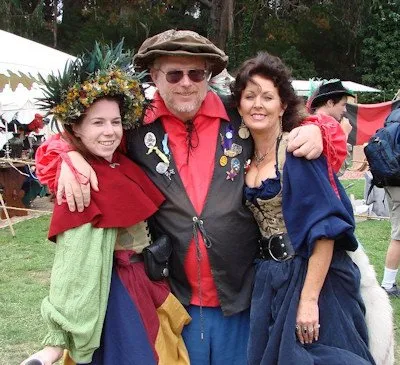
Cindy gave me a real answer, wrapped in jokes. Reach forward and hold the horse’s mane, she said. It’s attached well for exactly that purpose. And should you come away with a loose strand of it, you keep that strand, pin it somewhere visible, and proudly announce that you found yourself a “piece of tail” last eve. Then she delivered the line I can still hear in her voice: “Honey, you should know better than to ask the men anything. Ask me. I’ll always give you a straight answer.”
That was Cindy. She rode Vlad standing up, all hundred and three pounds of her balanced on twelve hundred pounds of wooden horse, for no reason other than that Les once told her she couldn’t. “Your ass isn’t big enough, honey,” he’d said. She said, “Watch me.” And she did.
What She Gave Me
I was a ghost when I met her. Claudia had been sick for nine years and then she was gone, and I had been hollowed out by it, drifting through life barely present, barely connected to anyone or anything. Warmth had become rare. Real human contact had become rare.
Cindy seemed to understand what I was carrying without my having to explain a word of it. She didn’t try to fix it. Nobody could have. What she did was make room for me at a time when I badly needed someone to, and she did it the way she did everything, with a wave and a joke and an open invitation to climb on the horse and rock for a while. She helped pull me out of one of the worst times of my life simply by being who she was and letting me near it.
She told me, more than once, that I’d always be welcome to ride with her. Any time, any place.
Something had begun to thaw in me, the same way it would thaw again later in my life when other generous people pulled me into their worlds. Cindy was one of the first to crack that wall open. For the first time in months, I felt like the world might still hold unexpected gifts for a grieving man who had nearly given up on finding them.
What She Left Behind
Cindy took her own life on a Sunday afternoon in the early 2000s. I held her until the paramedics came, and it remains the most painful thing I’ve ever been through. I don’t understand what was happening in her world that brought her to that point, and I’m not sure anyone fully did. She had so many friends. Every one of them loved her. That’s the cruelest part of this kind of loss, that it can take the very person who seemed, from the outside, to be the warmth holding everyone else together.
I won’t pretend to make sense of it here. I’ll only tell you what I knew of her, which was kindness, and humor, and a generosity that made the people around her feel more alive than they’d before she waved them over.
I still picture her up on that horse, grinning, calling someone in for a ride. That image has outlasted the grief. She took a thing the rest of us dismissed as a child’s toy and turned it into a small machine for joy and connection, and she handed that joy to anyone who walked by, including a heartbroken man who didn’t know he needed it.
I never knew her last name. I knew her heart, and that turned out to be the part worth keeping.
All because a short woman with a radiant smile and a wave decided that a grieving stranger belonged on the horse beside her.