
For one weekend at the Renaissance Pleasure Faire, my face was everywhere, and almost every copy of it had a strip of masking tape across it.
That was Gar Travis’s doing.
At the Faire, people trade favors: little pins and tokens that go on a vest or a bodice. The more you collect, the cooler you are, or at least that’s the game. Most of them are homemade. A clothespin with a face painted on it. A tiny wooden sundial. A scrap of ribbon with a bead. I collected them by the dozen, and some weekends by the hundred, mostly from the ladies.
One year I decided to play the game properly. I ordered about a hundred metal pins, an inch square, each one with my picture on it, and handed them out all over the Faire. Gar bought a roll of masking tape. Then he walked the grounds, talking to everybody, and taped over my face on every pin he could find. All weekend I kept running into people wearing my favor with a neat strip of tape across it. He thought it was the funniest thing in the world.
He was right.
Who was Gar Travis?
Gar Travis graduated from Fork Union Military Academy in 1978 and served in the United States Coast Guard. After his enlistment he spent more than fifteen years in North Carolina as a numismatic research consultant, an expert on coins. He started with film photography, turned professional in 1989, and was one of the early experimenters in digital photography of coins.
In 2004 he moved to California to become a senior numismatist and chief cataloger at Greg Martin Auctions, one of the largest numismatic auction houses in the world. The company is known today as Stack’s Bowers Galleries. He wrote and photo-illustrated a book, Cyprus Coins, published by the Cyprus Museum in 2006, a chronology of the island’s coinage built around the museum’s own collection.
He gave his camera away constantly.
He was the chief photographer for Powered Sport Flying magazine, a contributing editor to The Numismatist, the chief entertainment photographer for the Renaissance Pleasure Faire of Southern California, the ship’s photographer for the American Pride, and an adviser to the Children’s Maritime Foundation. He took on professional work in exchange for donations to the youth nonprofits he supported. His fellow photographers called him one of a kind.
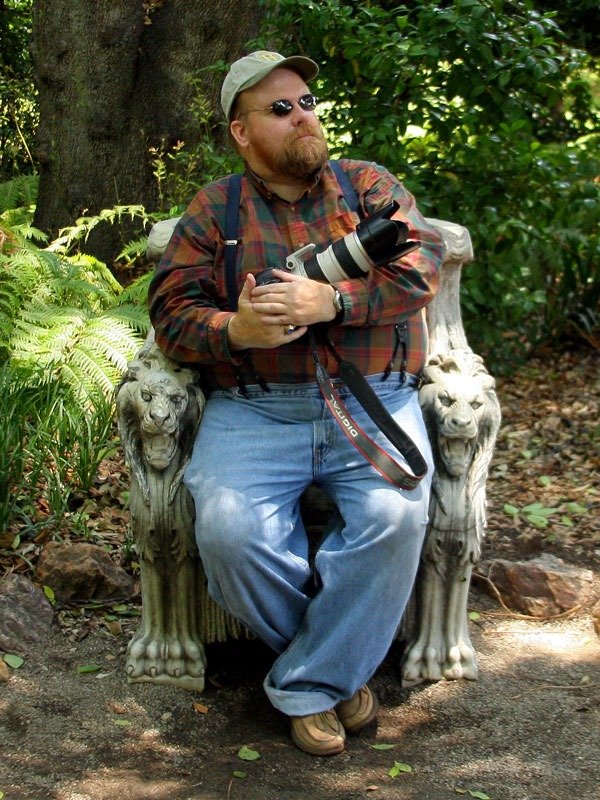
Gar Travis, with his camera, on a stone lion bench.
Two photographers, two ways of seeing
I met Gar around 2007 or 2008. Both of us walked the Faire with a camera all day, every weekend.
There were only a few of us chronicling the place, so we kept running into each other for years.
He was a big man, friendly and shy.
He went to everything. He was a coin man and a stamp man and a Faire man, and from what I understood he had a primo coin collection.
We worked in opposite ways. I shot everything that moved, a thousand photographs on a slow day and two thousand on a good one, and sorted them out later. Gar would release thirty or forty. I don’t know how many he took, but the ones he let out of the camera were finished. The light was right, the expression was right, and he’d caught the moment that mattered.
Look at the woman glancing over her shoulder, or the Puritan who looks like somebody just told him the Faire serves ale. That’s patience you can see.

A Faire portrait by Gar Travis.

One of Gar’s Puritans, mid-disapproval.
I shot two thousand photos a day at the Faire. Gar Travis released thirty, and every one of them was finished. Some lessons you learn from the photographer who does it the other way. – Richard LoweShare on X
Why weren’t we friends?
We were acquaintances. He tried to make it more than that, and the pins were his idea of breaking the ice. But he had a style that was different from mine, we were usually in different places, and the chance to sit down together never came. I liked him. We could have been friends. He turned his lens on me at least once, and the picture survived. It’s me in a feathered hat, hiding behind my own camera. That sounds about right.

Me, photographed by Gar Travis at the Faire. Copyright © Richard Lowe.
The last day at the Faire
Gar came down with encephalitis. He came back to the Faire one more time, for a single day, wrapped in protective layers so he wouldn’t catch anything that could make him worse. He walked the grounds he’d photographed for years. It was the last time I saw him there. He passed away not long after, in late 2012.
He showed up anyway. That tells you something about how much he loved the place.
Where did Gar Travis’s photographs go?
Gar had a gorgeous website. He built it, in his own words, to show his longtime friends in North Carolina where he’d been and what he’d seen, and to share his pictures with the world. I saved a copy of it while it was still up. The site itself is long gone now, and with it went most of the public record of the work of one of the best Faire photographers there ever was.
Photography feels permanent.
Then a domain lapses and a lifetime of work vanishes from the internet. The photographs on this page are a small piece of what he made. I’m glad they can live here.
Remembering Gar
Gar Travis was a good guy and somebody worth remembering. A coin scholar, a veteran, a generous photographer with a sharp eye and a dry sense of humor, and the only man who ever censored my face with masking tape. Life moves on. The Faire still opens every spring, and somewhere in it there’s a photographer waiting for exactly the right moment and shooting thirty frames instead of two thousand. I hope he gets the joke too.
If you knew Gar, or have one of his photographs, I’d love to hear from you. More of my own years at the Faire are in 980,000 Photos, 300 Faires, and What I Learned About Writing, and another friend from those days is remembered in my tribute to Vernon Lewis.
