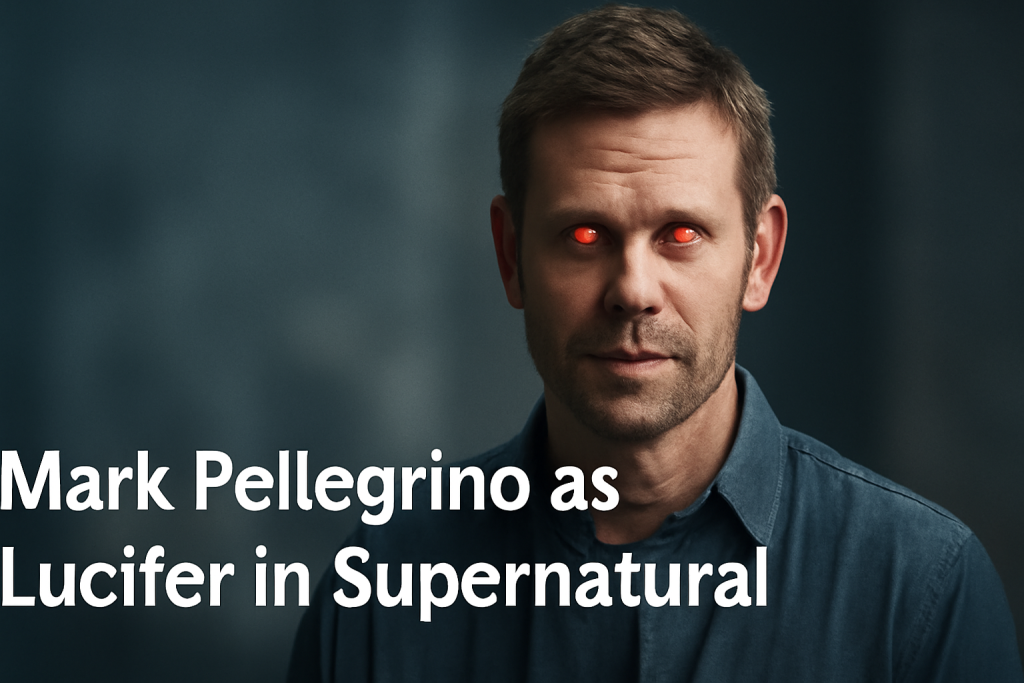
From One-Dimensional Antagonist to Television’s Greatest Villain
When you think of iconic TV villains, one name rises above the rest: Mark Pellegrino.
His portrayal of Lucifer in Supernatural redefined the role of the villain in a way that few actors have ever achieved. Pellegrino’s Lucifer was more than a foe. He was a deeply complex, relatable, and even sympathetic character. In this post, I look at how Mark redefined the archetype of what it means to be a villain on television.
The Genesis of a Groundbreaking Performance
In an industry filled with one-dimensional bad guys, Mark Pellegrino took on the role of Lucifer and immediately turned expectations upside down. Unlike many portrayals of the devil, Mark’s Lucifer wasn’t about causing chaos. He was a being of real complexity, with a backstory that showed deep human vulnerabilities. From the very first moment Mark stepped into the role, audiences saw more than a villain. They saw Lucifer’s pain, anger, and a distorted sense of justice.
Mark’s portrayal of Lucifer was unlike anything seen before in the Supernatural universe. It was layered and surprisingly human for a character often depicted as purely evil. Lucifer’s flaws and vulnerabilities, as revealed by Mark, transformed him from a monster into a tragic hero in many ways. Mark didn’t simply play a devil, he gave us a devil we could understand. He told Backstage he saw the part the way actors see the classics: “The great thing about Satan is it’s kind of like Hamlet. Everyone puts their own signature on it in a way, whether it’s Al Pacino or little old me.”
Mark Pellegrino didn’t simply play a devil, he gave us a devil we could understandShare on X

Mark Pellegrino’s Life Before Lucifer
Mark Pellegrino wasn’t always the villain you recognize today. He was born in Pasadena in 1965 and grew up in Van Nuys. He dropped out of college after a year, answered an ad for the John Roberts Powers modeling agency, and got free training there. He had no plan to become an actor. A commercial agent named Bob Hoover spotted him and set him up with an agent and acting coaches, and he went on to study the Meisner technique at Playhouse West, a school he picked, he told Backstage, “because it was near me and very cheap.” From there he worked his way through episodic TV shows, independent films, and even commercials.
Supernatural made him a fan favorite, but TV audiences already knew his face. He played Paul Bennett in the first two seasons of Dexter and Jacob in the last two seasons of Lost, and he turned up in guest roles on shows like The Mentalist. His versatility as an actor allowed him to take on many roles, each time leaving a lasting impact with his intensity and range.
Read how Mark Pellegrino redefined TV villains forever →Share on X
Mark has been open about how much work it took to get good. He told Backstage that early on, “I didn’t really know how to act,” and that he fell for the job only when “I finally understood it was a craft, and I fell in love with it.” He has kept making his own things too, including a YouTube series called Reality Checks.
Mark’s Influence: More Than Just a TV Villain
Mark Pellegrino’s Lucifer showed what a sympathetic villain could look like on network television. He made audiences root, at least a little, for the devil himself. That is a hard trick, and I think it is why his version stuck.
The show kept bringing him back. Pellegrino played Lucifer in seasons 5 and 7, returned in season 11, became a series regular in seasons 12 and 13, played Lucifer’s vessel Nick in season 14, and came back as Lucifer once more in season 15. When Rick Springfield was cast as a new vessel for Lucifer in season 12, Pellegrino thought he had been fired. He later told fans that when an email from co-showrunner Andrew Dabb said he would return, “I burst out crying.”
To me, his interpretation of evil is the bar anyone playing a complex villain has to clear. Mark proved that audiences crave depth over destruction, psychology over theatrics. Every “morally gray” antagonist on television since owes something to Mark’s groundbreaking approach to playing the ultimate bad guy.

Behind the Devil: The Man Behind the Iconic Role
But beyond his portrayal of Lucifer, Mark Pellegrino’s career shows the kind of dedication, craftsmanship, and passion required to create something timeless. His approach to acting is careful, always seeking to understand the emotional core of his characters. This level of commitment is what makes his performance so unforgettable. You can see him thinking through every line, and it shows.
Mark’s work ethic is a lesson for anyone who seeks to achieve greatness in their field. Through his relentless pursuit of truth in performance and his ability to take on roles that others shy away from, Mark’s career is a model for those who want to make a lasting impact, no matter their industry.
With his portrayal of Lucifer, Mark Pellegrino proved that a villain could be more, more dynamic, more relatable, and even more empatheticShare on X
Away from the camera, Mark is married to Tracy Pellegrino, a director and acting coach. The two split their time between Paris and Los Angeles, and he sometimes teaches at Playhouse Paris, the Meisner school she runs. An actor with his résumé who still teaches the basics tells me he cares about the craft more than the fame.
The Legacy of Mark Pellegrino’s Lucifer
Mark’s role as Lucifer in Supernatural has solidified his place in the TV villain hall of fame, but his influence goes beyond that. He’s become a cultural touchstone, the perfect example of how powerful storytelling can change the way we see the world. His work continues to inspire actors, writers, and creators to think beyond the traditional “good vs. evil” narrative and to dig deeper into the psychology of characters.
Mark’s influence extends beyond TV into other realms of storytelling. By showing the humanity within a character often seen as pure evil, Mark demonstrated the power of storytelling to evoke empathy and challenge perceptions. That is what sets his Lucifer apart for me.
Lessons from Mark’s Story: How You Can Create Your Own Legacy
Mark Pellegrino’s portrayal of Lucifer is more than an actor playing a part. It’s about owning your narrative and crafting something honest that lands with your audience. Mark’s path from episodic TV to fan favorite shows how far honest work can carry you. Just like Mark transformed his role into something far greater than it was written, you too can transform your career or business by telling your story with honesty and complexity. Mark refused to play Lucifer as a cartoon villain and gave television one of its most memorable devils instead.
A Legacy Beyond the Screen
Mark’s influence as Lucifer in Supernatural will be felt for years to come. His portrayal has set a new standard for how villains are written and portrayed in media. But perhaps more importantly, his career reminds us all that honesty matters: in our work, our approach, and how we connect with our audience. For those seeking to create their own legacy, Mark’s story is one of inspiration. It shows that with dedication and a commitment to honesty, anyone can leave an indelible mark on their industry.
Ready to Write Your Own Story?
Mark Pellegrino’s journey proves the power of honest storytelling. If you’re ready to build your own legacy and become a thought leader in your industry, I can help you craft a book that will build your credibility and make you unforgettable. Just like Mark used his story to redefine the TV villain, you can redefine your own career and leave a lasting impact.
Book a free consultation today to see how I can help you create your authoritative book and build your personal brand.
Want to Know More?
- Ghostwriting Case Studies
- Ghostwriter Code of Conduct
- About
- Why I Give a Damn
- Celebrity Ghostwriting
- Schedule a Book Discovery Call
Pellegrino’s mastery of complex characters shows how committed performance creates lasting impact across different mediums. This same principle drives everything I cover in “The Ghostwriting Advantage”: successful professionals know that their real-world expertise needs strategic presentation to build true authority. If you’re reshaping an industry or building a personal brand, professional ghostwriting ensures your story connects with the power and precision it deserves.