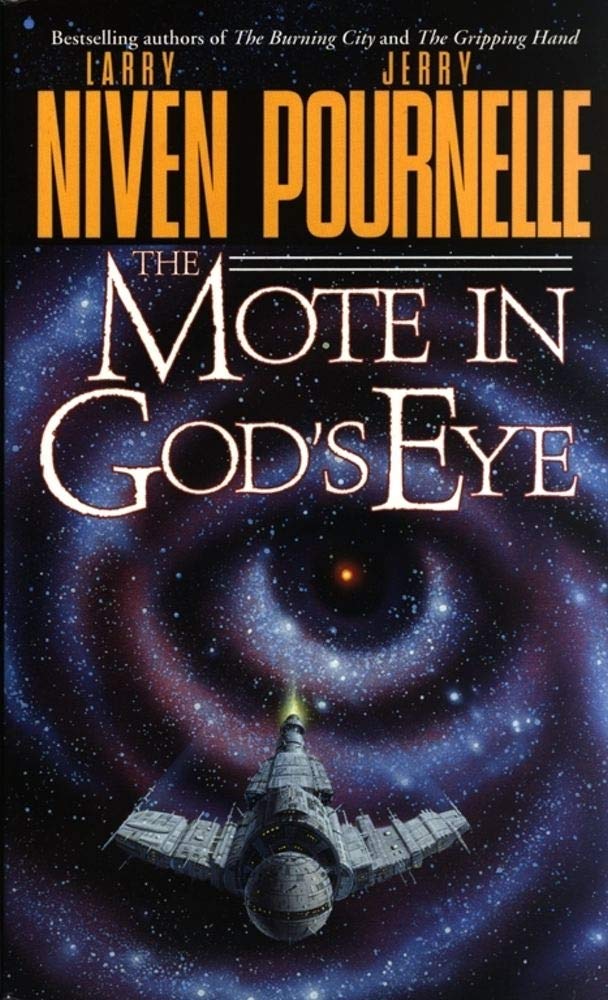
TL;DR
10/10. One of my favorite science fiction novels, read about six times. A masterful slow burn. It builds empire, politics, and world first, then delivers one of the genre’s finest first-contact stories. The chilling part is the recognition that the alien Moties may not be good for humanity. I loved its patient structure so much I wrote my own novel, Peacekeeper, the same way. The ending disappointed me, but the rest is phenomenal.
The Mote in God’s Eye is one of my favorite science fiction novels, and I’ve read it about six times. Larry Niven and Jerry Pournelle’s 1974 classic is set in a far-future interstellar empire that’s never met another intelligent species, until humanity finally encounters one: the Moties, an alien race confined to a single star system. It’s a slow burn, and I mean that as the highest praise.
It doesn’t open with action. It opens with empire-building, politics, and the details of its universe. Then it grows into space battles and a first-contact story of real depth. That kind of patient build is a pleasure, and this book does it as well as any I’ve read. I rate it a ten. I’ll say up front that I didn’t like the ending, and I’ll come back to that, but the ending aside this is a phenomenal book, and the rest of it more than deserves the highest rating.
A first contact done right
The heart of the book, and the thing I find most interesting, is the first meeting between humanity and the Moties. Niven and Pournelle refuse to play it as a simple encounter. It unfolds slowly. The humans come to understand the aliens, and then, more importantly, come to realize the Moties may not be good for humanity at all.
The book handles that slow recognition with intelligence and restraint. The dawning sense that this species is a deep and complicated danger instead of a friend to be welcomed. It’s far more chilling and thought-provoking than any sudden reveal could be. It’s one of the finest treatments of real alienness and the hard problem of first contact in all of science fiction.
Keep reading
Science fiction and the craft of genuine first contact: the slow, intelligent alien encounter at the heart of this book, in the wider craft of SF ideas.
Watch: Larry Niven and Jerry Pournelle's The Mote in God's Eye, TheWorstThingAboutNewBooks
The slow burn I loved
What makes the book work for me is its patience. It takes its time before the central encounter. The empire, the politics, the people, the workings of its universe.
That foundation makes everything after it hit harder. Some readers want action from page one; I’m not one of them, and a book that trusts the reader, that builds slowly and deliberately toward its payoff, is exactly my kind of science fiction.
The empire-building, the gradual accumulation of detail, the way the stakes rise as understanding deepens, all of it rewards a reader willing to settle in. The slow burn is the point here, and it’s masterfully done.
I liked that deliberate structure so much that I built my own novel on the same principle. My book Peacekeeper is written in a similar way, with a relatively slow opening that takes its time giving you the background and the world before the story accelerates. I did that intentionally, because that patient build is something I love as a reader, and The Mote in God’s Eye is one of the books that showed me how powerful it can be when it’s done right.
Keep reading
Peacekeeper: my own novel, written in this same slow-build style: the deliberate, background-first structure I borrowed from books like this one, in a story of my own.
The ending I did not like
Now the one real complaint. I didn’t like the conclusion.
After everything the book builds, so carefully and so intelligently, the ending struck me as anticlimactic and unwarranted, and it felt like it resolved the story on a note that didn’t fit what came before. I won’t give it away, but it didn’t work for me because it felt unjustified, and that’s a real disappointment after such a strong build.
I also didn’t care for the sequel at all. The ending is a small fraction of the book, and everything leading up to it is so good that I still rate it a ten. The rest is more than worth it.
Is The Mote in God’s Eye worth reading?
It’s a ten and one of my favorite science fiction novels, read about six times. The Mote in God’s Eye is a masterful slow burn, patient and deliberate, building empire, politics, and world before delivering one of the finest first-contact stories in the genre, the slow, chilling recognition that the alien Moties may not be good for humanity at all. I loved its patient structure so much that I wrote my own novel, Peacekeeper, in the same deliberate style.
My one real complaint is the ending, which struck me as anticlimactic and unwarranted, and I didn’t like the sequel, but the ending aside, the book is phenomenal and more than deserves the highest rating. A classic and a personal favorite. Highly recommended.
Explore the hub
The Entertainment Hub: science fiction classics and the ideas that endure, gathered in one place.