
Admiral Jessica Lang is nearly 200,000 years old. She’s outlived everyone she’s ever loved, served under governments that no longer exist, and commanded ships through conflicts that history has forgotten. She’s not a superhero. She’s a person who has been alive so long that the weight of it’s become the defining fact of her existence.
Peacekeeper is my science fiction novel, currently in final draft. It’s the book I’ve been building toward through fifty-plus ghostwritten projects, five novels at various stages my fiction ghostwriting, and a lifetime of reading everything from Heinlein and Asimov to Moorcock and Farmer. Every sci-fi project I’ve worked on taught me something about world-building, pacing, or character construction the fiction process. Peacekeeper is where all of that comes together.
The Premise
Jessica Lang commands a ship on a mission to prevent galactic chaos. That’s the surface-level pitch. Underneath it’s a story about what immortality costs.
Not the fantasy version where living forever is a gift. The version where you watch civilizations rise and fall, form attachments knowing you’ll outlive every one of them, and carry the accumulated memory of millennia while trying to stay functional enough to do your job.
The novel is built on a premise that changes everything about how space conflict works: faster-than-light travel doesn’t exist. There are no warp drives, no hyperspace jumps, no convenient shortcuts across the galaxy. Ships travel at sublight speeds. That means space battles unfold over days or weeks. Engagements are strategic. You see the enemy coming long before you can fight them, and the tension isn’t about who fires first.
It’s about positioning, resources, communication delays, and the psychological pressure of watching a threat approach for days with no way to speed up the confrontation.
Why No Faster-Than-Light Travel in Peacekeeper?
Most military sci-fi uses FTL travel as a convenience. Ships jump into position, fight, and jump out. The battles read like naval engagements compressed into minutes. That’s exciting, but it eliminates some of the most interesting dramatic possibilities of space warfare.
Without FTL, distance becomes a character in the story.
Communication has lag time. Reinforcements take weeks or months. Decisions made in one system have consequences in another that won’t be felt for years. Jessica Lang can’t call for help and expect it to arrive in the next chapter. She has to work with what she has, where she is, knowing that the people she’s trying to protect may not even know she’s fighting for them yet.
The no-FTL constraint also makes Jessica’s immortality structurally important instead of just thematically interesting.
Without FTL, distance becomes a character in the story.
She’s one of the few people who can maintain continuity across the kind of timeframes that sublight travel demands. A mission that takes decades doesn’t matter to her the way it would to a crew with normal lifespans. She’s the institutional memory of a civilization that can’t move fast enough to maintain its own coherence.
The Character
Jessica Lang breaks the usual mold for a military sci-fi protagonist. She’s not young, she’s not discovering her abilities, and she’s not on a hero’s journey. She’s a professional who has been doing this longer than most civilizations have existed, and the story’s tension comes from the question of whether that experience is an asset or a prison.
She’s competent to a degree that borders on isolation. The people around her can’t share her frame of reference. She remembers things that happened thousands of years before her crew was born. The knowledge that she’ll outlive every person she serves with shapes her relationships. That creates a kind of loneliness that I haven’t seen explored much in science fiction, at least not at the scale Peacekeeper operates on.
The novel explores duty, isolation, and what it means to keep serving a species you’ve watched make the same mistakes for 200,000 years. Jessica doesn’t fight because she believes humanity will get it right eventually. She fights because fighting is what she knows how to do, and stopping would mean confronting what she’s become.
My take
Most fiction treats immortality as a superpower, and I think the better story is the weight of it. Admiral Jessica Lang has outlived everyone she loved and keeps serving a species that repeats its mistakes. She fights because stopping would mean facing what she’s become. If you want military science fiction about duty and loneliness at a scale the genre rarely tries, watch for this one. It’s in final draft now.
What’s Next
Peacekeeper is in final draft. I’ll share publication details as they develop. If you want to know when it’s available, get in touch and I’ll make sure you hear about it.
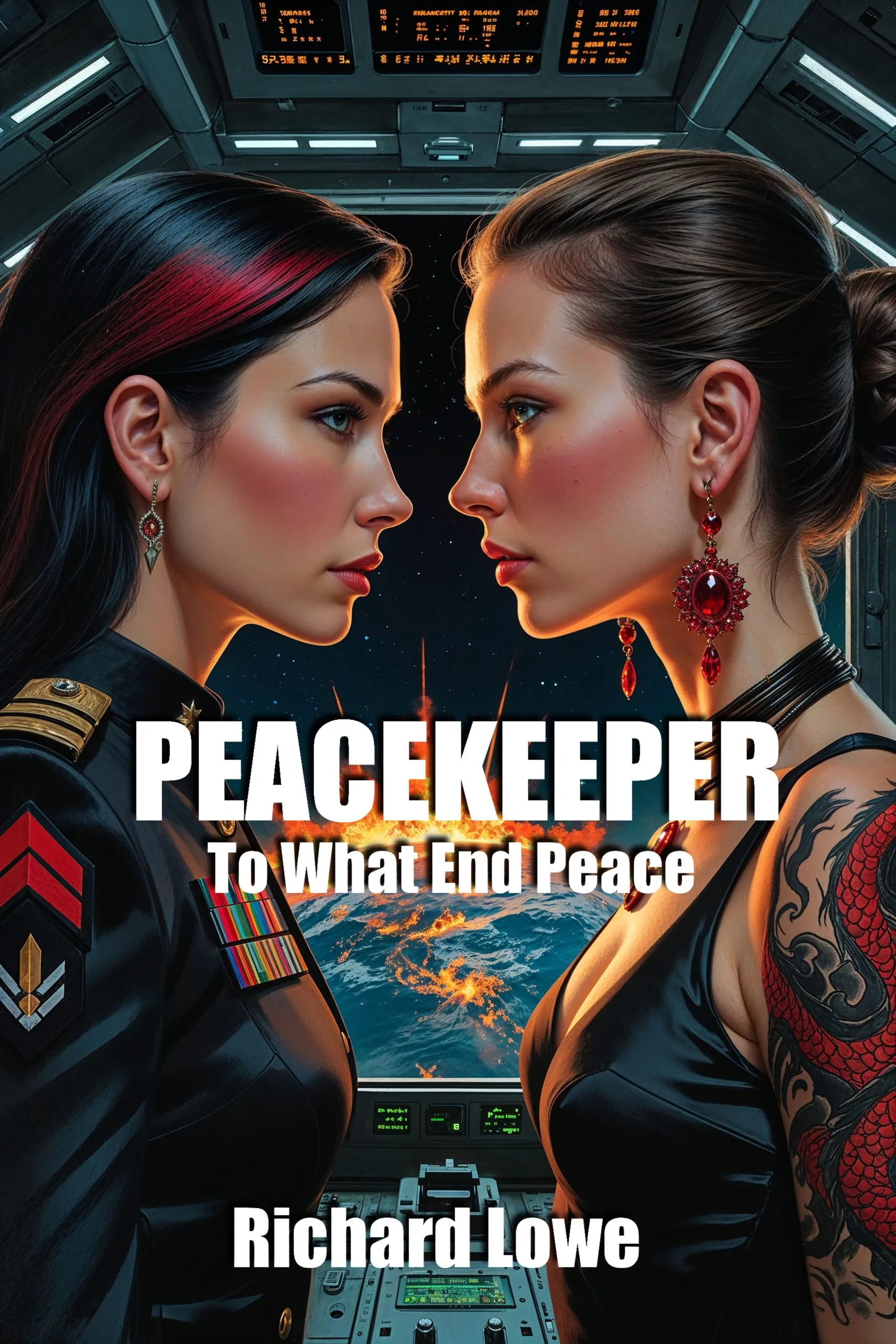
Peacekeeper follows Admiral Jessica Lang, who has enforced the Empire’s will for two hundred thousand years and never asked who wrote her loyalty. In Book One, a routine inspection of the colony Selob III turns into a war that costs her everything.
