TL;DR
6/10. A competent, thorough Barron’s handbook covering grammar, punctuation, usage, and style adequately and affordably. It does its job, but works in a crowded field where better-known, more authoritative references are readily available, and it doesn’t distinguish itself enough to displace them. Solid and serviceable, outshone by the field’s leaders.
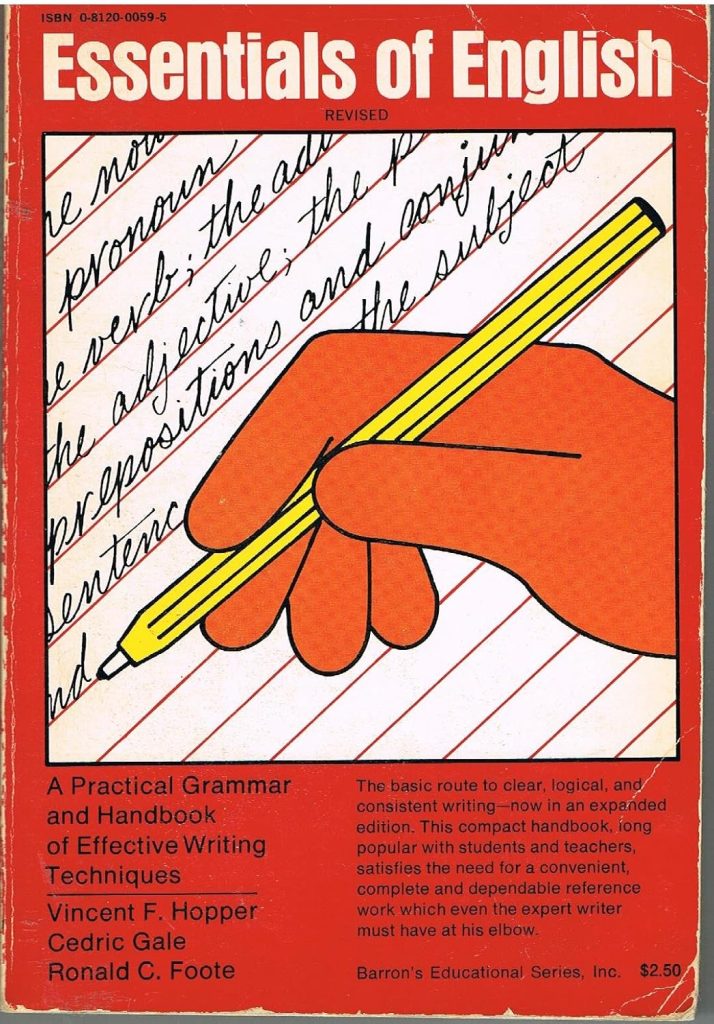
Essentials of English by Vincent Foster Hopper and collaborators is a Barron’s style manual, a compact reference covering the basics of effective communication: the rules of English grammar, sentence structure, usage, punctuation, and the conventions of clear writing. It’s the kind of broad, no-frills handbook that’s served students and writers for decades. My question is blunt: with several well-established competitors already out there, why would a writer pick this one? It’s a decent book stuck in a crowd, a frustrating spot for a decent book to be in.
A good general writing handbook is a useful thing to own, the reference you reach for to settle a usage question or check a punctuation rule, and Hopper’s has a long track record in that role.
What does Essentials of English cover?
The book’s strength is full coverage of the fundamentals in a manageable package.
It addresses grammar and sentence construction. The mechanics of punctuation. Common usage problems. The principles of clear, effective writing. That’s the whole toolkit of correctness a writer needs to produce clean, professional prose, and it covers that ground without fuss. As a single reference covering the range from basic grammar through points of style, it’s a competent all-in-one handbook, more major than a beginner’s primer and broad enough to answer most everyday questions a writer brings to a usage guide.
Keep reading
Grammar and usage: getting the small things right: the correctness fundamentals Hopper covers, in the wider craft of clean writing.
The crowded-shelf problem
The real difficulty is competition and distinctiveness. The English style-and-usage handbook is among the most populated categories in writing reference, and several titles, the famous brief style guides, the major usage dictionaries, the standard college handbooks, are more celebrated, more current, or more authoritative. Essentials of English is solid and serviceable but doesn’t clearly outclass these better-known options on any particular dimension, so its case rests more on being a competent, affordable, complete handbook than on being the best at anything.
A writer who already owns a strong style guide gains little by adding it; a writer who owns none could do worse, but could also do better. Middle of the pack is a hard sell in a category this crowded.
Keep reading
Self-editing: catching the errors you stopped seeing: a usage handbook supports the editing pass; here’s the wider self-editing discipline.
Is Essentials of English still current?
One practical caveat: usage and the conventions of effective writing do evolve, and editions of long-running handbooks vary, so a writer should check that they have a reasonably current edition instead of a decades-old printing, since guidance on style and acceptable usage shifts over time even when core grammar doesn’t. For the stable fundamentals of grammar and punctuation, the age of an edition matters little; for questions of contemporary usage and style, currency is worth attending to. A decades-old printing telling you what’s acceptable today is a bad joke.
Is Essentials of English worth reading?
It’s a competent, complete general writing handbook that covers the essentials of grammar, punctuation, usage, and style adequately and affordably. It gets a middling place not for any weakness in what it does but because it works in a crowded field where better-known, more authoritative, or more current references are readily available, and it doesn’t distinguish itself enough to displace them. For a writer who has it, it serves; for one shopping for a usage handbook, it’s a reasonable but ordinary option among stronger competitors.
Nothing in it is wrong, and nothing in it makes me want it over the big names. Solid, serviceable, and outshone by the field’s leaders.
Explore the hub
The Writing Hub: grammar, usage, self-editing, and the rest of the craft, gathered in one place.
Frequently Asked Questions
Other Books From – English and Grammar