TL;DR
5/10. A sound, respected compact dictionary whose problem is format. As a writer’s purchase it’s hard to justify against free, fuller, continuously updated online dictionaries, and the abridged paperback gives up detail. Useful as a no-power, no-distraction backup or for paper lovers; redundant otherwise. British-English lean that matters for American markets.
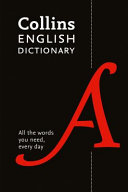
The Collins English Dictionary paperback edition is a single-volume general reference covering roughly 200,000 words, meanings, and phrases of everyday English. Reviewed as a writer’s tool instead of as a dictionary in the abstract, the question is narrow and a little awkward: in an era when a full, continuously updated dictionary sits one tap away for free, what’s the case for a writer buying a compact print one? The answer is real but limited, and it sets the rating.
Collins is a respected dictionary publisher, and the content is sound. This is a quality reference, and that makes its position more frustrating to me: good content stuck in a format most writers have already walked away from. The issue, as with any print dictionary now, isn’t accuracy but relevance to how writers work.
What is Collins English Dictionary Paperback Edition?
It’s a paperback general-purpose dictionary, the kind of compact single-volume reference meant for quick everyday lookups: spellings, basic definitions, common phrases. As a British-publisher dictionary it leans toward British English usage and spelling. That’s itself a consideration for a writer depending on their market. For its size it’s a perfectly good desk companion, clear and reliable for the routine checks that make up most dictionary use.
Keep reading
Self-editing: catching the errors you stopped seeing: a dictionary supports the editing pass; here’s the wider self-editing discipline.
The case against the format
The difficulty is that a compact print dictionary now competes against free, full, continuously updated online dictionaries, and on most measures it loses. The paperback is necessarily abridged, so it’s fewer words and less detail than a full edition or a good online resource.
It can’t update, so new words and senses pass it by. And it’s slower to use than typing a word into a search bar.
For a writer at a keyboard, meaning nearly all writing, the online option is faster, fuller, and free. The print dictionary’s remaining advantages are narrow: it works without power or connection, it doesn’t distract the way a browser does, and some writers simply prefer paper. Those are real but minor.
Keep reading
Grammar and usage: getting the small things right: reference tools support correctness; here’s the broader usage picture.
The British-English wrinkle for American writers
One feature deserves more than a passing mention because it can actively mislead a writer working for the American market. As a Collins dictionary, this leans British in spelling and usage, so it’ll give color, organize, and traveled as standard, treat certain words and senses by their British conventions, and reflect British instead of American punctuation habits in its guidance. For a British writer that’s exactly right.
For an American writer, or anyone writing for American publishers and readers, relying on it as the primary reference risks importing spellings and usages that an American copyeditor will flag, and a writer may not even notice the drift if they’re not watching for it. It’s a small thing on any single word and a real pain across a manuscript, the kind of drift that leaves a copyeditor’s markup looking like a crime scene.
A writer should match the dictionary to the market they’re writing for, and this one is built for the other side of the Atlantic. Know that before it shapes a book’s surface in ways the writer didn’t intend.
Is Collins English Dictionary Paperback Edition worth reading?
It’s a perfectly good compact dictionary whose problem isn’t quality but obsolescence of format for the working writer. As a reference it’s sound; as a purchase for someone who writes at a connected keyboard, it’s hard to justify against free, fuller, current online dictionaries, and the abridged paperback form gives up detail a writer may want. It belongs at the bottom of the shelf-worthy range, useful as a no-power, no-distraction backup or for a writer who prefers paper, redundant for everyone else.
A fine object, a weak case, and I can’t work up much enthusiasm for it. American writers have one more reason to leave it on the store shelf: those British spellings will creep into the manuscript.
Explore the hub
The Writing Hub: reference, self-editing, and the rest of the craft, gathered in one place.