
I was about eight years old the summer of the moon landing. We’d just moved out of an apartment in Rialto, California, into a house in San Bernardino, and my dad took me with him to fill up the car at the Gulf station. The man behind the counter handed us a flat sheet of printed cardboard. Punch out the pieces, fold the tabs, and you had your own Apollo lunar module.
By dinner I’d built it. It didn’t last long, because it was paper and I was eight, but for a week or so I had the Eagle sitting in my room.
Nobody gives you anything like that anymore. Gas stations, cereal companies, jelly makers, movie theaters and soda bottlers spent most of a century handing out little things for free: coins, glasses, rings, toys, models. Then they stopped. I’ve been thinking about when they stopped and why, and I’ve come to believe the giveaways tell a bigger story. They track how creative this country was, and how much its businesses were willing to give back to the people who kept them going.
That room in San Bernardino was creative heaven. I had a sheet of plywood on a table, covered with plaster hills, tanks, airplanes and the occasional monster. A model railroad ran in a circle around all of it. My first big model kit had real lights and wires in it. To eight-year-old eyes it looked enormous.
I still have it. It’s a lot smaller than I remember.
Everything I owned asked me to make something. We lost that.
When did companies start giving away free prizes?
Earlier than most people think. American merchants were handing out tokens and trade cards in the late 1700s, but the modern premium arrived with packaged goods.
Sperry and Hutchinson started S&H Green Stamps in 1896. You got stamps at the checkout, licked them into little books, and traded the books for lamps, toasters and furniture out of a catalog. Kellogg’s put out the first known cereal premium in 1909, a booklet called Funny Jungleland Moving Pictures. Then on February 19, 1912, Cracker Jack started putting a prize in every box, and kids all over the country learned to dig past the caramel corn before they ate any of it.
The Depression made giveaways bigger. In the 1930s, movie theaters ran dish nights, where every ticket came with a plate, a cup or a saucer, and families came back week after week to finish the set. Radio did the same thing for kids. Little Orphan Annie and The Lone Ranger sent decoder rings and badges to anyone who mailed in a cereal boxtop and a dime. Those cheap premiums are some of the most collectible objects in America today.
Who gives things away in the middle of a depression? During the worst economy in the country’s history, businesses were still giving things away, because they understood that a customer who felt good about you came back.
The big American giveaway eras, from trading stamps in 1896 to the end of fast-food glasses in 2010.
What did gas stations give away in the 1960s?
Everything. This was the golden age, and gas stations ran it.
In the 1950s and 1960s, gasoline was gasoline. One brand’s regular was about the same as the next. Stations a block apart priced it within a penny or two of each other. So stations fought for you with whatever they could hand across the counter.
They called it the gas wars.
The country was going to the moon, and the gas station down the street was handing out the moon lander.
Esso gave out the Oil Drop Man in 1958 and its “Tiger in your tank” tails starting in 1959. Gulf had horseshoes. Texaco had Fire Chief hats for kids. Sinclair had Dino, its green dinosaur. Hess started selling its toy trucks in 1964 for $1.29, and it still puts out a new one every holiday season. Union 76 put orange balls on car antennas starting in 1967.
In 1969 Shell ran its Mr. President coins, and Sunoco gave away aluminum coins with a cardboard board to mount them on. I still have my Sunoco coins. ARCO handed out a Noah’s Ark set in 1971.
And in the summer of 1969, Gulf handed out the cardboard lunar module that ended up in my bedroom. The country was going to the moon, and the gas station down the street wanted you to build the ship.
The glasses came from somewhere else, the grocery aisle and the restaurants, and every kitchen I knew had them. Welch’s sold its jelly in decorated jars you washed out and drank from afterward. Howdy Doody showed up in the early 1950s, and then the Flintstones, Archie and the Warner Bros. cartoon gang through the 1960s and 1970s. Pepsi put out its Looney Tunes collector series in 1973 and again in 1976, and you got them at burger joints and pizza places all over the country.
I drank out of Flintstones and Looney Tunes glasses for years. They weren’t fancy, but they were ours, and they were free.
Green Stamps peaked in the same years. S&H claimed to print more stamps than the United States Post Office, and the redemption catalog sat in practically every house on the block.
A few of the gas station giveaways from the gas war years, by brand and year.
Does creativity follow how a country feels about itself?
I think it does. I can’t measure it, and I won’t pretend I can. It’s what I’ve watched over most of my life.
In 1969 the country put men on the moon. The interstates were new, the cars were big, and somebody came out to wash your windshield while the tank filled. I rode Route 66 with my father on his business trips in those years, and my book on enshittification opens with that drive. I explained why in the story behind the book: the businesses along that road acted like they expected to be around for a long time.
When a country feels confident, its businesses act like it. They spend money on things that never show up in next quarter’s numbers, like a cardboard spaceship for a kid to fold together or a cartoon glass for the kitchen cabinet. That kind of spending only happens when the people running a company believe the future’s going to be good and want you to stick around for it.
When the confidence drains out, the generosity goes first. The craftsmanship and the people behind the counter follow it out the door. What’s left is a company that treats you as a transaction, because it doesn’t plan to be around long enough to care what you think.
The toys that made you build
The toys of my childhood came with work attached, too.
Model kits came as a box of gray plastic on sprues, a tube of glue and a sheet of decals. You cut, sanded, glued and painted, and if you were careless, you got fingerprints in the glue and a crooked wing.
If you weren’t, you got something nobody else had, because nobody else painted it your way. I’ve built a lot of kits since then, and I wrote about one disaster in what building model kits taught me about ghostwriting.
Tinker Toys were wooden spools and sticks. Lincoln Logs were notched wooden logs. My model railroad ran around plaster hills I’d made myself, and the slot cars ran on track I’d laid out on the floor.
Then there was the Erector set. Oh my God, you could build anything with an Erector set. A.C. Gilbert started selling them in 1913. He got the idea from a train window, watching workers put up steel girders for power lines. They were real steel strips and plates, real nuts and bolts, and the bigger sets came with an electric motor. You built cranes and bridges and Ferris wheels, and you cut your fingers on the edges, and you didn’t care.
Erector still exists, under Meccano. The edges are dulled now, and the danger’s gone. So’s a lot of the fun.
Even the board games were built to last. I still own a Risk game with wooden pieces and brass pieces, and a Monopoly set in all its original materials. Pick up one of those pieces and you can feel that somebody cared how it was made.
Why did gas stations stop giving away free stuff?
Because in October 1973, they didn’t need to anymore.
The Arab oil embargo hit, and within weeks drivers were waiting in lines around the block. Some states rationed fill-ups by the last digit of your license plate. A station that had been handing out coins and toys to win your business was now turning people away.
Nobody bribes a customer who’s already waiting an hour to buy what they’re selling.
The gas wars ended almost overnight. Self-service spread through the rest of the decade, the attendants who’d washed your windshield disappeared, and margins got thinner every year. The giveaways went with them.
Then the mergers finished what the embargo started. Atlantic Richfield swallowed Sinclair in 1969, and Dino began disappearing from the roadside. Esso became Exxon in the early 1970s. In 1984 came the big wave: Chevron bought Gulf, the company that handed me my lunar module, Texaco bought Getty, and Mobil bought Superior. The 1990s and early 2000s wrapped it up with Exxon and Mobil, BP and Amoco, BP and ARCO, Chevron and Texaco, and Conoco and Phillips.
Every merger meant fewer brands fighting for the same driver. A dozen companies competing on one corner hand out coins and toys. A few giants who own most of the corners don’t have to.
The rest of the giveaway world followed. Welch’s stopped its character glasses after 1978. Trading stamps faded through the 1970s as grocery chains cut costs and switched to discount pricing. Even the Erector set took a hit: by the mid-1970s, most of its plastic parts had been dropped or replaced with laminated fiberboard to save money during the oil crisis. The company A.C. Gilbert built had already gone bankrupt in 1967.
So the embargo killed the giveaways. Something else made sure they stayed dead.
Nobody gives anything away on a spreadsheet
The buyout era took off in the 1980s, and KKR’s takeover of RJR Nabisco in 1988 became the deal everybody remembers. That was the moment Wall Street learned it could buy a company with borrowed money, load the debt onto the company itself, cut everything that didn’t show up as profit next quarter, and walk away rich. I traced how that playbook took apart one industry after another in The Enshittification of America.
Run a cardboard lunar module through that kind of spreadsheet. What do you think happens to it?
A giveaway is generosity. It costs real money, and the return is a family that feels good about your brand for twenty years. A private equity fund that plans to sell the company in five years can’t book that return, so the giveaway is the first line it cuts. I can’t prove private equity would have killed the gas station premiums. The embargo got there first. But I’m certain it’s why they never came back.
What survived was the giveaway as a marketing machine. McDonald’s launched the Happy Meal in 1979, and the toy went from something a company gave you to something designed to make your kid nag you into the drive-through. The fast-food chains kept collectible glasses going through the 1980s and 1990s.
Then on June 4, 2010, McDonald’s recalled about 12 million Shrek glasses because the paint contained cadmium.
That was the end of the free glass. After a century of American giveaways, the last big one turned out to be poison.
Look at what you get now, when you get anything at all. Temu junk that breaks the first time you use it. AI-generated product photos of things that don’t exist. A points app that takes your data in exchange for a dollar off your next coffee. The Green Stamps idea is still around, but there’s nothing left to hold in your hand.
The old man behind the counter
I never did much fishing, but I remember bait and tackle shops. There was always an old man behind the counter, and if you asked him which lure to buy, you got ten minutes on which one worked best in which water, and why, and the time he caught the big one.
That was the best part of going in.
When did I last see a bait shop? Decades ago, and I can’t tell you where one is now. I’m sure they’re still out there somewhere, but most people buy their tackle in a Walmart aisle or off a website these days. Walmart and Amazon took the transaction, and the transaction was the least of it. The old man was what you went in for, and nothing replaced him. A product page with star ratings is what you get instead.
I go to my local HobbyTown regularly. The model railroad section used to take up half the store. It’s been shrinking for years, and now it’s one display case of railroad kits.
The model railroad section at my local hobby shop, then and now.
The kits still sell. Who buys them? Mostly my generation and the generations right before and after mine, plus people buying them to pass the hobby down to their kids and grandkids. A hobby that survives by inheritance is a hobby that isn’t finding new people on its own.
That’s enshittification at street level. It doesn’t take a hedge fund to shrink a railroad aisle. All it takes is a world where every store is expected to move the most units per square foot, and where the slow, hands-on hobbies lose that fight to whatever sells fastest.
How did plastic change the way toys are made?
Everything’s plastic now. Plastic is cheap, it’s made from oil byproducts, and you can mold it into anything a million times over. It isn’t wood, and it isn’t brass.
Somebody’s going to say I’m contradicting myself, because model kits are plastic too. They are. But a model kit hands you plastic as raw material. You do the cutting, sanding, gluing and painting, and the finished thing belongs to you. A Lego set or a box of Temu toys hands you plastic as a finished product, molded identical to every other copy in the world. There’s nothing left for you to do except snap it together, or throw it away when it breaks.
Plastic made cheap uniformity possible, and cheap uniformity pushed out wood, brass, steel and the craftsmanship that went with them. That’s the difference between my Risk set and the one in the store today.
I’ll grant you that some people get very creative with Legos. They build things nobody designed. But a Lego set built from the instructions comes out the same as every other copy of that set, and that’s how most of them get built.
Video games have the same problem from the other direction. There’s plenty of creativity in a video game, but it belongs to the people who made it. You’re following an adventure somebody else scripted. You aren’t writing your own.
So forget how much effort a thing takes. The question I care about is whose vision ends up in the finished thing.
The real dividing line is whose vision ends up in the finished thing.
A kit I painted my own way is my vision. My plaster hills were my vision. The Lego set from the instructions is the designer’s vision, and the scripted game is the studio’s. For forty years, almost everything people were handed went into that second category.
What happened to DVD box sets and special features?
Movies went through the same thing.
For most of the twentieth century, you saw a movie at a theater, and years later on television. That was it. You watched. All the creativity belonged to the people who made the film, and you didn’t even get to choose when you saw it.
Then came VHS, and after it DVD and Blu-ray, and for about twenty years home video got wildly creative. Studios put out special editions with commentary tracks, documentaries, trailers and deleted scenes. Then they started building box sets you’d want on your shelf for the rest of your life.
I own the Blade Runner set that comes in a numbered replica of Deckard’s briefcase. Inside are five discs with every cut of the film, a model of the Spinner car, a little unicorn figurine like the origami one in the movie, photo cards and a lenticular film clip. It’s awesome.
There were hundreds of sets like that. The Showgirls V.I.P. edition came with shot glasses and a deck of cards. Casablanca and The Wizard of Oz got collector’s boxes of their own. Steelbooks turned the case itself into something worth owning. And the DVD menus were gorgeous, little animated scenes you could sit and watch before you ever pressed play.
The menus started dropping away with Blu-ray. The extras shrank. Then streaming arrived.
I’ll be the first to admit streaming is easy. Sitting on my butt with the remote, flipping around until I find a movie, is a fine way to spend an evening. But streaming turned movies into one more commodity. There’s no box set on a streaming service and no menu. You press play and the movie starts, and when it’s over, the service picks the next one for you.
Boutique video labels still put out careful restorations for collectors, and I’m glad they exist. They don’t make the sets that used to come out, the briefcases and the shot glasses. Those belonged to a time when studios thought the people buying a movie deserved a little something extra, the same way the Gulf station did.
Can AI bring creativity back?
I think it already is, and the proof showed up this month.
A developer named Brandon Thomas used Claude to build free, open-source alternatives to seven Adobe Creative Cloud apps. Then he did the same thing to Microsoft Office: a Word replacement, an Excel replacement and a PowerPoint replacement, all free.
Microsoft took thousands of programmers and decades to build Office. He did it with a small team and an AI.
I don’t know how he makes money on it, and right now I don’t care. Look at what he did. He took software that people pay for every month and gave it away. That’s a giveaway, the same impulse as the gas station handing a kid a lunar module, and it’s coming from an individual instead of a corporation. The barrier that used to make you need a corporation is gone.
I do the same thing on a smaller scale. The plugins that run this website were written with AI. I’d never have hired a team of programmers to build them, so without AI they wouldn’t exist at all.
Plenty of people building apps with AI are just trying to make a quick buck. Some of them are trying to make something, and those are the ones I care about.
3D printing is the same story in plastic. I’ve never used a 3D printer, and I’ve never bought anything printed on one. I’ve watched it from the edges, in hobby ads and on the shelves at HobbyTown, and I wrote about its hype years in what 3D printing taught me about AI. The hype died, and the printers kept getting cheaper and better. Home printers now sell for a few hundred dollars.
Look at what that does to plastic. With a model kit you got the raw material. With a printer you get the mold too. You can change the design, scale it up or down, print a version nobody else has, then paint it and finish it the way I finished my first kit. The material that cheapened everything becomes a creative medium again once it’s in your hands.
Plastic went from raw material, to identical product, and back to raw material.
AI does that for writing and code. 3D printing does it for objects. Building Excel used to take thousands of programmers. Building a mold used to take a factory. Now each takes a person with an idea and the right tool.
AI removes the barriers. It makes it possible for somebody to write or make art without the physical barriers standing between the person and the work. – Richard LoweShare on X
Why are writers and artists losing the fight against AI?
Because they don’t understand the war they’re fighting. Most of them don’t even understand the playing field.
The writers and artists fighting AI think they’re defending their craft against a machine. What they’re defending is the barrier, the years of training and the gatekeepers who decide who gets in the door. They’ll tell you the barrier is half the point, that the struggle makes it art. That’s their right. But a barrier is still a barrier, and barriers that fall don’t go back up. Scribes lost to the printing press. Typesetters lost to desktop publishing.
Nobody’s ever won this fight.
I’ve watched the anti-AI crowd tear into strangers for years, and I’ve written about it in the Dogpile series. People get called frauds and thieves for using a tool, and in AI Derangement Syndrome I described how AI becomes the only fact anyone notices about a book. All that rage is aimed at the wrong target.
And what if they won? Suppose AI got shut out of creative work tomorrow. They’d have protected their place by locking everyone else out again, at the exact moment ordinary people finally got a way to make things. The kid at the Gulf station would be handed a finished plastic toy, and told the real lunar modules were for professionals.
That’s a Pyrrhic victory. Pyrrhus of Epirus beat the Romans at Asculum in 279 BC and lost so many men doing it that he said one more victory like that would finish him. Win the battle, lose everything the battle was supposed to protect.
My take
The giveaways died when American business stopped giving and started extracting, and the hands-on toys died with them. The country got cheaper and more uniform, and most people were handed finished things with nobody’s vision in them but the designer’s. AI and 3D printing are handing the tools back. Use them. The people fighting that are defending a gate, and the gate’s already open.
The road to the Grand Canyon
When I drive to the Grand Canyon, I drive straight there. I stop to eat, to pee and to sleep if the drive’s long enough, and that’s it.
I’m not interested in the roadside attractions. I’m interested in the canyon.
That’s how I feel about making things. Some people love the drive, and I respect that. I care about where I end up. If a tool gets me to the finished book or the finished plugin faster, I’ll use it, and I’ll still be the one deciding what gets made.
For most of my life, the country seemed to drift away from that. The giveaways stopped and the hobby aisles shrank, while the toys turned into finished products you weren’t supposed to change. Now, for the first time in a long time, I’m watching it come back. This time it’s coming from people, and the corporations have nothing to do with it.
If you’ve got a book in you and the barriers have kept you from writing it, they’re lower now than they’ve ever been. My book coaching service can get you to the finished book, and the rest of my writing on how America got here is in the Enemies of You hub.
That cardboard lunar module fell apart in about a week. Today a kid in San Bernardino could print one in plastic, paint it the way he wants, and keep it for sixty years.
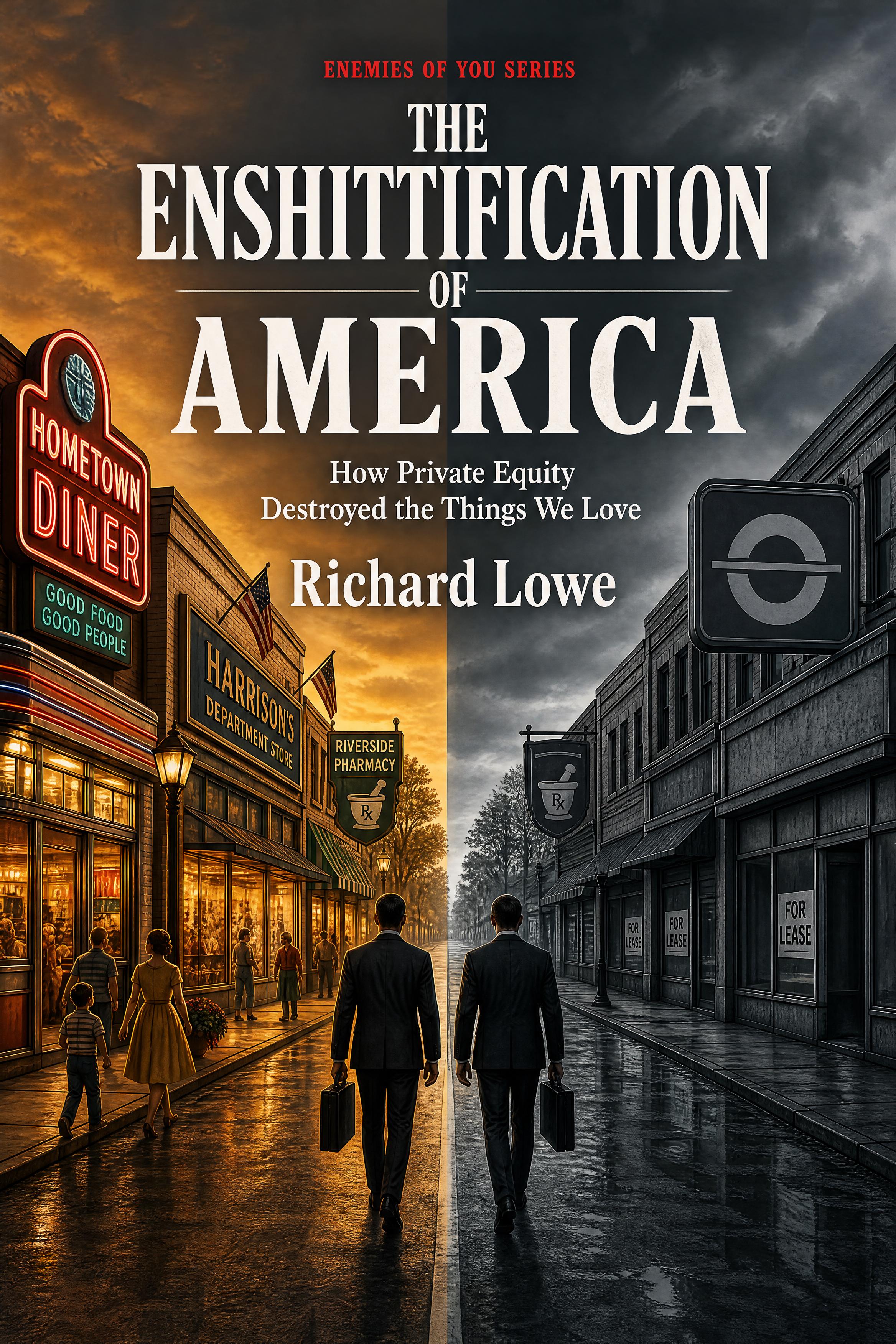
The giveaways are one small symptom. My book follows the private equity playbook through thirteen industries and shows how good businesses were taken apart from the inside.
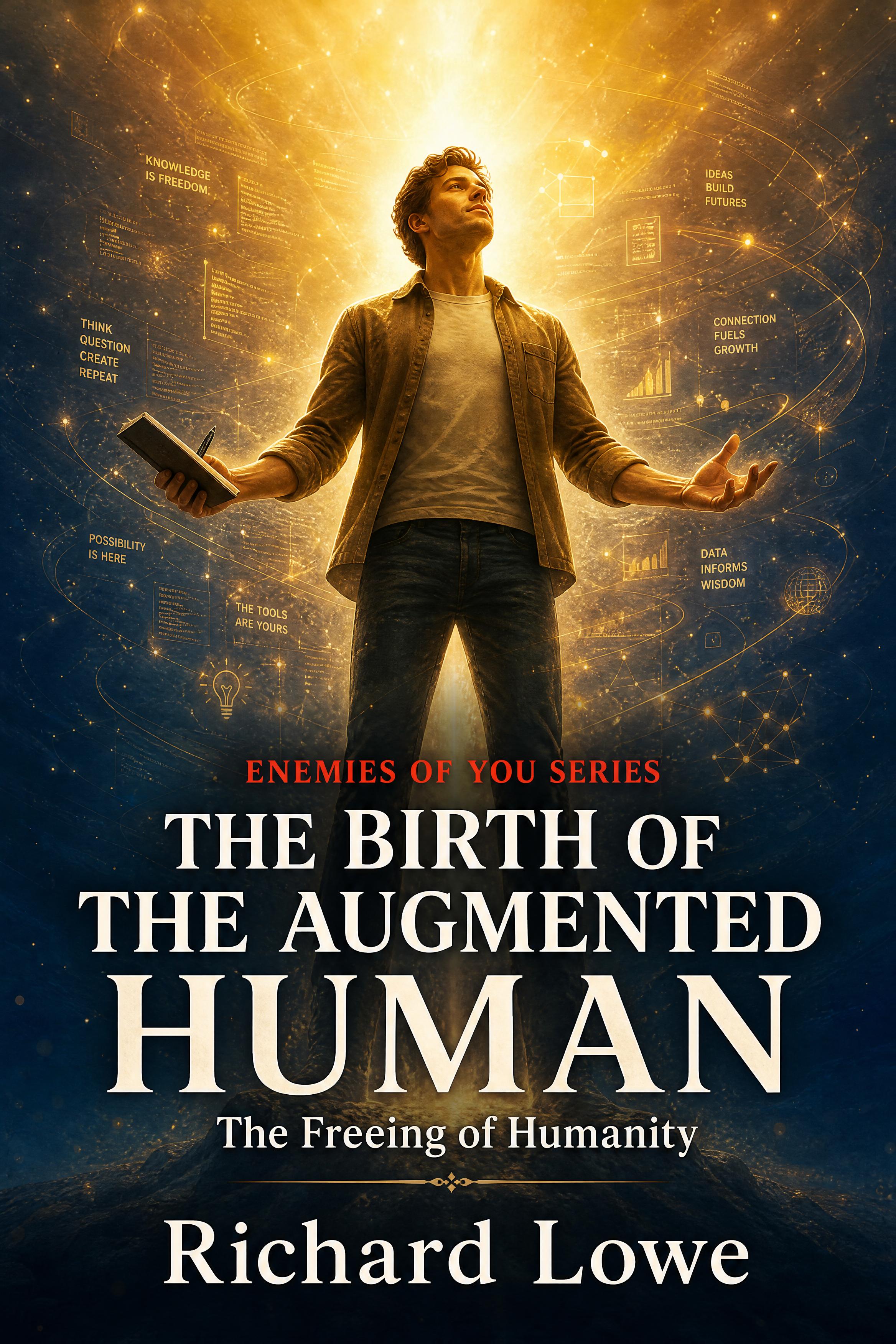
If AI is handing the tools back, this is my book on using them well, so they amplify your thinking and you keep doing it yourself.
