
I use AI every day. It’s part of my workflow as a ghostwriter and I’m transparent about that with every client.
For someone who needs a book but doesn’t have time to write one, the idea of feeding an AI some prompts and getting a manuscript back is appealing. The trouble is that what comes back is text shaped like a book, and the gap between that and a real book is what separates one that builds your credibility from one that damages it.
Why can’t AI write the book you need?
A book with your name on it is a permanent statement about your thinking and your standards.Share on X
The value of a business book, a memoir, or a thought leadership book comes from the author’s experience, insights, and results.
AI doesn’t have access to any of that. It has access to patterns in its training data. That means it can produce generic advice on any topic but can’t produce the particular thinking that makes your book worth reading.
For more, see AI and writing. When I ghostwrite a book, the process starts with extensive interviews. I ask questions that draw out the client’s actual experiences, the decisions they made, the mistakes they learned from, and the structures they developed through years of work. That material doesn’t exist in any AI’s training data. It exists only in the client’s head, and getting it out requires the kind of conversation that AI can’t have.
A client who raised $30 million in venture capital using his book as a credibility tool didn’t get there with generic startup advice.
He got there because his book contained his approach to his market, grounded in outcomes that investors could verify. AI could have generated a book about venture capital. It couldn’t have generated his book.
Is AI Writing Detectable?
Publishers, literary agents, and increasingly readers can identify AI-generated content. The patterns are recognizable: hedging language, repetitive sentence structures, a tendency to list where a person would argue, and a consistent blandness that avoids anything specific enough to be wrong.
This matters for two reasons. First, if you’re submitting a manuscript to a publisher or using a book to establish credibility with a sophisticated audience, AI-generated content will be flagged. Detection tools exist and they’re improving.
Second, even without formal detection, experienced readers can feel the difference between writing that comes from real thinking and writing that’s been assembled from patterns. The former engages. The latter doesn’t.
The AI-Enhanced Awful Writing Handbook documents many of the patterns that make AI-generated writing recognizable: fake flaws in characters, interchangeable plot elements, hedging language that avoids commitment, and a tendency to produce content that sounds reasonable without saying anything concrete. The AI Shortcomings guide covers the wider limitations of AI as a writing tool. These patterns aren’t limited to fiction. They show up in AI-generated nonfiction as well.
The Editing Trap
A common argument for AI-generated books is that you can use AI to produce a draft and then edit it into shape. In practice, this doesn’t save time. It often costs more time than writing from scratch.
An AI draft requires editing at every level. The structure may not serve the argument. The voice won’t match the author’s. The examples will be generic or fabricated. The insights will be shallow because they’re drawn from patterns instead of experience. Fixing all of that means rewriting, and rewriting an AI draft into a real book is harder than writing the book from interviews, because you’re fighting the AI’s assumptions at every step.
I learned this on my own work. At the end of each year I review what I could have done better, and on one client book I leaned on AI to help write, and it was a mistake. It made our process longer. The book came out pretty good, but it took longer than it should have. That was the first time I’d really used AI on a book, and I didn’t like it. Now it stays a digital assistant.
I’ve seen manuscripts where clients attempted this approach before contacting me. In every case, we started over. The AI draft gave us nothing to build on and plenty to work around.
What AI Gets Wrong About Voice
Voice is the most important quality in a book and the one AI handles worst.
Voice is the way a person thinks: the rhythm of their reasoning, the kinds of examples they reach for, the things they emphasize and the things they skip. Vocabulary and sentence length are the smallest part of it. Voice is personality expressed through prose.
AI doesn’t have a personality. It has a default tone that sounds professional and slightly bland, and it can be prompted to mimic styles, but mimicry isn’t voice. A reader who knows the author will immediately feel the disconnect between the person they know and the text on the page. A reader who doesn’t know the author will feel nothing at all, because there’s no person behind the words.
When I ghostwrite, voice is the first thing I work on. The initial interviews are as much about how the client talks as what they talk about.
I listen for the phrases they repeat, the way they structure their arguments, whether they lead with stories or data, whether they’re direct or measured. That information shapes every sentence in the manuscript. AI doesn’t do this because AI can’t listen.
The Credibility Risk
Voice is the most important quality in a book and the one AI handles worst.
A book with your name on it is a permanent statement about your thinking and your standards. If that book reads like a machine generated it, it communicates something about your standards that you probably don’t intend. This risk is especially acute for executives, consultants, coaches, and thought leaders whose businesses depend on perceived expertise. A generic book doesn’t build credibility. It raises questions about whether the author has anything original to say.
In competitive fields where multiple people are publishing books on similar topics, the books that stand out are the ones built on specific experience and real insight. AI can’t produce either.
Purdue used my own consulting book as a course textbook four years in a row. No professor keeps assigning generic advice for four years.
That book held structures I’d worked out myself, and no model could have supplied them, because they existed only in my experience until I wrote them down. Your book needs that same kind of material, and you’re the only one who has it.
Where Does AI Belong in the Writing Process?
AI is a useful tool when used properly. I use it for research, for testing arguments against counterpoints, for brainstorming chapter structures, and for solving specific problems during the drafting process. I describe my use of AI to clients as a digital assistant. That’s accurate.
It assists. It doesn’t create.
The distinction is important because the publishing industry and the reading public are paying attention to AI use in books.
Transparency about how AI is used builds trust. Pretending a book is human-written when it’s not destroys trust the moment the truth emerges. And in the age of detection tools and reader sophistication, the truth always emerges.
The right approach is to use AI where it adds value, in research, organization and fact-checking, and to use human expertise where it’s irreplaceable: voice, narrative, emotional depth, specific experience, and the kind of sustained original thinking that only comes from a person who has done the work.
My take
No model can write your book, because the material that makes it worth reading lives only in your head. I use AI every day as a digital assistant that helps me write, and I still do the writing. A generic book doesn’t build credibility, and readers who spot one will wonder if you had anything original to say. Let the machine help with research and structure. Bring the experience yourself, and be open about how you used the tool.
Is AI ruining writing?
Your book needs to sound like you, contain your actual thinking, and show the depth of expertise that justifies your audience’s time and trust. A raw AI draft can’t deliver those things. Anyone who sells a busy executive on the idea that it can is doing real harm, because that executive’s name ends up on a book that sounds like everyone else’s. You can find current ghostwriting pricing on the ghostwriting page. My clients own their manuscripts completely. The process typically takes four to eight months depending on scope. If you want to understand the full process, Understanding the Ghostwriting Process covers it in detail. If you’re considering a book and want to talk through whether ghostwriting is the right approach for your project, schedule a conversation.
The AI-Enhanced Book Promotion Handbook covers positioning and promoting a book for maximum business impact. The AI-Enhanced Book Proposals Handbook covers developing a book concept that serves your goals. For writers interested in how AI fits into a responsible writing workflow, the AI Writing Partner Handbook and the free Using AI for Writing guide cover what AI does well and where it falls short.
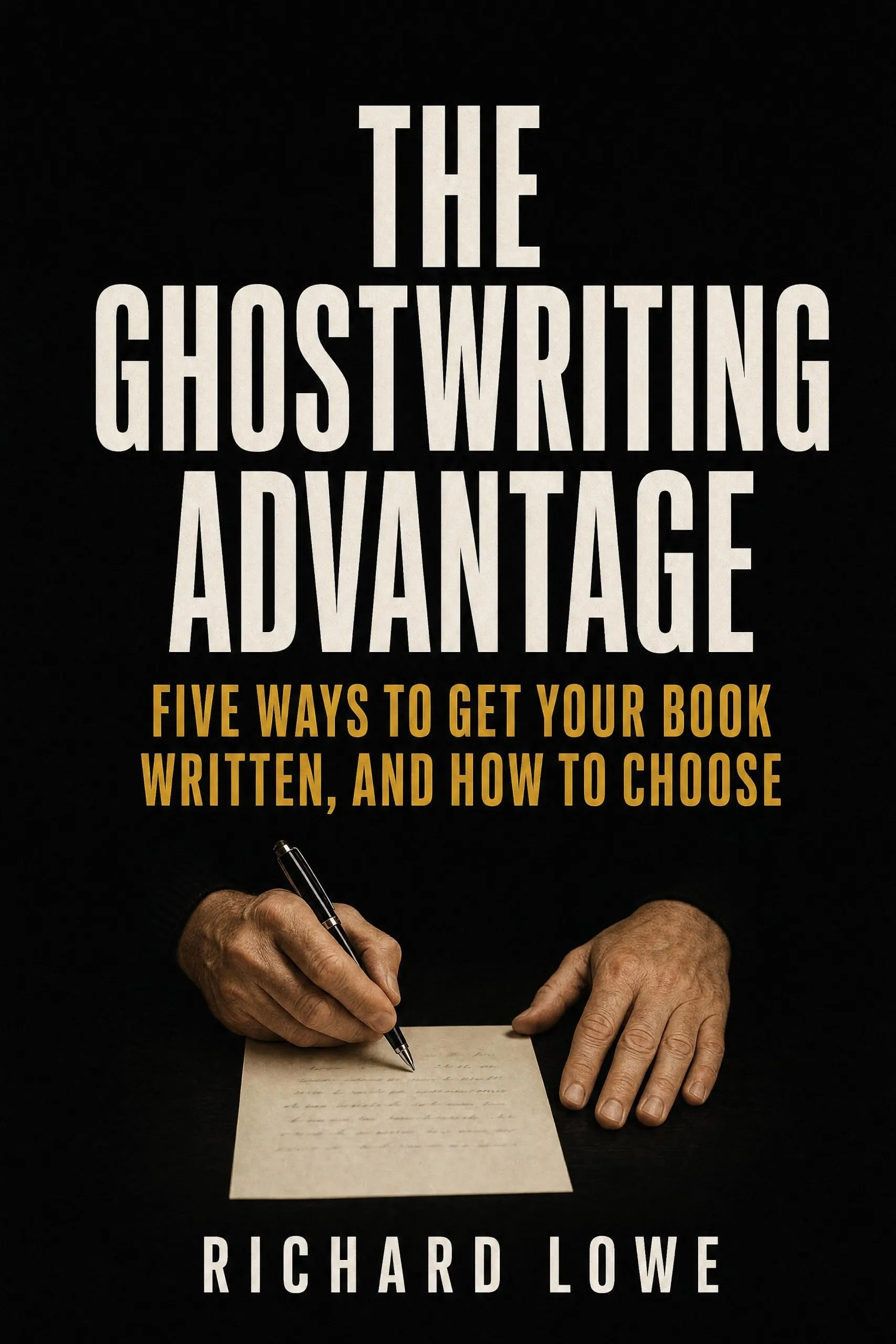
Books built on your voice and your stories need a human ghostwriter. The Ghostwriting Advantage explains how to get your book written for you, drawn from 54+ ghostwritten books.
Frequently Asked Questions
The book on this: The Ghostwriting Advantage is 254 pages on what a ghostwriter is for now that clean prose costs nothing. That’s exactly the part a model can’t supply.
