
Plenty of ghostwriters use tools. What matters to me is whether a writer tells you the truth about how your book gets made, protects your voice, and writes the pages instead of assembling them. If you’re putting real money into a book with your name on the cover, you’re paying for judgment, voice and accountability, and a writer who hides how the work gets done is shortchanging you on all three.
Ethical ghostwriting rests on three pillars: consent, provenance, and voice. Consent means the client knows where tools appear in the workflow and agrees to it in writing. Provenance means there’s a visible path from interview to outline to chapter, with drafts that show how ideas move from conversation to page.
Voice means the book sounds like the author on their best day, with their cadence, phrasing, and edge. If any one of these falls, ethics fall with it. Shortcuts exist, and most produce smooth but lifeless prose. Speed alone isn’t the problem. Dishonesty is.
Tools can help without stealing authorship. Treat them like research and organization assistants that never get a byline. A writer can use a summarizer to scan public sources quickly, then personally verify every claim before it reaches the page. The judgment remains in what to believe, what to ignore, and how to frame the insight.
After a ninety-minute interview, transcription software can cluster recurring themes, so the writer jumps to the right section fast. The writer still decides which quotes matter and which stories carry emotional weight. When a chapter needs sharpening, the writer might pressure test it by asking for potential objections and then choosing which counterpoints strengthen the argument.
That’s close to how I work. I use AI every day as a digital assistant: it handles transcripts, helps me turn each interview session into a summary document the client receives, and gives me a first-pass outline to push against. I still do the writing. A ghostwriter who can’t tell you where that line sits in their own process has probably already crossed it.
For polish, a grammar pass can catch typos, then the writer reads the chapter aloud to protect rhythm and restore the author’s voice where an overzealous correction flattened it. None of this replaces authorship. Selection, structure, voice, and narrative remain human work. Tools serve the writer. The writer serves the book.
Unethical use begins when the tool becomes the author and the ghost becomes a prompt editor.
Thiago Ferreira teaches Human Centered AI for All at the University of Miami. On Leaders and Their Stories, he gave me the right picture of the tool: “Think of AI as your very smart intern that you just hired, who needs a lot of direction and oversight.” Nobody lets the intern sign the book.
The shift is quiet, and you notice it on the page. A first draft produced by a generator and lightly edited to sound less robotic is passing off machine output as craft. Skipping interviews and stitching a chapter from public articles and scraps isn’t authorship of a personal book. You can feel the absence of concrete scenes, private language, and lived experience.
A writer who charges for authorship and hands over lightly edited machine output is a fraud, selling the client something that doesn’t exist. The client usually finds out when friends and colleagues read the book and say it doesn’t sound like them. The contrast is easy to hear. In an ethical process, a client says, “When we lost the seed round, I sat in the car and stared at the steering wheel until my hands stopped shaking.”
That line goes into the voice guide and becomes the anchor of Chapter Two, including the pause after the verb and the short sentence at the end.
A writer who charges for authorship and hands over lightly edited machine output is a fraud, selling the client something that doesn’t exist.
In an unethical process, the same moment dissolves into a generic statement like, “We faced significant fundraising challenges, which taught us resilience.” No car. No hands. No scene. Fog.
Data handling reveals character just as quickly. Pasting raw transcripts, names, and confidential numbers into public systems without masking is reckless. Sensitive inputs get logged somewhere the client didn’t approve and can’t control.
The ethical version is careful and dull. The writer masks names and figures or uses an enterprise environment, and sensitive files live offline with controlled access. The client knows this up front because it’s part of the agreement from the start.
If a client told me their writer had pasted confidential figures into a public chatbot, I’d tell them to get their files back and find someone else. Anyone who handles other people’s secrets for a living has given up the right to be casual about where those secrets go.
Revisions tell the truth about authorship. When a client asks for changes and the response is, “We can’t alter that section or the prompt chain will break,” the workflow has become more important than the book. Ethical writing sounds different. “You’re right. That scene is flat.” The writer returns to the interview, finds the missed detail, and rewrites until the paragraph breathes. Real writers revise. They don’t hide behind tooling.
Clients don’t need to become technologists to protect their book.
They need consent, control, and evidence. Consent is explicit and documented before work begins. The writer explains where tools show up and where they don’t, the client agrees in writing, and the contract mirrors the plan. Control means that upon payment the client owns the transcripts, outlines, drafts, and the voice guide.
If the relationship ends, the files go with the client and the project doesn’t vanish into a private system.
Evidence means there’s an audit trail. You can trace a finished paragraph to a specific interview clip and a section of the outline. The writing bible shows how the writer chose a metaphor, why a scene moved, and which phrases are part of the author’s natural speech. It’s a workshop with tools on the wall and labels on the drawers.
Process enforces ethics almost automatically. Interviews come first and produce raw material richer than any search result. The outline captures promises as well as topics, so Chapter Three becomes “The week we almost shut down” instead of “Dealing with failure.” The writing bible records voice deliberately. If a client often says, “Here’s the part nobody tells you,” that phrase enters the guide and appears later in the right places and nowhere else.
The first chapter tests everything. If a paragraph comes back sounding angry when the client is measured by nature, the writer checks the tape, sees the mismatch, and corrects it at the source. The remaining chapters follow the approved plan. That leaves little space for panic-driven generation. Revisions confirm intent. A client remembers a mentor story that belongs in Chapter Five. The writer schedules a short pickup interview, threads the story into the draft, and notes the change in the history. The book gets better and the trail is clear.
The temptation to cut corners is real. Speed and plausible fluency are available at the press of a button. A ghost staring down a missed deadline can paste the outline into a generator, take the eighteen hundred smooth words that appear in ninety seconds, sprinkle in a few quotes, and call it a draft. That move looks efficient from a distance. It collapses on close reading.
That writer is gambling with somebody else’s name. The client paid for a book built from their own life, and ninety seconds of generated prose with a few quotes dropped in will read like exactly what it is, to the client first and then to every reader who picks it up.
The disciplined version is slower and honest. my ethics and code of conduct The writer blocks two days, builds three scenes from transcripts, writes connective tissue that sounds like the client, and delivers fewer words that carry more truth. The deadline slips by a day. The relationship gains trust. The book keeps its soul.
Clients can ask for simple proofs without policing anyone.
“Show me how this paragraph connects to our interview” is a fair request, and the professional response sounds like, “Interview two, minute forty-one. Here’s the clip.” “Where do you use tools?” should return a direct answer such as, “Organizing transcripts and grammar checks. Drafting is human. Sensitive inputs are masked.” “How do revisions work?” deserves a clear plan that matches the earlier agreement about stage approvals and change control. Real pros are relieved by these questions because they bring out the details that protect both sides.
The old myth says the best ghost is invisible. In practice, total invisibility isn’t the goal. Responsibility is. The ethical ghost is visible to the client and accountable at every step. They guide interviews with real curiosity, explain structural choices, own misses, and fix them. They’re a partner. They vanish only on launch day, when readers hold a book that sounds like the author who lived it.
Books carry a heavier risk than short content because they travel farther with more authority. Models still fabricate when context is thin. They invent citations and events and do it with confidence. You can correct a blog without anyone noticing.
A book lasts, and people quote it. The responsible approach is dull and dependable. The writer verifies claims against real sources, and interview material dominates over third-party summaries because lived experience doesn’t hallucinate. The difference shows in the footnotes and in the way a story reads.
Money and calendars reveal ethics as clearly as any paragraph.
Pricing a book as handcrafted work and delivering computer throughput is a lie. Promising a full, high-quality chapter from scratch in twenty-four hours is either a lie or a corner cut. There’s nothing wrong with offering a lower-priced playbook built from research and chosen stories when that’s what a client needs, and there’s nothing wrong with offering a full book that requires interviews, a writing bible, and true drafting at a premium. Honesty is the dividing line.
Sell the right product under the right label and deliver what the label promises. A research-built book at a lower price is perfectly fine when it’s sold as exactly that. The writer who charges for handcrafted work and ships something else is lying to a client who has no easy way to check, and I’d like to see that practice driven out of this business.
A simple statement captures the standard any serious ghostwriter should be willing to sign. I disclose where I use tools and where I don’t. I never paste confidential material into public systems without masking or enterprise protections. I build chapters from interviews and the author’s materials. I verify facts and track sources. I write the chapters myself. I welcome revisions inside the agreed scope. I maintain an audit trail that shows how the book was made. The client owns the work when paid.
If I change the process, I tell the client and update the agreement. That’s honest.
You can feel ethics on the page. An ethical draft has concrete detail.
A narrator closes a laptop, walks the block twice, catches the smell of hot rubber and jasmine, and decides to call Nate. Voice, image, motion, decision. An unethical draft has fog. “In moments of adversity, it’s crucial to maintain perspective and seek counsel.” Smooth, vague, nobody is there. Once you tune your ear, the distinction is obvious.
Books outlast projects. Years from now, the author will still be tied to those sentences, and an ethical ghostwriter writes with that future in mind. Tools can organize, remind and pressure-test. They can’t care about the person whose name is on the spine, and care is what shows up on the page as craft and honesty.
If you’re hiring a ghostwriter, ask for transparency, protection of your voice, a clear path from interview to chapter, secure handling of your material, truthful timelines and a revision process that honors the work. If you’re a ghostwriter, offer all of that before anyone asks. A writer who gets defensive when a client asks how the book is being made is hiding something, and I’d tell that client to end the call and keep looking.
Ready to move? Book a 15-minute fit call and we’ll scope your book today.
My take
Any ghostwriter who gets defensive when you ask how the book is made is hiding something. End that call. Tools are fine for organizing and pressure testing, and they don’t care about the person whose name is on the spine. Ask for a clear path from interview to chapter, honest timelines, and secure handling of your material. Then read a sample. You want real people on the page instead of fog.
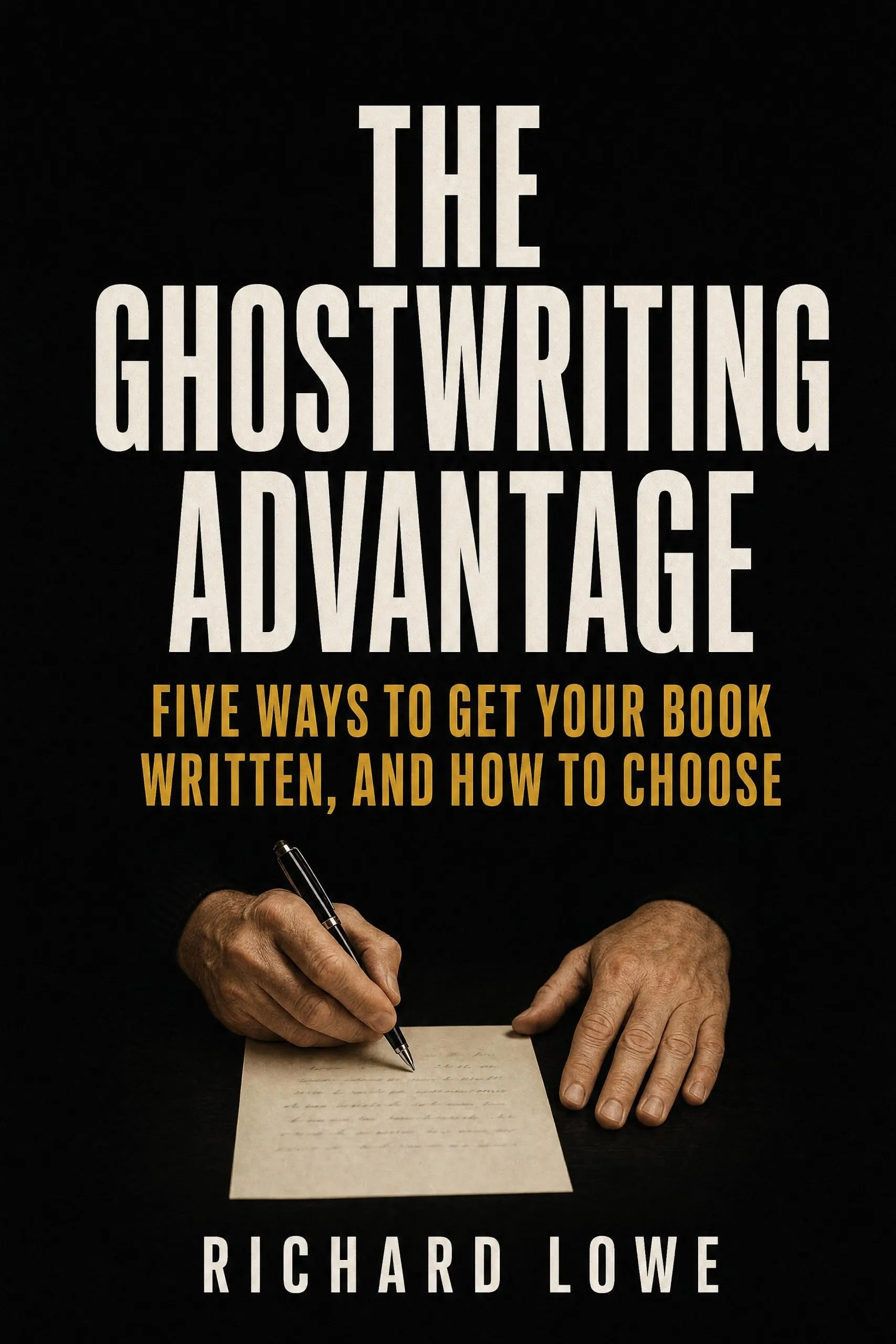
Read The Ghostwriting Advantage before you hire anyone. It explains how a book gets written for you by a person who has ghostwritten 54+ of them, so you know what honest work looks like.
Frequently Asked Questions
If you’re investing real money in a book that carries your name, you’re buying judgment, voice, and accountability.Share on X
The book on this: The Ghostwriting Advantage is 254 pages on what a ghostwriter is for, and why the material a book runs on can’t be typed into a prompt box.
