TL;DR
7/10. A practical self-editing tool for the common problem of wordiness, a dictionary of bloated phrases and their leaner alternatives that treats concision as a learnable discipline instead of vague advice. A solid, useful resource, held from higher by its narrow single-purpose scope, the judgment it requires, and overlap with full style guides.
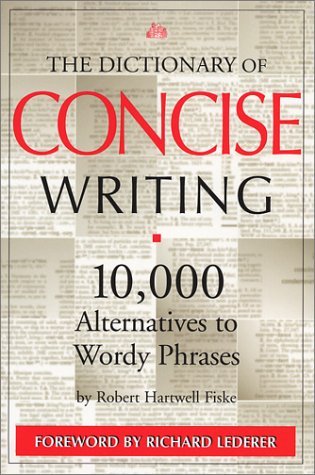
Wordiness is among the most common and most fixable problems in writing, and The Dictionary of Concise Writing by Robert Hartwell Fiske is a reference built to cure it. Despite the name, it’s an editing tool more than a dictionary. A guide to reducing wordiness, organized as a dictionary of bloated phrases paired with their leaner alternatives, plus general guidelines for tighter prose.
Padded prose is one of my pet hates, and Fiske goes after it with a list instead of a sermon. For a writer who tends toward the verbose, the redundant, or the padded, it’s a useful, practical resource for cutting flab and sharpening sentences. Judged as the focused self-editing tool it is, it does its job well. The premise is sound and the need is real: most first-draft prose is too wordy, and concision is a learnable skill that immediately improves clarity and impact.
A practical cure for wordiness
The book’s core, its dictionary of wordy phrases and their concise replacements, is its most useful feature.
A writer can look up a flabby construction they habitually use and find the tighter alternative. Browsing the entries trains the eye to recognize the padding, redundancy, and circumlocution that bloat prose. Combined with its general guidelines on concise writing, it works as both a reference and a self-teaching tool, helping a writer internalize the habit of economy.
Every padded phrase in a manuscript wastes the reader’s time, and this targeted, example-driven approach is exactly the kind of practical help that stops it fast.
Keep reading
Cutting the weasel words and padding from your prose: Fiske’s wordy-phrase fixes, in the craft of lean, economical writing.
Concision as a skill
The deeper value is that the book treats concision as a learnable discipline instead of a vague aspiration. Tight writing is about cutting the words that add nothing instead of being terse. The redundancies. The empty intensifiers. The long phrases a single word replaces. What remains then carries real weight.
By cataloging the specific offenders and their cures, Fiske gives a writer a concrete way to practice that discipline until it becomes instinct. Every writer has heard the advice to omit needless words, and most of them ignore it the minute they start drafting. Fiske’s catalog makes that much harder to get away with. The specificity makes it work.
Keep reading
Breaking the bad writing habits that bloat your prose: the verbosity Fiske targets, among the habits worth unlearning.
What are the weaknesses of The Dictionary of Concise Writing?
The caveats are about scope. It’s a narrow, single-purpose reference, focused on concision and nothing else, so it’s a supplement to a writer’s toolkit instead of a complete craft education, valuable for this one weakness and silent on everything else. Concision can also be overdone, stripped too far, prose becomes choppy or loses necessary nuance and rhythm, so the tool requires judgment instead of mechanical application; not every long phrase is wrong. And its content overlaps with the concision guidance in full style guides.
The overcutting risk is the one that worries me. A writer who strips every sentence to the bone ends up with prose that reads like a telegram. Within its lane, though, it does useful work.
Is The Dictionary of Concise Writing worth reading?
It’s a practical, useful self-editing reference for the common and correctable problem of wordiness, valuable for its concrete dictionary of bloated phrases and their leaner alternatives and for treating concision as a learnable discipline instead of vague advice. It deserves a solid rating, held from higher by its narrow single-purpose scope, the judgment required so concision isn’t overdone, and overlap with full style guides.
For a writer who struggles with verbosity and wants a targeted, example-driven fix, it’s an effective tool that produces immediate improvement; for broader craft, it’s one specialized piece. Bloat is the most fixable sin in prose, and this book makes ignoring it look lazy.
Explore the hub
The Writing Hub: self-editing, concision, and the rest of the craft, gathered in one place.
Frequently Asked Questions
Other Books From – English and Grammar