
Robert Hartwell Fiske (March 5, 1948 to April 25, 2016) was an American writer, editor, and the founding publisher of The Vocabula Review, an online journal about the English language that he ran from 1999 until his death. He was one of the most uncompromising and acerbic working voices on English usage of his generation, a self-described language fanatic who, in the words of The Wall Street Journal, wanted to save the English language and knew he could count on little help. Vocabula was licensed by Columbia University, Princeton, Stanford, and other major universities.
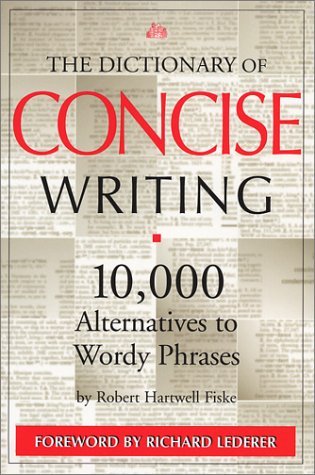
His writing references include The Dimwit's Dictionary (third edition, Marion Street Press, 2011), a compilation of more than five thousand cliches, colloquialisms, idioms, and what he called dimwitticisms that people use unendingly, along with sharper alternatives for each. To the Point: A Dictionary of Concise Writing (W.W. Norton, 2014) catalogs more than ten thousand wordy phrases and offers tighter substitutes, with the underlying argument that wordy prose is not a stylistic preference but a failure of thinking. Robert Hartwell Fiske's Dictionary of Unendurable English: A Compendium of Mistakes in Grammar, Usage, and Spelling (Scribner, 2011) treats the working failures of contemporary American English with the same uncompromising eye, with extended commentary on the descriptive school of lexicography and its consequences.
His positive vocabulary references include Elegant English (Vocabula Books, 2014), 101 Elegant Paragraphs, and The Best Words, each making the case that good prose is a learned skill and that high standards in the use of language matter for thought as much as for style. He believed, as the novelist Joseph Epstein wrote in his foreword to The Dimwit's Dictionary, that clear language is our only hope for clear thought, that dull language deadens the mind and dampens the imagination, and that nothing exceeds language in its significance to the human enterprise.
Beyond his books he published Robert Hartwell Fiske's Disagreeable English, a bimonthly bulletin of misused, misspelled, and mispronounced English, and the free Daily Vocabula email newsletter with sections on disagreeable English, elegant English, concise writing, and scarcely used words. He owned Vocabula Communications Company, which included The Vocabula Review, Vocabula Books, and the Language Guardian editing service. He lived for many years in Rockport, Massachusetts, and Gloucester, and died of melanoma at age sixty-eight.
Robert Hartwell Fiske
Professional ghostwriting for executives, founders, coaches, and authors who want to get the book done right. 113+ books authored. 54+ ghostwritten for clients.
Ready to discuss your book?
BOOK YOUR PRIVATE CONSULTATIONNo pitch. No pressure.
© 2026 Richard Lowe. The Writing King. All rights reserved.