TL;DR
7/10. Turns show-don’t-tell into a usable method for emotion: show the physical and behavioral signs of a feeling instead of naming it, grounded in how the brain engages with concrete detail. A handy catalog of bodily cues, with the risk that leaning on it mechanically produces cliché. Focused, sound, and helpful within its lane.
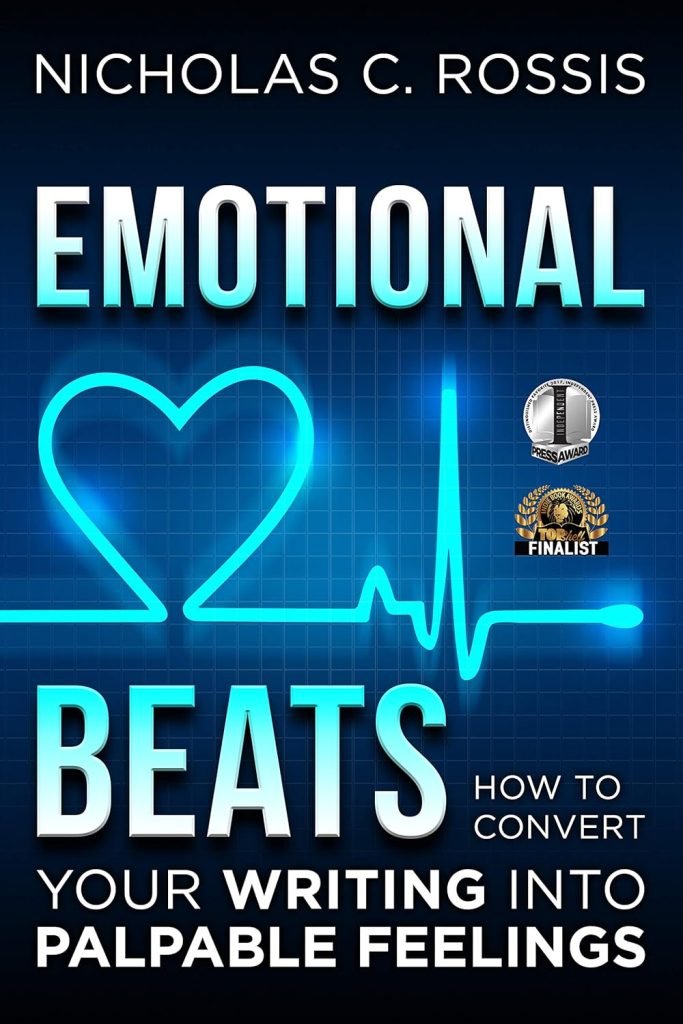
Show, don’t tell is the most repeated advice in fiction and the least often explained. That’s always irritated me, since a rule nobody explains is a rule nobody follows. Emotional Beats by Nicholas C. Rossis takes the practical case of emotion, how to convey what a character feels without simply naming the feeling, and turns it into a usable method. The premise is grounded in how the brain processes story.
Readers empathize more strongly when a writer shows the physical and behavioral signs of an emotion instead of labeling it. The book is a toolkit for doing that.
This is an independently published craft book, and a focused, practical one. It doesn’t try to teach all of fiction; it solves one common, nagging problem, and solves it concretely.
The core technique
The central idea is sound and well framed. Writing she felt anxious tells the reader a fact. Showing the restless hands, the shallow breath, and the inability to sit still lets the reader infer and feel the anxiety themselves. That hits far harder. Rossis ties this to the way the brain engages with sensory and physical detail over abstract labels. The familiar show-don’t-tell rule gets a concrete rationale instead of staying a slogan.
The argument that named emotions keep a reader at arm’s length while shown physical beats pull them in is the right diagnosis of why so much amateur emotional writing falls flat.
Keep reading
Show, don’t tell: when to do which, and why it matters: Rossis applies the rule to emotion; here’s the fuller balance of show and tell.
A reference of physical beats
Where the book is most practically useful is as a catalog. It provides lists of physical and behavioral expressions for various emotions, the bodily signs that signal fear, anger, joy, grief, and the rest, so a writer stuck on how to show a feeling has a menu of options to draw from. This makes it a close cousin of the emotion-thesaurus approach: a lookup tool for translating an abstract feeling into concrete, observable detail.
For a writer who knows what a character feels but can’t find a fresh way to render it, that reference function is the book’s main draw.
Keep reading
Body language in fiction: showing emotion through the body: the physical vocabulary of emotion, in the wider craft of rendering feeling.
What are the limits of Emotional Beats?
Two caveats keep it in the mid-range. First, the catalog approach carries the same risk as any list of physical cues: leaned on mechanically, it produces the clichéd, repetitive body-language tics, the pounding hearts and clenching jaws, that become their own kind of telling. The beats are a starting point for fresh observation, not a substitute for it, and a writer who simply pulls from the list will write stock gestures. I’ve had my fill of clenched jaws, and a list makes them easier to churn out.
Second, as a focused indie volume it covers its one technique well but is neither deep nor broad; it’s a single useful tool, not a complete craft education, and its production and polish are those of a self-published book instead of a major press.
Is Emotional Beats worth reading?
It’s a useful, practical book on a real and common problem, with the right central insight, that shown physical beats convey emotion more powerfully than named feelings, and a handy catalog of bodily cues to draw on. It deserves a solid mid-range place, held there by the catalog’s risk of producing mechanical cliché if used as a crutch and by the narrowness of a single-technique indie guide.
For a writer whose emotional writing reads as flat or on-the-nose, it’s a worthwhile, affordable tool, best used as a prompt toward fresh, specific observation instead of a list to copy. Focused, sound, and helpful within its lane.
Explore the hub
The Psychology of Writing Hub: emotion, body language, and the mental side of craft, gathered in one place.
Frequently Asked Questions
Other Books From – Being an Author




About the author