TL;DR
9/10. Christie’s masterpiece and the purest demonstration of plot construction in crime fiction: ten strangers stranded on an island, killed one by one, the solution both shocking and scrupulously fair. A model of closed-circle suspense and fair-play misdirection. Thin characters and dated attitudes are the cost of its puzzle-first design.
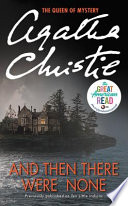
Ten strangers are lured to an isolated island off the Devon coast by a host who never appears, accused one by one of a hidden murder, and then killed off in sequence with no one else on the island and no apparent way out. And Then There Were None is Agatha Christie’s masterpiece and one of the best-selling novels ever written, and it’s the purest demonstration in crime fiction of a single, perfectly executed structural idea. For a writer, it’s a model of plot construction.
Christie called it the hardest book she ever wrote, and the difficulty shows in the precision. There’s no series detective here, no Poirot or Marple to lean on, only the premise and the relentless machine of its execution.
The closed-circle engine
The book perfected the closed-circle mystery, the form where the author cuts a finite group off from the world so that the killer must be one of them. By stranding ten people on an island they can’t leave and from which help can’t come, Christie creates an airtight logical space: every death narrows the suspects, the tension ratchets with each one, and she traps the reader in the same shrinking circle as the characters. The structure creates the tension.
There’s nowhere for the story to sag because the premise itself generates relentless, escalating pressure. A writer studying how to build suspense from situation instead of incident should start here.
Keep reading
How to write a thriller that grips from page one: Christie’s closed-circle premise generates suspense structurally. How situation creates tension.
Watch: And Then There Were None (1945) AGATHA CHRISTIE, PizzaFlix
The fair-play puzzle
What lifts it from clever to masterful is that the solution is both shocking and entirely fair. Christie plays by the rules of the puzzle, the clues are all present, the logic holds, and yet almost no first-time reader solves it, because the misdirection is so expertly placed. This is the hardest balance in mystery writing: surprising the reader while leaving them no grounds to feel cheated, so that the revelation produces delight instead of annoyance.
Christie’s control of what the reader notices and what they overlook is the skill the whole genre rests on, and few books show it this cleanly.
Keep reading
Writing a mystery that plays fair and still surprises: Christie’s fair-play misdirection dissected. How to surprise without cheating.
The nursery rhyme as structural clock
One device deserves singling out because it’s the kind of thing a writer can steal.
Christie hangs the whole sequence of deaths on a children’s counting rhyme, the ten little figures of the title, each verse foretelling the manner of the next death. It’s a brilliant piece of construction working on several levels at once. It works as a countdown, so the reader always knows how many are left and feels the circle tightening.
It adds dread, because each victim, and the reader, can see the pattern coming and is powerless to stop it.
And it provides a chilling, almost playful contrast between the innocence of a nursery rhyme and the horror it scripts. For a writer, it’s a lesson in using a simple external structure, a song, a list, a ritual, to organize a plot and generate inevitability. The rhyme does the bookkeeping the suspense needs, freeing Christie to focus on the misdirection while the form itself keeps the pressure mounting.
What are the weaknesses of And Then There Were None?
The limits are those of its era and its design.
The characters are functional instead of deep, types defined by their hidden crimes and their usefulness to the plot, because the puzzle is the point and rich interiority would only get in its way. The prose is brisk and unadorned, a delivery system for the mechanism instead of a pleasure in itself. And the book carries the social attitudes of 1939, including, notably, an original title since changed for its racism, which a modern reader will register.
These are real, but they’re the cost of a book engineered for structural perfection instead of literary depth.
Is And Then There Were None worth reading?
As a demonstration of plot construction and fair-play misdirection it’s close to flawless, and it remains the model every closed-circle mystery since has been measured against.
A writer learning to build suspense from premise, to control reader attention, and to engineer a shocking-but-fair twist can study no better example. It loses a little only for the thin characterization and dated attitudes that come with its puzzle-first design. For pure structural craft, it’s essential, and its lasting sales are the proof that a perfect mechanism never goes out of style.
Explore the hub
The Entertainment Hub: mystery and crime fiction across the form, gathered in one place.
Frequently Asked Questions
Other Books From – Fiction

About the author