
More on the executive book process. He writes about missing her miso soup. About wishing he could see cherry blossoms bloom one more time. About being scared and wanting to come home. The letter never gets sent. It’s found decades later by archaeologists, along with hundreds of others, final thoughts from boys who became men in the space between bullets, then disappeared into history. Those letters, written in the shadow of death, contained more truth than every military report, strategic analysis, and official account from that battle combined.
What Don’t CEOs Write About?
I’ve spent years ghostwriting books for executives. Titans of industry who’ve conquered markets, disrupted entire sectors, built empires from garage startups. They love talking about their strategic pivots and competitive advantages. They’ll spend hours explaining their structures, their methodologies, their systematic approaches to success. What I’ve learned from the leaders I’ve written for is that the executive books that change people, the ones that get passed from CEO to CEO, that get quoted in boardrooms, that leaders keep on their nightstands instead of their office shelves, they’re built on the letters these executives never sent. The letter to their father explaining why they couldn’t take over the family business, even though it broke his heart. The letter to their first employee who died of cancer six months before the IPO that would have made him rich. The letter to their sixteen-year-old self about what success costs when you count everything. The letter to their spouse about the nights they chose the deal over the dance recital. These are the stories that transform business books from corporate monuments into human documents that matter to readers.
The Cave Beneath Success
Every executive I work with has a cave, a metaphorical space where they store the moments of truth they’ve never shared publicly.
As someone who specializes in ghostwriting for business leaders, I’ve learned that the most powerful stories live in these hidden spaces. The 3 AM panic attacks during the merger when they weren’t sure they could pull it off. The day they almost lost their marriage to their ambition. The mentor whose sudden death taught them more about leadership than Harvard Business School ever could. The pharmaceutical executive who discovered her company had buried safety data and spent the next decade building free clinics in Honduras. The tech founder who realized he’d missed his daughter’s entire childhood building something that barely mattered five years later. The retail CEO who had to fire her best friend to save the company, and the two of them never spoke again. These stories never make it to industry conferences or the case studies in Harvard Business Review, but they reveal who these leaders really are when everything else gets stripped away. I once worked with a manufacturing CEO who kept a photo on his desk of Miguel Hernandez, a worker who died in his plant on a Tuesday in March. Miguel left behind a wife and two kids and a mortgage that the CEO personally paid off. But that wasn’t the story he wanted to tell. “Every safety decision I’ve made since that day runs through Miguel’s memory,” he told me. “Every protocol, every procedure, every dollar we spend on equipment. I ask myself what Miguel would think.” That story became the opening chapter of his book. His IPO, his industry awards, and his expansion into twelve countries didn’t. Because Miguel’s story contained something no business structure ever could: the weight of real consequence, the true cost of leadership, the humanity that gets lost in spreadsheets. When I’m ghostwriting executive memoirs, I’ve found that readers don’t remember the CEO’s profit margins or market share. They remember Miguel. They remember thinking about the people their own decisions affected, the faces behind the numbers, the families touched by their choices.
Why do unsent letters matter in memoir?
I want these stories in an executive’s book because the polished version of a leader is the one readers already own. Every airport bookstore is stacked with it. What a reader can’t get anywhere else is the moment the title stopped protecting you, and that’s the moment most executives want to cut first. Cutting it is a mistake, and it’s the one I push back on hardest.
In “Letters from Iwo Jima,” the soldiers’ final words weren’t about strategy or victory. They were about love, regret, and fear. The universal things that make us human when everything else gets stripped away. Business leaders face their own battles. Different weapons, same human core. The executive who laid off 200 people to save the company carries those names differently than any spreadsheet can capture. She knows it was Steve from accounting who was six months from retirement. Maria from HR who’d just had her third kid. David from sales who’d been working there longer than anyone. The founder who chose growth over family time doesn’t miss “family events.” He misses Emma’s solo in the school play. Jake’s first goal in soccer. The way his wife looked when she stopped expecting him to show up. These are the stories that matter, and they matter because they’re true. And truth, as those soldiers on Iwo Jima understood, is what survives when everything else crumbles.
What Those Boys Knew About Wisdom
The Japanese soldiers writing those letters weren’t old men with decades of experience to draw from. Many were barely twenty, thrown into a hell they never could have imagined. But facing death stripped away everything except what mattered most.
Their letters reveal a truth that business schools don’t teach and success often obscures: Wisdom comes out of what nearly broke you. Every leader has defining moments that cracked them open. The deal that fell through and revealed their character. The partnership that failed and taught them about trust. The success that felt hollow and showed them what they valued. The failure that stripped away their pretenses and left them with nothing but truth. Those cracks are where the light gets in. And where real books get written. My client Sarah built three companies before she was fifty. Survived breast cancer twice. Raised five children as a single mother after her husband left. Her resume could fill volumes, her achievements inspire business school case studies. But what she wanted to write about was the letter she never sent to her father before he died when she was twelve. “I forgave him,” she told me, seventy-year-old tears finally finding their way out. “For the drinking, for the yelling, for leaving us with nothing. I forgave him years ago. But I never told him.” That letter, to a man who’d been gone for six decades, became the opening chapter of her book. Not her business victories. Not her triumph over cancer. Not her success as a single mother. Her unspoken forgiveness. The book hit bestseller lists because every reader found themselves sitting in their own childhood bedroom, thinking about their own unsent words, their own unspoken forgiveness, their own unfinished conversations.
The Test of Truth
From the podcast
Rob Fenstermaker works with men on exactly this question, and starts by asking what’s non-negotiable, on Leaders and Their Stories:
What are those things that are non-negotiable to you? You have to know what those are.The letters in the caves were written by men who had answered that question and had nothing left to hedge.
This is how I know if someone has a real book in them instead of another business memoir that reads like a LinkedIn profile in chapter form. When I’m considering professional ghostwriting projects for executives, I ask them about their biggest failure. If they start with market analysis and strategic missteps and lessons learned about diversification, we’re not ready yet. That’s the surface story, the one they’ve polished for board meetings and conference panels. If they start with how it felt to look their team in the eye and admit they were wrong, if they talk about the specific faces in the room when they announced the layoffs, if they describe the weight of disappointing people who believed in them, then we have something. The executives who change industries don’t just solve problems differently. They see problems differently. Usually because something, or someone, cracked them open first and taught them to look deeper than the numbers, beyond the metrics, past the spreadsheets to the human truth underneath.
Letters Found in Caves
Those Japanese soldiers on Iwo Jima didn’t know their letters would be found seventy years later.
They weren’t writing for posterity or publication. They were writing because time was running out and truth was all they’d left. No audience to impress, no image to maintain, no brand to protect. Just human beings putting their hearts on paper before the world ended. The most powerful executive books I’ve worked on feel like found letters. Raw. Honest. Unpolished in the best possible way. Written not for applause but for understanding, not for admiration but for connection. When ghostwriting books for business leaders, I’ve seen how real storytelling transforms both the author and the reader. For more on how a book pivots a C-suite career, hear Richard on Author to Authority. The manufacturing CEO’s book became required reading at safety conferences nationwide. Not because of his impressive business metrics or innovative processes, but because he had the courage to write about Miguel. About responsibility. About the weight of decisions that affect real families. About the photo on his desk that reminds him every day that leadership means more than profit margins. Readers connected because every leader carries their own version of Miguel’s story. The person whose life they changed, whose family they affected, whose trust they carried.
What My Grandmother Understood
My grandmother could barely read, never graduated high school, never managed a P&L or led a strategic initiative. But she was the wisest person I ever met. She raised eight children during the Depression, buried two of them before their time, and somehow maintained a faith in humanity that business school could never teach. She understood something that most executives forget in their climb to the top: wisdom is what broke you and how you chose to heal.
Their letters reveal a truth that business schools don’t teach and success often obscures: Wisdom comes out of what nearly broke you.
It’s what you learned about yourself when the pretenses fell away and you had to face who you really were underneath the title and the corner office and the stock options. The leaders who change the world, really change it, not just disrupt it for a quarter or two, they all have moments when they got broken open. And instead of just patching themselves up and moving on, they let the breaking teach them something about being human.
What Gets Left Behind When You Don’t Write Your Story?
I’ve written memoirs from a subject’s papers after they died, interviewing the family to fill in what the pages couldn’t.
It can be done. It’s also far harder than sitting down with the person while they can still answer a question, and some things don’t survive the trip. The reasons behind the hard calls are usually the first to go. I hate losing a story that could have been told.
Your quarterly earnings won’t be discussed at family dinners fifty years from now. Your market share won’t inspire anyone’s courage. Your competitive advantages won’t comfort your grandchildren when they’re facing their own impossible choices. But the wisdom you carved from pain, the compassion you built from loss, the strength you discovered in your deepest doubts, that echoes across generations.
That’s what changes people. That’s what lasts. The soldiers on Iwo Jima didn’t have time to polish their thoughts or craft their personal brands or worry about their professional image. They just wrote what mattered most while they still could. They wrote truth because truth was all they’d left to give.
The Letters in Your Cave
What letters are you not writing? What truths sit in your own cave, waiting for the courage to bring them into the light? Every executive I work with carries stories that could change how someone else sees their own struggles. Wisdom earned through failure that could spare someone else years of wandering in the dark. Insights about leadership, about life, about what matters when everything you thought was important gets stripped away. The pharmaceutical executive’s clinics in Honduras have treated over fifty thousand patients. Not because of her business acumen, but because she had the courage to write about moral failure and redemption. Sarah’s book has been translated into twelve languages. Readers don’t remember her business achievements. They remember her letter to her father, her model of forgiveness, her example of healing wounds that seemed too old to heal. Your achievements will be footnotes in industry magazines. Your humanity will be remembered in changed lives.
My take
Record the story behind your hardest decisions while you’re alive to tell it. I’ve built memoirs from a subject’s papers after death, and the reasons behind the hard calls are the first thing lost. Nobody will bring up your market share at a family dinner fifty years from now. They’ll remember what broke you and how you healed. Put that in the book. Leave the earnings for the annual report.
Why write your letters and memoir now?
The soldiers on Iwo Jima ran out of time to send their letters. But their words survived, found decades later in caves, still carrying the power to move hearts and change minds. You haven’t run out of time. Your letters can still be sent. Your truth can still be shared. Your wisdom can still change someone’s life. But only if you have the courage to write what matters. Only if you’re willing to dig into your own cave and pull out the letters you’ve been carrying. Only if you can set aside the achievement lists and company histories and strategic structures long enough to write about the human being behind the business success. Stop asking whether you’re important enough to write a book. Ask whether you’re brave enough to write the letters you’ve been hiding in your own cave. What are you waiting for? If you’re ready to stop writing about what you’ve accomplished and start writing about what you’ve learned, really learned, in the places that hurt and the moments that mattered, I’d like to help you find those letters. After years of ghostwriting books for executives, I’ve learned that the world has enough strategy books and success stories and leadership structures. What we need are more truths from the cave. More letters that were almost never sent. More wisdom born from breaking and healing and choosing to be human in a world that rewards us for being anything else. See what makes a successful book. Understanding comes from finding the courage to tell the truth that only you can tell.
Ghostwriting for Executives: Frequently Asked Questions
I’m a professional ghostwriter specializing in executive books that matter. Not achievement lists. Human truth. Not resumes. Revelations. Not monuments to success. Letters from the cave.
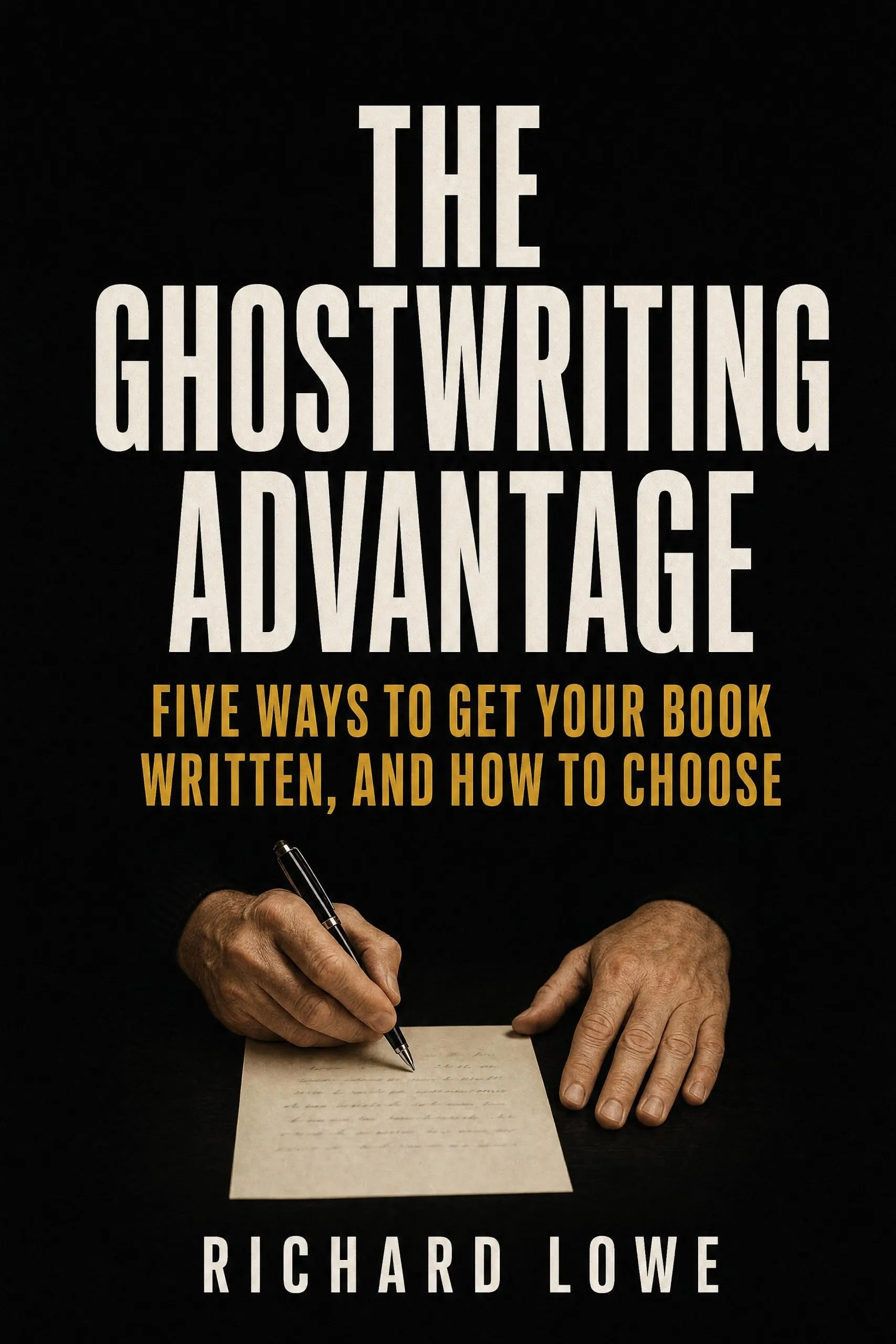
Executives carry stories like those letters and rarely write them down. The Ghostwriting Advantage is my book on how to get your book written for you with a ghostwriter.
