TL;DR
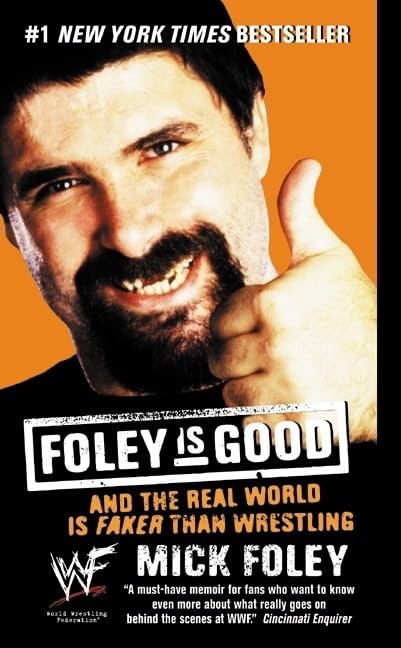
9/10. Mick Foley’s first memoir, the #1 bestseller that started his writing career and one of two Foley books I use as examples of the memoir form done right. He wrote it himself after rejecting a ghostwriter, and that authentic, funny, self-aware voice carrying an interesting life is exactly why it works. No interest in wrestling required. One of my favorites, read half a dozen times.
This is the book that started it, both Mick Foley’s writing career and my conviction that he is one of the best memoirists working in popular nonfiction. Have a Nice Day!: A Tale of Blood and Sweatsocks is Foley’s first memoir, the surprise smash that hit number one on the New York Times list in 1999, and along with its sequel it is one of the two books I hand clients when they ask me for examples of how a memoir should be done.
I have read both of them half a dozen times. This is where the voice I admire so much first appeared, fully formed, on the page.
It tells Foley’s story from his upbringing to winning the WWF championship from The Rock. The route ran through Japanese death matches, an ear lost in the ring, and a career built on a willingness to endure punishment most people cannot imagine. And it tells it in a voice that turned out to be the real revelation.
The book that proved he could write
Here is the detail that says everything, and that I love as a ghostwriter. The publisher originally assigned Foley a ghostwriter. Foley was not satisfied with the work, so he sat down and wrote the entire book himself, longhand, on the road between shows. That decision is the reason the book works. What could have been another smoothed-out, ghost-built celebrity cash-in instead became a genuine, unmistakable, first-person account in Foley’s own voice, funny, self-deprecating, intelligent, and completely his own.
As someone who ghostwrites for a living, I find the irony delicious and the lesson clear. Sometimes the most authentic thing a person can do is write it themselves. When they have a voice like Foley’s, the result is far better than polish.
Keep reading
Memoir voice: why sounding like yourself beats sounding literary: Foley’s self-written debut as the clearest case I know for voice over polish.
Why it works as a memoir model
When clients ask me what makes a memoir worth reading, I point to this book, because it does everything right. It has a compelling narrator you want to keep listening to. It offers authentic, specific insider access to a world, professional wrestling, that most readers know only as spectacle, and it is honest about the cost, the artifice, and the genuine danger of that world. And it never mistakes self-importance for substance; Foley is candid and self-aware, critical where criticism is earned but never whiny, and funny throughout.
Even critics with no interest in wrestling praised it, because the storytelling and the voice carry it regardless of the subject. That is the test of a real memoir, and this one passes it cleanly.
Keep reading
How to write a memoir that people actually want to read: Have a Nice Day as my go-to example of the memoir form done right.
The book that opened a door
It also matters for what it changed. Before Have a Nice Day, publishers largely assumed there was no market for wrestling books, that the audience would not read. Foley’s book, selling in the hundreds of thousands and far beyond anyone’s expectations, demolished that assumption and opened the door for a wave of wrestler memoirs that followed.
There is something fitting in that. The man who took the hardest physical punishment in his industry also broke down a wall in publishing. He did it by writing an honest, well-crafted book that proved the audience was there all along. For a writer, it is a reminder that a genuine, well-told story can create its own market.
A personal note
I will admit my regard is not purely professional. Foley has a second career now as a stand-up comedian, and a show of his was booked near me, scheduled for April 1, 2020, with a VIP seat that would have put me right at the stage, close enough that we would likely have talked. Then the pandemic canceled everything, the show with it, and he has not come back through the area since.
I still want to meet him, because everything in these two memoirs suggests he is exactly the person he seems: funny, decent, and interesting, a man who was a hardcore wrestler, then a bestselling author who writes his own books, and now a comedian. The near-miss only sharpened my appreciation for the work, which remains the next best thing to the conversation I have not yet had.
Verdict
It is one of my favorite memoirs and, with its sequel, one of the two books I use to show clients what the form can be: an authentic, self-written voice carrying an interesting life, with honesty, humor, and real insider substance. It needs no interest in wrestling to work, the voice and storytelling carry any reader, and what it teaches about memoir, that sounding like yourself beats sounding literary, is worth the read on its own.
It started Foley’s writing career, opened a door for an entire category of books, and remains a high-water mark for the celebrity memoir. I have read it half a dozen times and expect to again. Highly recommended.
Explore the hub
The Entertainment Hub: memoir, sports, and entertainment writing, gathered in one place.