
TL;DR: Executives delegate legal, finance, marketing, and code without a second thought, then reserve the highest-use brand asset of their careers for their own two hands. Only about 8 percent of business authors use professional ghostwriters despite measurably higher returns. The thinking can’t be delegated and isn’t; the rendering can be, the same as every other specialist engagement you already run.
Run the inventory of what you already delegate.
Contracts: an attorney drafts them; you review and sign. Financial statements: your CPA prepares them; you attest. The website, the campaigns, the sales deck, the code, the org’s entire written output under your name every quarter, drafted by professionals, approved by you. Nobody calls any of it inauthentic. It’s called competence, and the discipline behind it has a name you probably say in meetings: work at the top of your license.
Then the book comes up, the single asset with the longest shelf life and the highest authority use you’ll ever attach your name to, and the delegation discipline vanishes. This one, you feel, you should type yourself.
Industry data puts the result in numbers. Only about 8 percent of business authors work with professional ghostwriters. Studies of business book outcomes still show professionally produced books returning multiples of the DIY versions.
Ninety-two percent of the smartest delegators in the economy make an exception for the one project where the exception costs the most. That paradox is worth an autopsy, because if you feel the pull of it, the pull has reasons, and they’re worth looking at directly.
This one drives me a little crazy. The same executive who’d never draft their own merger agreement will spend years fighting a manuscript alone, and the book that should be opening doors sits half-finished in a folder while competitors with thinner résumés publish theirs.
Why Does Delegating the Book Feel Different?
Because a book feels personal. Executives who hand off everything else assume this is the one thing they have to write themselves, and it sits unwritten for years.
From the podcast
Arnaud Lucas describes what changes when the work stops being yours to do, on Leaders and Their Stories:
It’s about you giving ownership to other people, and for them then to think about the work.Handing over a book is the same transfer, and it fails for the same reason: ownership given in name only.
“The book is my thinking, and thinking can’t be delegated.” Correct premise, wrong conclusion. You can’t delegate the thinking, and in a professional engagement, you don’t. The book is built from your recorded interviews: your frameworks, your war stories, your judgment, extracted over hours of structured conversation and organized by a craftsman. You delegate the same thing you delegate to your attorney: the specialized rendering of your judgment into a technical form. You’d never claim your CFO’s spreadsheet skills make the strategy hers.
Confidentiality works the way it does with your attorney.
I tell prospects on the first call that they’re under nondisclosure, and my statement of work marks everything they share as proprietary. Two or three clients wanted a signed NDA before our first hour-long meeting, and that’s fine by me. What clients worry about is other people learning their ideas before publication, and the paperwork is there to stop that.
The typing doesn’t make the thinking mine, either. I’ve written this up at length in Why the Smartest Executives Never Write Their Own Books.
Readers can’t see effort. A book ground out alone over three years and a book built with a professional in six months are indistinguishable on the shelf, except the second one is finished.Share on X
“Writing it myself proves it’s authentic.” This is the badge-of-authenticity instinct, and it’s the strongest driver of the 92 percent. The badge has no audience. Readers can’t see effort; they can only see results. Put two books on a shelf. One you ground out alone across three exhausted years, one you built with a professional in six focused months. They’re indistinguishable, except that the second one is usually better written, finished, and published while the market it addresses still exists.
The authenticity readers can detect lives in the ideas and stories. They’re yours in either scenario. The suffering was never visible. It was only expensive.
“I’m a good writer.” Many executives are, at the unit of the memo and the email. A book is a different discipline from a long memo, the way a house isn’t a large birdhouse. Structure across 60,000 words, pacing across fourteen chapters, and a voice held consistent from page 3 to page 240 are craft problems that consume first-time authors regardless of their sentence-level talent.
I say this as someone who writes his own books. Purdue used my own consulting book as a course textbook four years in a row, and I’d still never tell a first-time author to take on a book’s structure alone because their emails are good.
A book is a different discipline from a long memo, the way a house isn’t a large birdhouse.
This is why so many executive books stall at chapter three, a pattern I dissect in the false-starts article: the writing was fine, and the architecture collapsed anyway.
What Do the 8 Percent of Executive Authors Understand?
The minority who delegate the book apply the same arithmetic they apply everywhere else, and the arithmetic isn’t close.
Writing a book yourself costs 250 to 500 hours of your working life. Price those hours at whatever your time trades for, then add the two-to-three-year delay that self-writing typically adds, and the opportunity cost of the speaking, clients, and positioning the book would have generated during those years. Against that, a professional engagement costs a defined fee and perhaps 30 to 40 hours of your time, in interviews and chapter reviews, the two activities that require you.
Speed belongs in that arithmetic too. My fastest book was an 80,000-word communications book, finished in three months. Put that next to the two-to-three-year delay self-writing adds, and tell me which schedule you’d approve for any other project in your company.
The business book ROI research shows where the returns land, and returns compound from the publication date, which the delegated book reaches years sooner.
They also understand what the book is for: the authority it creates. It books clients, puts you on stages, unlocks deals, and makes a career’s expertise permanent and giftable. The typing never made that list.
It was the toll between you and the list, and you already pay professionals to handle tolls everywhere else in your working life. I’ve never understood why the book gets an exemption.
My take
Executives who write their own book are paying a toll they’d hand off anywhere else. The thinking stays yours, in the interviews and the chapter reviews. The typing was never the asset. My fastest book was an 80,000-word communications book finished in three months, so compare that to the two or three years self-writing adds. Treat the book like any other specialist engagement. Hire the help and start the returns sooner.
The Consistency Question
So the question this paradox leaves you with is narrower and harder than whether to use a ghostwriter: what makes the book different from everything else you delegate, other than the feeling? If you find a real answer, honor it, and if the answer is that you love the craft of writing and want those 400 hours as hours of writing, that’s a real answer, and book coaching exists for you.
If the answer is only the feeling, you’ve found a superstition in an otherwise disciplined career, and I’d push back on it hard. Every year the book stays in your head is a year a competitor with less to say gets the keynote, the client and the credibility that should have gone to you.
The book isn’t the deliverable. The authority is. The typing was only ever the toll.Share on X
The Book Discovery Intensive is the low-risk version of that conversation: ten hours, a complete book strategy, a sample chapter in your voice, fee credited toward the full engagement. Treat it as due diligence on the paradox. The 8 percent did.
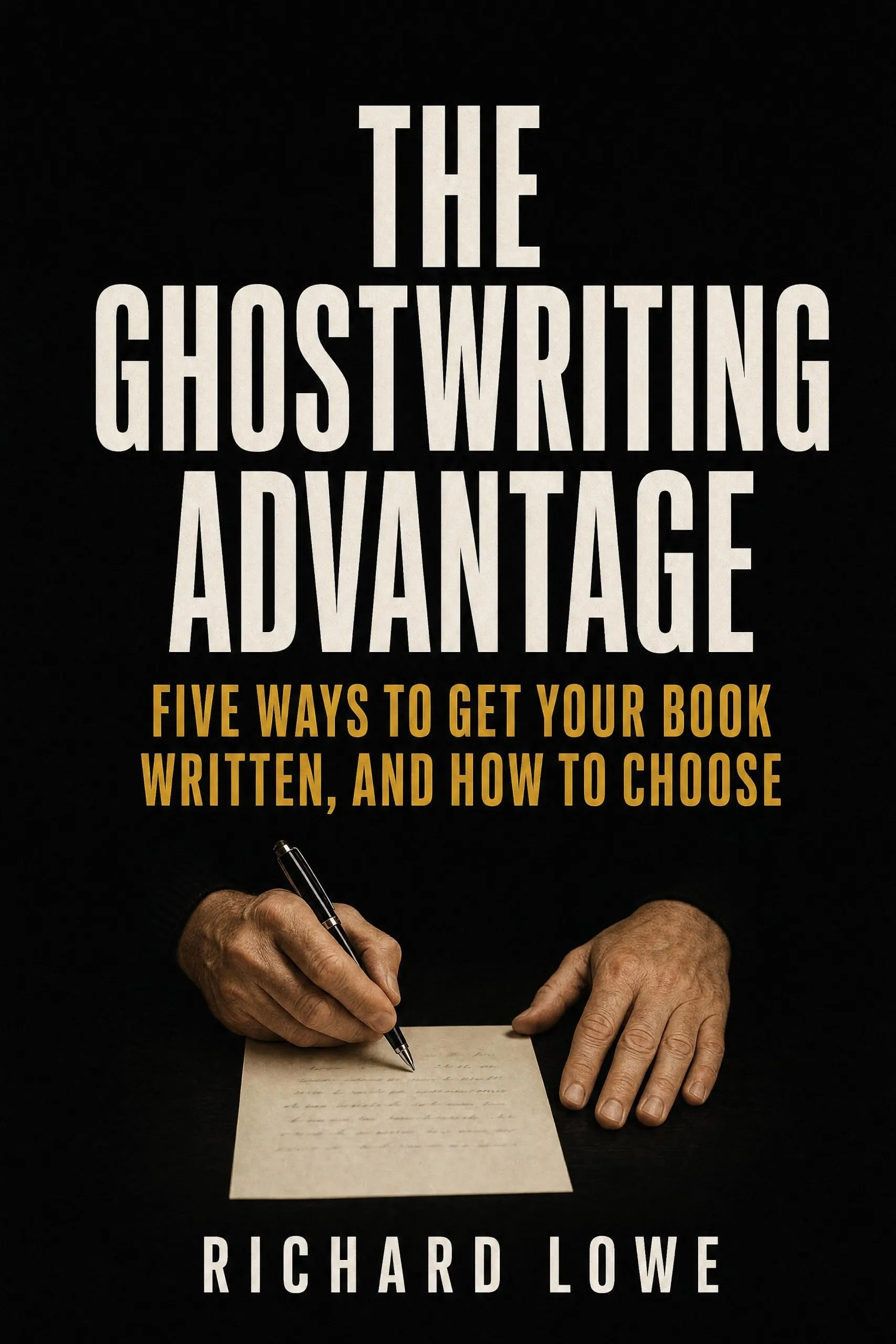
Delegate the writing and keep the ideas. The Ghostwriting Advantage is my guide to getting your book written for you, drawn from 54+ books I have ghostwritten for other people.
