TL;DR
6/10. Written when Paolini was fifteen, a hugely successful gateway fantasy that’s also openly derivative: a Star Wars plot over a Tolkien world with McCaffrey’s dragon-riders. Credit for teen-author ambition and real young-reader appeal, balanced against borrowed plotting and the prose limits of a young writer. A solid entry point to the genre, short of a classic.
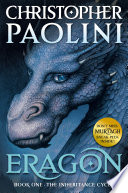
A teenage farm boy finds a mysterious stone that hatches into a dragon, the evil empire’s servants murder his uncle, an old mentor reveals himself as a member of a fallen order and gives the boy a sword, and together they set off to topple a tyrant.
If that outline sounds deeply familiar, that’s the central fact about Eragon: Christopher Paolini’s debut is at once a phenomenon, beloved by a generation of young readers, and among the most openly derivative fantasy novels ever to become a bestseller. An honest review has to hold both truths at once. The context is part of the story. Paolini began writing Eragon at fifteen, fresh out of homeschooling, and that fact cuts both ways, as unusual achievement and as explanation for the book’s limitations.
The derivativeness, named plainly
There’s no honest way around it: the plot is Star Wars with a Lord of the Rings paint job. The farm boy of humble origins, the murdered guardian, the wise mentor from a destroyed order of knights, the hidden lineage, the evil emperor, the climactic confrontation, these are the beats of Luke Skywalker’s story transposed to a fantasy world. That world, in turn, is heavily Tolkien: elves, dwarves, and an orc analogue sharing a continent, with a magic system built on an ancient language.
Add the dragon-rider bond lifted from Anne McCaffrey’s Pern, and the influences aren’t subtle homage but near-tracing. Critics who called it pastiche instead of originality had a real point, and a writer reading it as craft study should see clearly how much is borrowed.
Keep reading
Originality in fantasy: building on influences without copying them: Eragon is the cautionary case; this piece shows how to transform influences instead of tracing them.
Watch: Eragon in 15 Minutes, JP Kloess
Why young readers loved it anyway
And yet millions of young readers adored it, which an honest review must take seriously instead of dismiss. For a reader who hasn’t yet encountered the source material, the familiar archetypes aren’t stale but thrilling, the chosen-one quest and the dragon-rider bond work because they’re proven, resonant structures. The bond between Eragon and his dragon Saphira, conveyed largely through their mental connection, is engaging, and Paolini’s earnest, wholehearted commitment to his epic, free of irony or cynicism, is exactly what many young fantasy readers want.
As a gateway into the genre, the book has launched countless readers toward the fantasy that influenced it.
Keep reading
Writing young adult fantasy that hooks its readers: what Eragon gets right about young-reader appeal, in the craft of YA fantasy.
The teen-author question
The fairest lens is also the most double-edged: Paolini wrote this at fifteen. That makes the accomplishment, a complete, publishable, eventually bestselling epic fantasy from a teenager, impressive, and it also explains the weaknesses. The derivative plotting, the sometimes overwrought and adjective-heavy prose, the thinner characterization, the pacing that sags, are the marks of a talented young writer still absorbing his influences instead of transcending them. Judged as the work of a teenager it’s unusual; judged against the adult fantasy masters it imitates it falls well short.
Both judgments are true, and the book sits between them.
Is Eragon worth reading?
It’s a competent, earnest, hugely successful gateway fantasy whose appeal to young readers is real and whose derivativeness is equally real. It rates in the middle: credit for the productivity and ambition of a teenage author, for the pull of the dragon-rider bond, and for its proven power to bring young readers into the genre, balanced against plotting lifted almost wholesale from Star Wars, a heavily borrowed Tolkien-style world, and the prose and character limitations of a very young writer.
For its target young-reader audience it works; for an adult steeped in fantasy it’ll read as familiar to the point of pastiche. A solid entry point, not a classic, and honest about being both.
Explore the hub
The Entertainment Hub: fantasy fiction and the books that shaped the genre, gathered in one place.
Frequently Asked Questions
Other Books From – Science Fiction


About the author