TL;DR
6/10. The best of the major dictionaries for a serious writer. Its depth and precision serve the craft of choosing words. Distinctions between near-synonyms. Fuller senses. Etymology. A learner’s or basic dictionary doesn’t. British-English oriented, and like any print dictionary outpaced for currency by free online resources, including Oxford’s own.
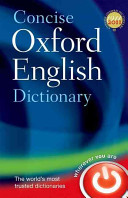
The Concise Oxford English Dictionary is, by reputation and substance, one of the finest single-volume dictionaries in the language, the compact descendant of the great Oxford English Dictionary, and this centenary edition aims to present the most accurate picture of current English. Reviewed as a writer’s tool, it’s excellent. The question is whether a serious print dictionary still earns desk space in a working writer’s life. The answer is a real but qualified yes.
Unlike a learner’s dictionary, the Concise Oxford is built for fluent, demanding users. That makes it the most relevant of the major dictionaries to a professional writer. Its authority is solid, and Oxford’s lexicographical standards are the gold standard. Of the dictionaries on this shelf, it impresses me most, and it still gets a middling score from me, because print keeps losing ground and no amount of Oxford craftsmanship fixes that.
What sets it apart
For a writer, the Concise Oxford’s strengths are depth and precision. It offers more nuance than a learner’s dictionary. Careful distinctions between near-synonyms. Fuller treatment of senses. Attention to etymology and usage. That’s the kind of detail a writer reaching for exactly the right word wants. A basic dictionary confirms a spelling. The Concise Oxford helps a writer choose between words that mean almost but not quite the same thing. That’s where real prose precision lives.
It’s a reference for someone who cares about the difference between words, meaning, for a writer.
Keep reading
Word choice: picking the right word, not just a correct one: the precise distinctions a serious dictionary supports, in the craft of word choice.
The pedigree behind it
Part of what a writer is buying is lineage. The Concise Oxford is the compact, working descendant of the full Oxford English Dictionary, the most authoritative record of the English language ever assembled, and that scholarly heritage shows in the care of its definitions and the reliability of its usage judgments.
When a writer needs to know both what a word means and how it’s properly used, what tone it carries, whether a sense is current or archaic, how it differs from its near neighbors, the Oxford lexicographical tradition is the one most likely to answer correctly. For prose where word choice carries real weight, that authority is worth something a quick online lookup of a crowd-sourced definition can’t reliably match.
The trade is depth and reliability against currency and convenience, and for a writer who treats words as tools of precision, the depth side of that trade has real appeal even in a digital age.
British English, and the centenary question
Two practical notes. As an Oxford dictionary it reflects British English conventions and spelling, so an American writer should be aware it’ll give color and organize as standard, useful to know depending on the market you write for, though Oxford’s coverage is international. And as a print reference, even a centenary edition faces the same currency problem as any physical dictionary: language moves, new words and senses arrive, and a printed volume is frozen at its publication date while Oxford’s own online dictionary keeps updating.
The print Concise Oxford is a snapshot of a moment, beautifully made, and it’s frustrating that Oxford’s own website makes its printed book look dated.
Keep reading
Grammar and usage: getting the small things right: the usage guidance a quality dictionary supports, in the wider picture of correctness.
Is Concise Oxford English Dictionary worth reading?
It’s the best of the major dictionaries for a serious writer’s purposes, because its depth and precision serve the work of choosing words well, where a learner’s dictionary or a basic paperback doesn’t. That lifts it above the other dictionaries on this shelf. But it shares their fundamental limitation: a print dictionary, however excellent, is outpaced for currency by free online resources, including Oxford’s own, and the British-English orientation is a consideration for American writers.
It deserves a solid middle place, useful and a pleasure to own for a writer who values word precision, while honest about the print format’s limits. It’s the finest dictionary here, and it’s a damn shame the best one in the stack still can’t answer why anyone needs print.
Explore the hub
The Writing Hub: word choice, reference, and the rest of the craft, gathered in one place.