
TL;DR: Every AI-assisted project drifts the same way. Over weeks of casual use, the line between machine and human work slides toward the machine, and by the time you notice, the content has lost the voice that made it worth reading.
I’ve got nothing against AI on a book project, and I’d be a hypocrite if I did. What I can’t stand is the slow slide where a writer stops checking and the machine takes over the prose. Drift has specific signs, and a simple monthly check will catch it before your readers do.
What does AI drift look like?
Nobody starts an AI-assisted project planning to let the machine take over. The line is clear at the start. Voice stays human.
Mechanics run through the machine with verification. The discipline is real and the work is better for it. Then something happens. A deadline arrives. For more, see AI Isn’t a Fad and Will AI replace my work? The answer depends on the structure of what you do.
Nobody starts an AI-assisted project planning to let the machine take over.
The machine drafts a chapter that was supposed to be human-written, and someone “lightly edits” it, with the rewrite step compressed. The shortcut produces an okay result and goes unnoticed. The next time something is due, the same shortcut feels easier to take. how I keep voice human Within a few months, the line that was clear has moved, and the content is increasingly machine-produced with human polish on top.
That drift is the predictable failure mode of every AI-assisted practice, and it ruins more projects than any other. The fix takes a habit: check where the line is now against where it was supposed to be, and bring a human back into the work the moment the check fails.
What are the signs AI has crossed the line?
Five specific signs indicate drift has happened and a human needs to come back in. The first is that you can’t remember writing the sentences. A reader’s question prompts you to look up your own work, and you read it as if you’ve never seen it before. That’s not normal forgetting. The sentences you wrote yourself live in some recognizable part of memory. Sentences you generated through AI and lightly edited don’t. The unfamiliarity is the signal.
The second is that you could swap two recent pieces of your content and nobody would notice. If you could move your last newsletter into your last article without anyone catching the gear shift, the voice has flattened across both. The third is that you’re catching yourself approving drafts that “are close enough” instead of rewriting them into voice. That phrase “close enough” is the warning sign. The fourth is that the engagement metrics that used to track your content, opens, replies, shares, are sliding.
Audiences notice voice drift faster than authors do, and they vote with their attention. The fifth is that you find yourself producing more volume but enjoying it less. The work that felt creative now feels like supervising a machine, the symptom of having become the editor of your own AI output instead of the writer.
What do you gain by bringing a human back into AI work?
The fix is to identify which sections of your current work crossed the line and rewrite them by hand. Not lightly. By hand. From the source material, without looking at the AI draft, in your voice, the way you would have written them in the first place. The first piece is slow because you’re reestablishing the habit. The second is faster. By the fourth, you’re producing voice-driven content at something close to the original speed, and you can feel the difference immediately. So can the audience.
The thing you get back is the human voice in the prose that the machine drains away under any sustained use. That voice made the book worth writing and what makes the content system worth running. The recovery is fast once you commit to the rewrite, and the engagement metrics often follow within a few weeks because audiences feel the return of voice before they consciously name it.
The main piece on the voice rule walks through why the voice matters, and the recovery process is the same one that keeps the voice rule working in the first place.
What diagnostic catches AI drift early?
The simplest diagnostic is a monthly review. Read everything you published in the last thirty days. Mark every sentence that doesn’t sound like you, every paragraph that feels generic, every piece where you can’t remember writing significant portions. The marks are the drift, and the volume of marks tells you how far the line has moved.
A monthly review with zero marks means the line is holding. One piece with marks means the line wobbled and you need to rewrite that piece.
Marks across most of your output mean the line has crossed entirely, and the next month should be dedicated to rewriting the source material by hand and resetting the workflow. The review takes an hour. The cost of skipping it is the slow erosion of the asset your book and your content were supposed to build.
What the rule looks like across a working practice
The rule that’s run through this entire series, AI never writes in your voice, sounds simple when stated. As a statement, it’s simple. As a practice across months and years, it’s hard, because every shortcut and every deadline pushes against it. The practitioners who hold the line treat the line as a habit instead of a principle. They check it monthly.
Early signs of drift get noticed. Humans come back in the moment a check fails. “Close enough” never becomes the standard.
Authors who hold the line produce books readers finish, content that builds authority, and practices that grow over years.
Authors who let the line drift produce competent content that disappears into the average AI output of the moment, and they wonder why their audience eroded. The difference is the willingness to do the check, notice the drift, and bring humans back into the work. That’s the entire model, and the model works for any author who runs it.
My take
Read every piece you published in the last thirty days, once a month, and mark anything that doesn’t sound like you. A few marks mean you rewrite that piece. Marks everywhere mean the line has moved and next month goes to rewriting by hand. The review takes an hour. Drift slides toward the machine one deadline at a time, and nobody notices until the voice is gone. Treat the check as a habit.
The real closer
AI on a book or a business is an ongoing discipline that holds a line between machine and human work, with the line moving constantly under the pressure of convenience. The job of the author is to keep the line where it should be. That means doing the unglamorous work of checking, noticing, and rewriting when the check fails.
The reward for doing that work is that your book and your content keep sounding like you across years, while the work of authors who let the line slip starts sounding like every other AI-generated business blog from 2025.
I think letting the line slip is the most expensive shortcut an author can take, and it gets sold as efficiency far too often. The hours the machine saves you come back as readers who quit halfway through and never buy the next book. Keep the line where it belongs, check it every month, and the AI on your project will save you real time without taking your voice with it.
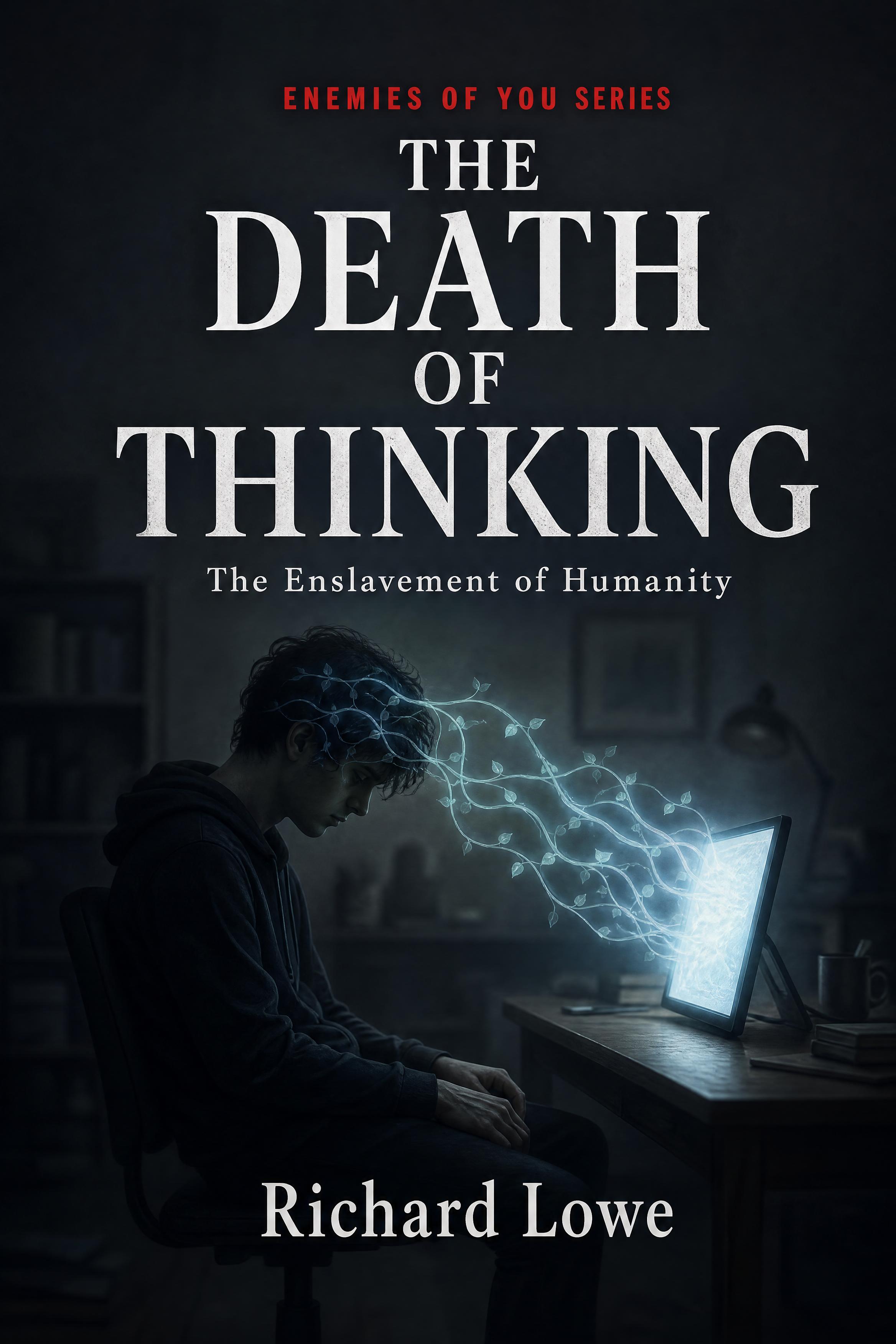
Every slide toward the machine feels reasonable at the time. The Death of Thinking is my book on how those small handoffs add up to a loss you only notice later.
