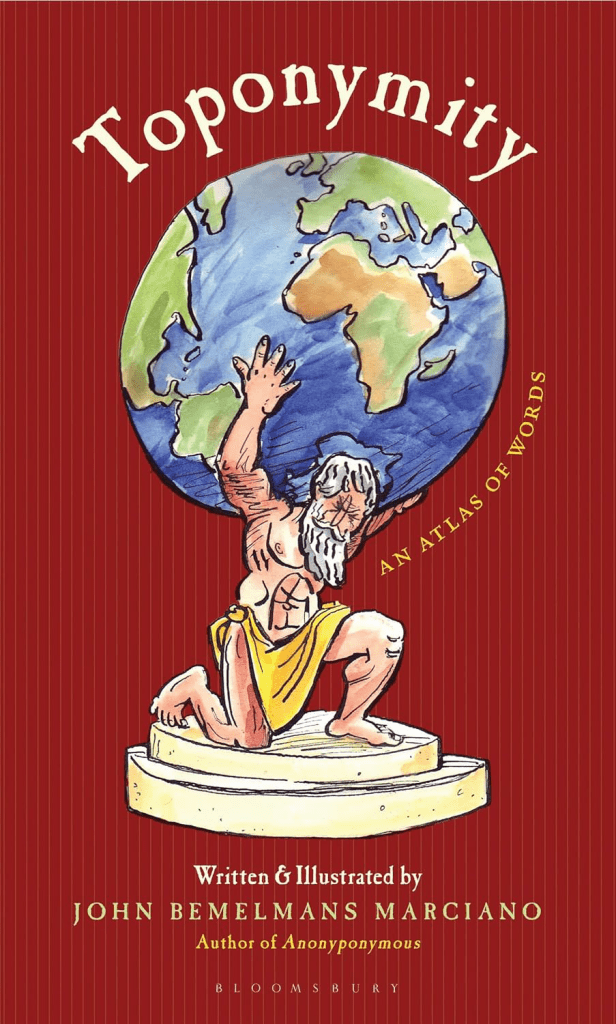
TL;DR
7/10. A witty, enjoyable popular etymology with a distinctive focus, exploring the surprising geographic origins of everyday words from frankfurters to bikinis and revealing how much of the map is hidden in the dictionary. A solid, delightful slice of etymology that complements the broader word-origin books, held to the middle by its narrow-theme, popular-entertainment nature.
Toponymity by John Bemelmans Marciano is a witty, browsable exploration of toponyms, common words that come from place names, showing the hidden linguistic heritage of everyday terms derived from places, from frankfurters and hamburgers (Frankfurt and Hamburg) to tuxedos (Tuxedo Park) and bikinis (Bikini Atoll). In the entertaining tradition of popular word-origin books, it reveals the surprising geographic stories behind words we use without a second thought, a pleasure for anyone curious about language.
As a focused, enjoyable popular etymology of place-derived words, it does its delightful job well and deserves a solid rating, distinct from the broader etymology books by its theme. The narrow focus is the charm. By zeroing in on words born from places, Marciano turns a single linguistic category into a tour of geography, history, and the odd ways places leave their names on the language.
The places hidden in words
The book’s pleasure is in the surprise of recognition, learning that words we use constantly carry forgotten geographic origins. Marciano gathers the stories behind toponyms across food, fashion, and everyday objects. Each one shows how a place lent its name to a thing, often through history a reader never knew. The cumulative effect is a delightful awareness of how much geography is hidden in plain sight in ordinary language. Like the best popular word-origin books, it informs while it entertains, turning etymology into a series of small, satisfying discoveries.
For anyone who enjoys language and its odd histories, the lens of place-derived words gives a fresh, focused source of those pleasures.
Keep reading
The hidden geographic origins of everyday words: the place-derived words Marciano uncovers, in the craft of richer language awareness.
A focused take on word origins
What distinguishes Toponymity from the broader etymology books is its narrow, thematic focus.
A general word-origin book ranges across all of language. This one concentrates entirely on toponyms, words born from places. That gives it a coherence and a particular flavor, a tour through the phenomenon of places becoming words. That focus connects language to geography and history in a distinctive way, showing how the map is embedded in the dictionary, and it makes the book a complement instead of a duplicate of more general etymological reading.
For a writer, the deeper benefit is the same as with any good word-origin book: a heightened awareness of and delight in the language. That sharpens the instinct for words and their hidden textures.
Explore the hub
The Writing Hub: language, word origins, and the craft of writing, gathered in one place.
What are the weaknesses of Toponymity?
The caveats are gentle and inherent to its nature. It’s a popular entertainment built on a narrow theme, so its appeal, while real, is specific: a delight for the language-curious and largely irrelevant to anyone indifferent to word origins, and even within etymology it covers one slice instead of the whole field. As a themed browse it’s also for reading and enjoyment instead of reference or instruction, offering pleasure and small enrichment instead of practical writing help.
And its single-theme focus, charming as it is, means a little repetitiveness of structure across entries. These are simply the characteristics of a focused popular etymology instead of flaws, and for the right reader it’s a pleasure.
Is Toponymity worth reading?
It’s a witty, enjoyable popular etymology with a distinctive focus, exploring the surprising geographic origins of everyday words from frankfurters to bikinis, and revealing how much of the map is hidden in the dictionary. It deserves a solid rating for doing its delightful job well and for offering a fresh, themed angle that complements instead of duplicates the broader word-origin books.
It’s held to that level by its inherent nature: a narrow-theme popular entertainment whose appeal is real but specific to the language-curious, for enjoyment instead of reference, with a touch of structural repetition. For a reader or writer who loves language and its odd histories, it’s a charming, enriching browse; for others, a curiosity. A sound, delightful slice of etymology, fairly judged for what it is.
Explore the hub
The Entertainment Hub: language, curiosities, and the pleasures of words, gathered in one place.
Frequently Asked Questions
Other Books From – Writing and Language




About the author