
The Meaning Behind My Tattoos: Phoenix, Dragon, and Hidden Power
Some stories mark you permanently. My interest in tattoos began with unexpected encounters and led to lessons about art, meaning, and the courage to wear your story on your skin.
A Tattoo Show Revelation
Her smile was warm and immediate. “Sure. Let me show you the whole thing.”
Without hesitation, she dropped her robe entirely. Completely. She stood there in the middle of the convention, utterly unashamed.
My brain short-circuited for several seconds. She laughed when she saw my expression. “What’s the matter? It’s just skin. Aren’t you here for the tattoos?”
The question hit deeper than she probably intended.
I’d been thinking of tattoos as decorations instead of transformations. Standing before me was someone who had turned her entire body into a living canvas, and she wore that art with a confidence I’d never encountered. Her body told stories through ink: sprawling landscapes that seemed to move across her skin, delicate patterns that spoke of cultural heritage, bold symbols that marked significant moments.
Every inch revealed another chapter. This wasn’t body modification. This was autobiography written in permanent ink.
I focused on the camera work, capturing her living gallery while making conversation about the craftsmanship. She posed with obvious pride, turning to reveal different angles and stories, though the absurdity of the situation wasn’t lost on either of us. Every few minutes, she’d chuckle at my continued amazement. By the time I finished, we were both laughing.
She pulled her robe back on, thanked me for appreciating her art, and walked away, leaving me with some of the most memorable images of the day. Her comfort in her own skin stayed with me long after the convention ended.
The Artist Who Taught Patience
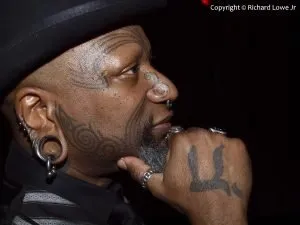 When I first approached Roni Zulu with my tattoo concepts, I knew he was the artist I needed.
His reputation preceded him: he treated tattooing as a personal and spiritual experience as much as a craft. Based in Beverly Hills at the time, he’d already earned recognition among the industry’s finest, and his philosophy struck me more than his fame.
I entered his studio with clear visions for two large tattoos covering my upper arms: a phoenix on one and a dragon on the other. Both were symbolic representations of who I was and the years that had brought me to his chair.
I expected Zulu to grab sketching materials and start drafting ideas. Instead, he did something unexpected. He listened. For an entire hour, we talked.
I shared the story of my wife’s passing, how her loss had reshaped my understanding of life, and why the phoenix felt like the right representation of my rebirth from that experience. I explained how the dragon wasn’t just a mythical creature to me.
It embodied power, intelligence, and the resilience I’d discovered within myself. Zulu listened, asking questions that forced me to articulate exactly what these tattoos would mean to me personally.
Then, instead of sketching, he leaned back with a knowing smile and said: “Wait six months.” “Think about it,” he continued. “These tattoos are permanent. You’re going to carry them for the rest of your life. Make absolutely certain they represent exactly what you want to say.”
Those six months weren’t a waiting period. They became an opportunity to think over my ideas, to make sure the designs fit the story I intended to tell. When I returned half a year later, I was ready.
Zulu saw tattoos as transformations you undergo. His insistence on waiting was about honoring the permanence of the work.
Looking back, I’m grateful he made me wait. Grief pushes you to do something, anything, and the last thing a grieving man should rush is a decision he’ll wear on his skin for the rest of his life. Zulu understood that before I did, and those six months made the phoenix mean what it means to me today.
The Phoenix: Rising From Ashes
The phoenix became our first project. When my wife passed away, it felt as though my entire world had been reduced to ashes.
The person I’d been, the life we’d built together, seemed to vanish. Grief doesn’t just knock you down. It burns through every aspect of your existence, leaving you to figure out how to rebuild yourself into someone new.
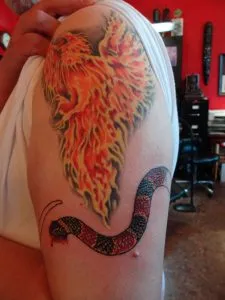 The phoenix became my symbol of that transformation. Finding the strength to rise from devastation and create something meaningful from the ruins of loss. When I explained this to Zulu, he nodded with immediate understanding.
Instead of showing me existing designs or suggesting preliminary sketches, he picked up a marker and began drawing directly onto my arm. No stencils, no safety nets. Just his steady hand and his ability to visualize the story I wanted to tell.
As it emerged, the phoenix wasn’t simply a mythical bird in flames. Every feather seemed to hold significance. The wings spread wide across my upper arm, positioned as if ready to lift me skyward.
The flames, rendered in detailed swirls and curves, danced around the bird. They symbolized both destruction and renewal. This was my phoenix, my story of transformation made visible.
Mardhavi: The Beautiful Tormentor
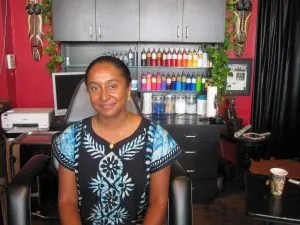 The process tested my pain tolerance, and that’s where one of my dearest friends proved both essential and merciless. Mardhavi, a beautiful Bharatanatyam dancer from Sri Lanka, had accompanied me to the studio with a mission: to laugh at my suffering. She’s one of those friends who combines real care with relentless teasing. With the grace that comes from years of classical Indian dance, she settled into a chair with the perfect vantage point to witness my ordeal, her eyes already sparkling with mischievous anticipation.
“You know,” she said as Zulu prepared his equipment, “in Bharatanatyam, we learn to control every expression, every gesture. Pain becomes part of the art.” She paused, grinning. “But I have a feeling you’re going to give me quite a show.”
She was right. The moment Zulu’s needle touched my skin, I tensed up. The sensation was more intense than I’d anticipated, and I must have made some involuntary sound because Mardhavi burst into delighted laughter.
“Already? We’ve barely started!” For the next several hours, she provided running commentary on my reactions that was both humiliating and oddly comforting.
Every flinch got a giggle. Every gritted tooth got a knowing chuckle. Every sound of discomfort sent her into full laughter.
“You’re not actually crying, are you?” she asked at one especially tender moment. “I mean, it’s just a bird.” Here was this graceful artist, whose own discipline required great physical control and endurance, finding endless entertainment in my considerably less graceful responses to pain.
“In my dance,” she explained during a brief break, “we tell stories of gods and goddesses, of triumph over suffering. But those stories are much more elegant than this.” She gestured at me with theatrical flair. “This is more like comedy.”
Even Zulu couldn’t help smiling. “She’s got a point. Though I have to say, you’re taking it better than most.”
“Don’t encourage him,” Mardhavi protested. “He needs to suffer for his art. It’s traditional.”
Her teasing was relentless, but it helped. Every time I wanted to focus on the discomfort, she’d crack a joke that reminded me why I was there. Her laughter became part of the experience, transforming what could have been an ordeal into something oddly joyful.
“You know,” she said as we neared the end of the session, “in our classical stories, the heroes face their trials with dignity and grace.” She paused. “Clearly, those stories are fiction.”
By the time the phoenix was complete, we were all laughing. When I saw the finished piece in the mirror, it took my breath away.
The wings seemed to extend beyond the tattoo’s boundaries. The flames didn’t just burn. They moved. Zulu had captured the phoenix’s image and the spirit of what it represented.
The Dragon: Embodiment of Inner Strength
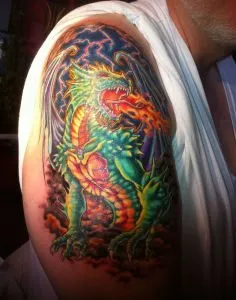 After the phoenix, we moved to the dragon. If the phoenix symbolized transformation and rebirth, the dragon stood for inner strength and the wisdom I’d built through experience. Dragons have always fascinated me beyond their mythical status. In the stories that shaped my imagination, dragons were wise, commanding, and powerful. They didn’t need to roar to inspire respect. Their presence was sufficient. The dragon was who I aspire to be. Zulu approached it with the same freehand method. He picked up his marker and began drawing directly on my skin, the dragon taking shape as though it had been waiting to emerge all along. The head, fierce yet regal, rested near my shoulder, its eyes conveying intelligence and barely contained power. The body coiled down my arm, each scale carefully rendered. The tail wrapped around my bicep, completing the design in a way that felt both natural and authoritative. If Mardhavi had been merciless during the phoenix session, she was diabolical for the dragon. Having studied my pain tolerance during the first tattoo, she now knew exactly which buttons to push. “Oh good,” she announced as she settled into her chair. “The sequel.”
The dragon’s larger size and detailed detail took the discomfort to a new level. The session stretched longer than the phoenix. This gave Mardhavi ample opportunity to perfect her art.
“Isn’t the dragon supposed to be tough?” she teased after a sharp intake of breath on my part. “I don’t think dragons whimper. Maybe you should ask Zulu to make it a baby dragon instead?” She showed what I apparently looked like, contorting her features into an exaggerated grimace that had even Zulu chuckling.
“She makes a valid point,” Zulu said, his voice calm and steady. “Though the dragon is looking fierce. Much fiercer than its owner.”
“I think,” she announced toward the end of the session, “that this dragon represents your inner drama queen more than your inner strength. But don’t worry. That’s probably more accurate anyway.”
By the time Zulu finished, my arm felt like it had survived an epic battle, but my spirits were high. Mardhavi’s relentless friendship had turned pain into comedy.
The Coral Snakes: Visible Power
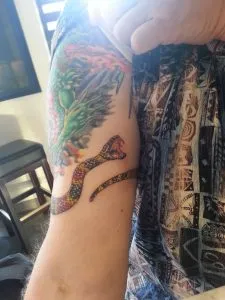 To create visual and symbolic unity between the phoenix and dragon, Zulu suggested adding coral snakes that would encircle both arms. Bold red, yellow, and black bands that are at the same time beautiful and dangerous. For me, they represented visible power, the kind that commands attention and respect without needing to prove itself through aggression.
Zulu used the same freehand approach, sketching the snakes directly onto my skin. The way he wrapped them around my arms gave the design dynamic movement, as though the snakes were alive. Their placement tied the separate tattoos together, creating a cohesive narrative across both arms.
He also incorporated a deliberate break in the pattern. He explained that in certain spiritual traditions, a closed loop can symbolically trap the soul. By leaving a small gap, the design allowed for freedom of spirit and energy.
That subtle detail added depth that made the tattoos feel even more personally significant. It reminded me that power should never confine your essential nature.
The colorful bands demanded precision to keep the colors bright and the patterns sharp. The result was bold. The coral snakes seemed to move with the natural contours of my arms, their vivid colors providing contrast against the black and gray tones of the phoenix and dragon.
The Black Widow: Hidden Strength
As we neared completion of the coral snakes, Zulu suggested one final addition: a black widow spider, subtly integrated into the existing design. I hesitated.
The phoenix, dragon, and snakes already felt complete. But Zulu explained his reasoning: while the coral snakes represented visible power, the black widow would symbolize hidden strength. The kind that doesn’t announce itself to be effective.
The black widow is an interesting creature. Small and unassuming, it carries an air of understated danger. It doesn’t flaunt its power or demand attention, but its presence commands respect and healthy caution.
For me, it became a symbol of the strength I’ve learned to wield strategically and discreetly. It reminds me that not every battle requires brute force. Sometimes the most potent power remains unseen until needed.
Zulu placed the black widow in a subtle location, positioned so it would be nearly hidden at first glance. Its small size contrasted deliberately with the boldness of the other elements. I love that the spider is the piece a casual glance misses. It was meant to add complexity, a detail you’d only notice on close examination, much like the hidden strength it represented, and I prefer it that way.
A Complete Story in Ink
What set all of this apart was Zulu’s freehand approach. Most tattoo artists rely on stencils. Zulu trusted his skill and instincts. Every line seemed effortless, yet the results were detailed and perfectly aligned with the natural contours of my arms.

Roni Zulu, the artist behind every piece of ink on my arms. Copyright © Richard Lowe.
The freehand method gave the tattoos fluidity and a natural feel that stencils can’t replicate. He didn’t just draw. He listened, asked questions about my life and experiences, and made every element intentional. I’ve seen plenty of arms covered in pieces that have nothing to do with each other, one design slapped down next to the last like stickers on a laptop. Mine tell one story across both arms, and that’s entirely Zulu’s doing.
My phoenix speaks of transformation and rebirth, of rising from loss. The dragon stands for strength and power. The coral snakes represent the power I project openly. The black widow represents the quieter, strategic side. Together, they’re chapters of my life story, woven into a narrative I carry every day. Thanks to Zulu’s artistry and Mardhavi’s relentless, loving mockery, the experience became something I’ll never forget.
Of everything I’ve written, these are the only pages I can’t set down. My wife’s death, the man I had to rebuild afterward, the strength I show and the strength I keep in reserve, all of it rides along every time I roll up a sleeve. Getting it hurt like hell, and Mardhavi made sure I never forgot how much I complained. I wouldn’t trade a minute of it.