TL;DR
6/10. A scholarly encyclopedia of Frank Herbert’s Dune saga, its characters, terms, and concepts. Useful for Dune scholars and devoted fans, marginal for working writers. Its main lesson is indirect: deep world-building eventually generates its own scholarship, and a complex series needs an internal bible from the start.
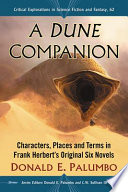
A Dune Companion by Donald E. Palumbo is a scholarly reference book, an encyclopedia of the characters, concepts, terminology, and places of Frank Herbert’s Dune saga, published by the academic press McFarland. Reviewing it for a working writer instead of a Dune scholar means being clear about what it is and isn’t. This is a specialized tool with a narrow audience, and most writers don’t need it. What impresses me is what it says about Herbert: he wrote a novel so dense that academics had to build a dictionary for it.
It’s a concordance. An alphabetical guide to the vast invented vocabulary and dramatis personae of Herbert’s universe. It’s the kind of apparatus a dense, world-heavy saga generates around itself once enough scholars and devoted readers want a map to its complexity.
What it is for
The book’s purpose is reference. If you’re studying the Dune saga seriously, writing about it, teaching it, or simply trying to keep its sprawling terminology and cast straight across six dense novels, a companion like this is useful. It collects in one place what Herbert scattered across thousands of pages. The definitions. The genealogies. The political factions. The invented concepts. That saves you the labor of assembling them yourself.
Keep reading
World building for fiction writers: obsessive world-building done right: Dune generated its own encyclopedia. What that says about the depth of Herbert’s world-building.
The indirect lesson for writers
It’s worth a working writer’s attention for one reason, even though the book itself is a reference few will read cover to cover. The mere existence of a scholarly companion to a novel is a kind of achievement report on the original’s world-building. You don’t get an encyclopedia written about a thin world. That Dune generated enough internal complexity, terminology, history, and conceptual depth to warrant a full academic concordance is itself a measure of how thoroughly Herbert built his universe.
For a writer, the companion is indirect evidence of the standard set by the original: build a world deep enough and it acquires the gravity to pull scholarship into orbit around it.
There’s a quieter, practical lesson too. A saga as dense as Dune almost requires this kind of apparatus for its own author to maintain consistency. The companion is what a reader assembled after the fact, but Herbert needed something like it while writing, a bible of his own invented terms and relationships, to keep the world coherent across six books. Any writer building a complex series should take the hint: the encyclopedia a scholar might one day write is the document you need to keep for yourself from the start.
That document, the series bible, is the transferable takeaway, and it’s worth dwelling on because so many writers skip it and pay for it later. As a story grows across volumes, the writer’s memory of their own invented details, who said what, how a piece of technology works, the spelling of a minor character’s name, how many years passed between events, becomes unreliable, and inconsistencies creep in that sharp-eyed readers catch and that erode the world’s credibility. Few things in a long series annoy me more than a detail that shifts between books, because it tells me the author stopped paying attention. A running internal reference, updated as you invent, is the cure.
It need not be elegant; it needs only to be complete and searchable. Seeing a finished scholarly companion to Dune is a useful jolt for a writer because it shows the end state of all that tracking, the full map of a world that one person had to hold in their head while building it. The lesson isn’t to read this book, but to start keeping your own version of it before your series grows past the point where you can reconstruct it.
Keep reading
Writing a series: how to plant and pay off across multiple books: a complex saga needs its own internal bible. Why a series writer should build one.
What are the limits of A Dune Companion?
For the vast majority of writers, this book is simply unnecessary.
It’s a reference for one existing work, not a craft guide, and it teaches nothing about writing directly; its lessons are entirely indirect and could be absorbed in a sentence. It’s also priced as an academic title, meaning expensive for what a non-scholar would get from it. Unless you’re doing serious work on Dune, you don’t need it, and even the world-building lesson it illustrates is better learned from the novels themselves.
Is A Dune Companion worth reading?
As a piece of Dune scholarship it’s a competent, useful reference for its narrow audience of students, scholars, and devoted fans. As a book for working writers it’s marginal, valuable mainly as a demonstration of what sufficiently deep world-building eventually produces, and as a nudge to keep your own series bible.
It deserves a place on the shelf only for the Dune specialist or the writer who collects examples of world-building taken to its scholarly limit. For everyone else the book is overkill. The idea behind it, a bible you keep from day one, is worth far more to a novelist than the book itself.
Explore the hub
The Writing Hub: world-building, series craft, and the rest, gathered in one place.