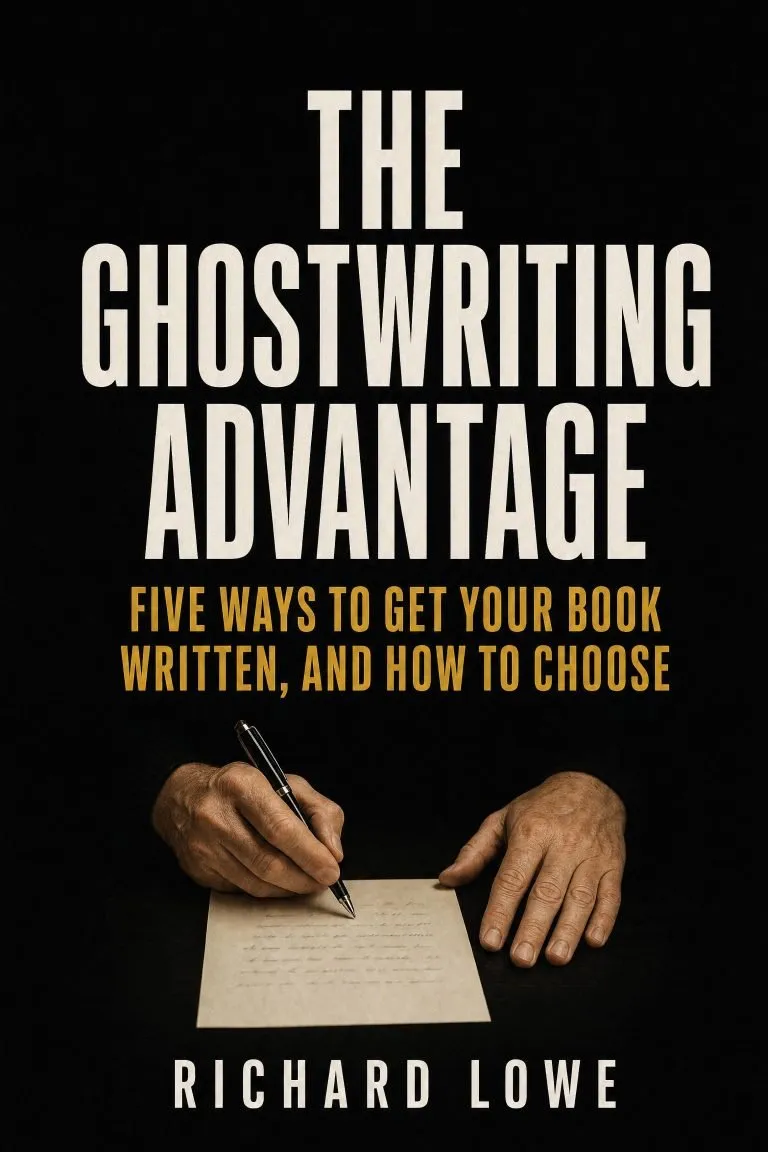
Search broke in half, and everyone told you it was the best thing that ever happened to you. For twenty-five years there was one way to be found online: rank, get listed, get clicked. Now the box answers. You ask a machine which ghostwriter, which laptop, which contractor, and it hands back a name instead of a list. An answer has no page two. Either the machine names you, or it names someone else, and you never find out you were skipped.
The Day Your Website Died is different.
Richard Lowe spent years getting websites to rank and got good at it. Then the traffic changed shape, so he went looking for a clear account of how AI search actually decides who gets named, and could not find one. This book is the one he assembled instead. Not theory. Not recycled SEO advice with the word AI stapled on. What he did to his own identity online, what happened when he did it, and what he learned on a long, twisty, genuinely rewarding road, from a man who can build the schema and read the server logs as easily as he can write the prose.
The book opens with the proof instead of the promise. A client hired him for a substantial book project and, when asked how he found him, said he had asked Perplexity for a ghostwriter with a technical background. It happened again a few weeks later, with ChatGPT. Neither client typed a query and scrolled a list. And here is the part that matters: at the time, none of the heavy work in this book had been done. A sound foundation was already enough to get named. Chapter by chapter, the rest of the book is how you stop leaving that to chance. The anchor schema block that says who you are, sameAs as the equals sign of the web, Wikidata and the hard identifiers, the density principle that explains why corroboration multiplies instead of adds, rebuilding a page so a machine can lift it, the evidence that earns a citation, listings and reviews, YouTube and GitHub and Reddit and Quora, reading your own server logs to confirm the crawlers can reach you, and how an entity gets poisoned and defended.
Throughout, Richard writes from what he actually measured. The book includes firsthand log data showing which bots came and what they read, the accidental block that hid the work for weeks, the stale cache lesson, the two clients the engines delivered, and the finding that a single check of any engine tells you almost nothing because the same question run twice returns different names. It also goes where books like this refuse to go: a full chapter on the honest limits, on what barely moves the needle and what works far more slowly than anyone selling this admits, and a plain warning that Wikipedia is earned rather than pursued and that forcing it is worse than skipping it.
And it is built for the reader who sees the word schema and quietly decides the whole thing is over their head. There is a note at the front written for exactly that person. Almost everything genuinely hard in this book is hard in a technical way, and the technical parts are the parts you hand to someone else. What only you can do is decide the settled facts about your business and say them clearly. Forty-two chapters, a glossary, a full sources appendix, and a one-page operating card.
For anyone who has spent years earning a place in a list that fewer people are reading.
Questions
Read the Preface
I have spent a long time getting websites to rank, and I have been good at it. That is search engine optimization, and like anyone who has done it for years, I have ridden its ups and downs. You learn the rules, the rules shift, you learn them again. Over time I got pretty good at the whole dance.
Then the traffic started to change. Not all at once, and not in a way that set off alarms at first, just a shift in the shape of it. So I did what I always do when something changes. I started reading. I started reading about AI, and from there about answer engine optimization, and I found a whole different world.
This book is the compilation of what I learned on that journey. It has been a long and twisty road, and an interesting one, and so far a successful one. I wrote it because I went looking for a clear account of how this actually works and could not find one, so I assembled the one I wish I had been handed at the start.
I want to set one expectation before you begin, because it is the thing that surprised me most and the thing most likely to throw you. This is not like SEO. With SEO there is, eventually, a kind of big bang. A day arrives when Google decides to rank you, and the traffic shows up. AEO does not work that way. There is no single moment, no flip of a switch, no morning you wake up ranked.
What happens instead is quieter. You get a trickle here and a trickle there. An engine names you in one answer, then another. And before you quite notice it has happened, you are seeing more traffic in certain areas, more of the right people finding you, more conversations that started with a machine recommending your name. It builds the way trust builds, slowly and then suddenly. If you are used to the big bang, the trickle can feel like nothing is happening, right up until you look back and see how far it carried you.
That slow, twisty, genuinely rewarding road is what this book is about. Here is what I learned walking it.
Other Books From – Business & Economics




About the author