
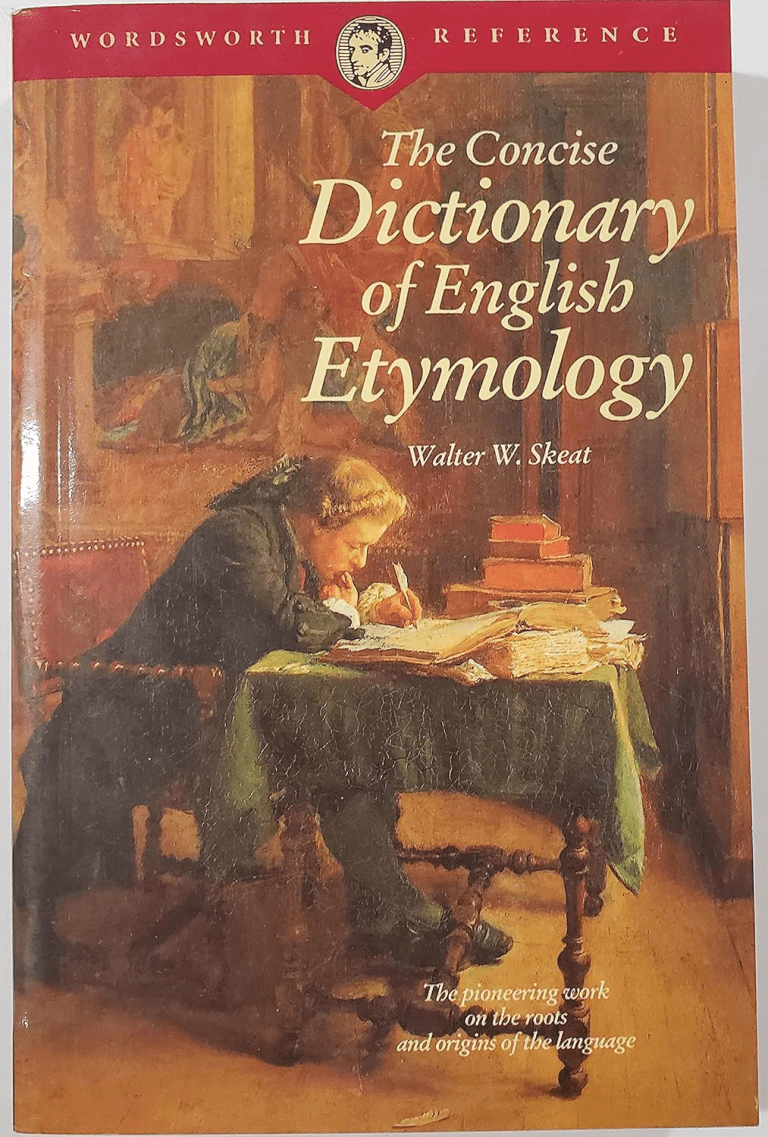
Walter William Skeat (November 21, 1835, London to October 6, 1912, Cambridge) was a British philologist and Anglican deacon and the pre-eminent English etymologist of his time. As Elrington and Bosworth Professor of Anglo-Saxon at the University of Cambridge from 1878 until his death, he was instrumental in developing English language and literature as a higher-education subject in the United Kingdom and a founding-generation Fellow of the British Academy.
He was educated at King's College School Wimbledon, Highgate School, and Christ's College, Cambridge, where he was elected a fellow in July 1860. His principal monument is An Etymological Dictionary of the English Language (Clarendon Press, first edition 1882, fully revised fourth edition 1910), which appeared two years before the first fascicle of the Oxford English Dictionary and ran in parallel with James Murray's OED throughout the major working decades of late-Victorian English lexicography. The two projects shared sources, the two men were trusted friends throughout, and Skeat's death in 1912 was, by Murray's own account, a heavy blow to the OED project. His shorter A Concise Etymological Dictionary of the English Language (1882, multiple revised editions through 1911) brought the same scholarship to a broader audience. He coined the lexicographer's working term ghost word for a word that came into existence not by long-standing usage and not by deliberate coinage but only as the result of a transmission error.
He produced the standard scholarly editions of Geoffrey Chaucer (Complete Works of Geoffrey Chaucer, six volumes, Clarendon Press, 1894-1897) and William Langland's Piers Plowman, the latter in three parallel texts published in 1886, both of which remained the standard scholarly editions of those poets for most of the twentieth century. He completed Mitchell Kemble's edition of the Anglo-Saxon Gospels and did extensive working editorial labor in Anglo-Saxon and Gothic. For the Early English Text Society he edited The Bruce of John Barbour, Pierce the Ploughman's Crede, the romances Havelok the Dane and William of Palerne, and Aelfric's Lives of the Saints in four volumes. For the Scottish Text Society he edited The Kingis Quair attributed to James I of Scotland.
His other principal works include Principles of English Etymology (two volumes, 1887 and 1891), A Concise Dictionary of Middle English with A.L. Mayhew (1888), English Dialects from the Eighth Century to the Present Day (1912), A Student's Pastime (1896), The Chaucer Canon (1900), and A Primer of Classical and English Philology (1905). His daughter Bertha Marian Skeat was a noted headteacher; his son Walter William Skeat the younger was a noted anthropologist of the Malay Peninsula; and his grandson T.C. Skeat became a leading palaeographer at the British Museum.
Walter W. Skeat
Professional ghostwriting for executives, founders, coaches, and authors who want to get the book done right. 113+ books authored. 54+ ghostwritten for clients.
Ready to discuss your book?
BOOK YOUR PRIVATE CONSULTATIONNo pitch. No pressure.
© 2026 Richard Lowe. The Writing King. All rights reserved.