

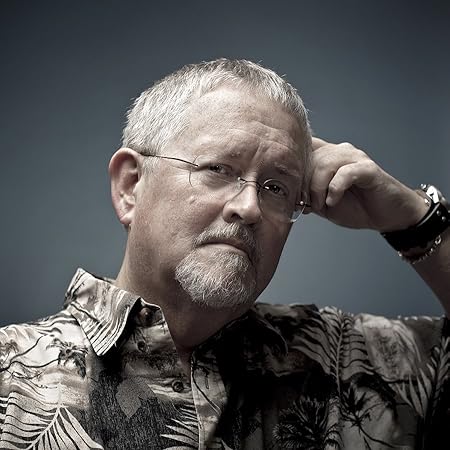
Orson Scott Card (born August 24, 1951, Richland, Washington) is an American science fiction and fantasy novelist, playwright, poet, essayist, public speaker, and critic, best known for the Ender Saga, which began with the short story Ender's Game in 1977 and the novel Ender's Game in 1985. He is one of only two authors to win both the Hugo and Nebula awards for Best Novel in consecutive years, taking the pair in 1986 for Ender's Game and again in 1987 for its direct sequel Speaker for the Dead.
The Ender Saga has grown into more than a dozen novels and short fiction pieces across two parallel storylines: the original Ender quartet (Ender's Game, Speaker for the Dead, Xenocide, Children of the Mind) which follows Andrew Ender Wiggin from child commander to wandering philosopher across millennia, and the Shadow series (Ender's Shadow, Shadow of the Hegemon, Shadow Puppets, Shadow of the Giant, Shadows in Flight, Shadows Alive) which follows Bean and the other children from Battle School through the geopolitics of post-war Earth. Ender's Game has been a Marine Corps recommended reading list title and was adapted as a 2013 feature film.
His other major series include the Tales of Alvin Maker, a six-volume alternate-history fantasy set in a frontier America where folk magic is real and Alvin grows from seventh son of a seventh son into a maker who can reshape matter, and the Homecoming Saga, a five-volume science fiction retelling of the Book of Mormon set on a far-future world. He has written more than fifty novels, several plays, dozens of short stories, and a long list of nonfiction.
His two Writer's Digest craft books are widely used in workshops and creative writing programs: How to Write Science Fiction and Fantasy (1990) and Characters and Viewpoint (1988, second edition 2010), part of the Elements of Fiction Writing series. The latter is one of the most-cited modern references on the craft of point of view, character introduction, and how psychic distance actually works on the page. He has taught at Brigham Young University and Southern Virginia University, where he holds an endowed chair, and runs the annual Literary Boot Camp for emerging writers.
Orson Scott Card
Professional ghostwriting for executives, founders, coaches, and authors who want to get the book done right. 113+ books authored. 54+ ghostwritten for clients.
Ready to discuss your book?
BOOK YOUR PRIVATE CONSULTATIONNo pitch. No pressure.
© 2026 Richard Lowe. The Writing King. All rights reserved.