TL;DR
6/10. The dependable, authoritative, trusted everyday American standard, the dictionary a writer reaches for without a second thought, kept reasonably current by regular additions of new words and senses. A solid, reliable default, held from higher by its own free online version and other digital tools that handle quick lookups better, and the limits of a compact edition.
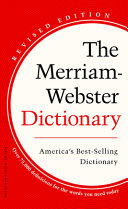
If there’s a default American dictionary, it’s Merriam-Webster. The Merriam-Webster Dictionary is the compact, authoritative everyday edition from the publisher whose name is practically synonymous with American lexicography, offering tens of thousands of definitions of the words people use, regularly updated with new entries. For a writer, it’s the reliable, mainstream standard, the dictionary you reach for without a second thought, and recent editions stay current by adding new words and senses.
Judged as the trusted everyday American reference it is, it does its job dependably, with the now-familiar caveat about print dictionaries in the digital age. I find it dependable and a little dull, and I mean both halves. Among the many dictionaries a writer might own, this one’s identity is ubiquity and trust. It’s the American default, and its rulings settle most everyday questions without controversy.
The trusted everyday standard
The dictionary’s value is exactly its authority and reliability for daily use. Merriam-Webster is the long-established standard for American English. This edition gives dependable, current coverage of the words a writer meets and uses regularly. Clear definitions, spellings, and basic usage, from a source whose authority no one questions. It’s no thrill to read, and it doesn’t need to be.
For settling the common questions, how a word is spelled, what it means, whether it’s the right one, it’s the trusted everyday reference, and its regular updating with new words and senses keeps it reasonably current with the living language. For a writer who wants one dependable, mainstream dictionary, this is the safe, sensible default.
Keep reading
Why a dependable dictionary matters as a writer’s tool: Merriam-Webster as the trusted everyday standard, in the craft of precise word use.
Currency and the living language
One real strength of the recent editions is their attention to keeping up with English as it changes. Merriam-Webster adds new words and new senses regularly as the language evolves. That matters to a writer who needs to know whether a term is established, what it currently means, and how it’s really used now instead of decades ago.
I’ll give it real credit here. A dictionary that freezes the language at some earlier moment is a museum piece, and Merriam-Webster’s descriptive, usage-tracking approach keeps it a tool for current writing instead of a historical artifact.
Keep reading
Building vocabulary with a current, trusted dictionary: the up-to-date word coverage that supports precise, contemporary word choice.
What are the weaknesses of The Merriam-Webster Dictionary?
The caveats are those of any print dictionary now. Merriam-Webster’s own free online dictionary, along with other free digital references, handles quick everyday lookups instantly and at no cost, and updates continuously, so the practical case for the print edition is weaker than it once was, especially since this is the everyday instead of the unabridged volume. A compact print edition is also necessarily less complete than a full unabridged dictionary, covering the common words well but omitting the rarer terms and the depth a serious researcher might want.
And a dictionary is a tool to consult. It won’t teach you to write well. These are the normal limits of a compact print reference in the digital age instead of flaws.
Is The Merriam-Webster Dictionary worth reading?
It’s the dependable, authoritative, trusted everyday American dictionary, valuable for being the reliable mainstream standard a writer can reach for without a second thought, kept reasonably current by regular additions of new words and senses. It gets a fair, solid rating as exactly that, held from higher by the realities of the form: its own free online version and other digital tools handle quick lookups better, and a compact edition is less complete than an unabridged one.
For a writer who wants one trusted physical dictionary as a default, it’s the safe, sensible choice; for quick daily questions or deep research, the free online tools or a larger volume serve better. I’d call it a solid workhorse with no surprises, and a six is the right number for a book that does its job and nothing more.
Explore the hub
The Writing Hub: word choice, usage, and the rest of the craft, gathered in one place.