
Everyone knows what Florida looks like. That’s the problem.
A reader opens a book set here already holding a complete set of images, supplied by fifty years of film, advertising and viral news stories. If your prose confirms those images, you’ve written something the reader could have assembled without you.
The state has been a punchline for so long that the punchline has become the default tone, and a great deal of fiction set here’s really fiction set in the idea of here.
This subject is personal for me, because I live here and I’m tired of watching writers treat my own state as a punchline. Too much Florida fiction reads as though it came out of a motel room after a long weekend. The place deserves better, and the writers who bother to report it are the only ones I trust with it.
What does Florida shorthand cost a novel?
Four things arrive uninvited the moment a book opens in Florida.
The weather, described as oppressive. That’s the least interesting available fact about a place where fifteen million people choose to live.
The wildlife, deployed as menace. An alligator in the first chapter is a signal that the writer has been here on holiday. The retirees, written as scenery. A county where a large share of the population arrived with forty years of life behind them is a county full of protagonists, and treating them as background is the single biggest waste of material in Florida fiction. The retiree point matters most to me. These are people with forty years of work and trouble behind them, and fiction keeps parking them on a bench as background. No waste in Florida fiction is bigger.
And the weirdness. That’s the most damaging because it’s there. The state does produce more absurdity per square mile than anywhere else in the country. The mistake is inventing your own instead of reporting the real thing, and the invented version is always smaller and stupider than what really happens.
How the writers who got it right did it
The pattern is consistent and it’s not a literary technique. It’s reporting.
Tim Dorsey spent twelve years in newspapers before his first novel, including as a political reporter in the Tampa Tribune’s Tallahassee bureau and later as night metro editor. He credited that career with giving him two things: an encyclopedic knowledge of Florida lore, and familiarity with bizarre crimes.
Both are essential. The comedy in twenty-six novels works because the underlying detail is accurate, and a reader who knows the state can tell. Randy Wayne White described him as a field historian instead of a haphazard researcher. That’s the highest compliment available for this kind of work.
Dorsey belonged to a loose group of former Florida newspapermen alongside Dave Barry and Carl Hiaasen, and the shared method is the point. All three came out of newsrooms where the obligation was to get the details right about a place that supplies more material than anybody could invent.
The same instinct runs through the literary end. Saw Palm, the journal produced by the creative writing program at the University of South Florida, states its purpose as getting past the version of Florida found in tourist brochures and capturing the actual experience of Florida lives and landscapes. That’s an editorial position and it’s also a craft instruction.
Reading the state before writing it
The mistake is inventing your own instead of reporting the real thing, and the invented version is always smaller and stupider than what really happens.
The fastest way to stop writing the postcard is to read the people who already solved this, and there’s a reading order worth following. Read Dorsey for structure. Twenty-six novels built as road trips across the state, each location arriving with its history, its local peculiarity and whatever the plot needs. He researched them like the reporter he had been, so the trivia is broadly reliable and the books track how Florida changed across a quarter-century.
Read the journals for range. Saw Palm publishes work connected to Florida through images, people or themes, and past issues are available free as PDFs. That means you can read twenty years of how other writers have handled this state without spending anything. The piece on the two journals published here covers where to find them and how to submit.
Read the local history that nobody turned into fiction. Newspaper archives, county histories, the material in the reference collections. That’s where the specifics live and it’s the least contested territory available. And read outside the Florida shelf entirely, because the problem you’re solving is a general one. Every writer working in a place with a strong exported image faces the same difficulty, and the solutions travel.
The specific beats the general, every time
This is the whole method and it’s unglamorous.
Not heat. The particular hour in August when the air stops moving before a storm, and what that does to sound.
Not a beach. Which beach, what the sand is like there compared to the next one down, where the parking is, who’s on it on a Tuesday in October.
Not palms. Which palm, because a sabal isn’t a queen isn’t a coconut, and locals distinguish them without thinking.
Not retirees. A man from Ohio who ran a tool and die shop for thirty-one years and now knows every employee at one particular hardware store by name. Not weird Florida. A specific municipal ordinance, a particular defunct attraction, a trade that existed here and doesn’t now.
The general is available to everybody. That’s why it carries no information. The specific is only available to the person who was there, and it’s the only thing that proves you were.
I think that paragraph is the whole lesson. A writer who knows a sabal from a queen palm earns my trust in one sentence, and a writer who lets palm trees sway in the breeze loses it just as fast.
The material nobody has used
This region in particular is underwritten, and the gaps are large.
Ybor City is the densest square mile of material in the state and most of it is untouched, including the lectores who were paid by the cigar rollers themselves to read novels and newspapers aloud on the factory floor.
Tarpon Springs has the sponge docks and the Greek community that built them, a town organized around a single trade that drew immigrants from a specific place, then watched the industry change. Work, migration, community and decline, in one walkable downtown. Pinellas Park, Gulfport, Oldsmar and Safety Harbor all have origin stories nobody has written properly.
This is what excites me about writing in Tampa Bay. Entire towns here have origin stories nobody has told properly, and I’d much sooner read one of those than another thriller with a body in the Everglades. And the whole county is full of people who did something considerable somewhere else and then moved here. That’s a structural feature of the place and almost never the subject of a book set in it. I’ve written about that in the piece on retiring here with a life behind you.
Where the detail comes from
Not from memory, and not from a search engine, because both give you the version everybody already has. The Burgert Brothers collection is the strongest single source for this region. More than twenty thousand photographs from roughly 1850 to 1963, taken by a commercial studio documenting whatever it was paid to document. That means the pavement, the signage, the parked cars and whoever was walking past are all in frame incidentally. Over fifteen thousand are digitized and searchable.
The fourth floor of the John F. Germany library holds that archive alongside one of the largest genealogy collections in the southeastern United States, a Tampa Bay obituary index covering 1855 to 1990, and a history publications index covering 1925 to 1999. No library card is required.
Local libraries hold local collections, and the reference staff know what exists beyond them. That service is free and almost nobody under sixty uses it, as I keep saying across this whole series. And then there’s standing somewhere with a notebook, which no archive replaces. Drafting can happen anywhere. Being in a place can’t.
Writing weather without writing about weather
Weather in Florida is a fact of a day, not a metaphor, and what gives an outsider away is treating it as atmosphere. People here don’t remark on heat in June any more than people in Minnesota remark on cold in January. What they do is plan around it, complain about specific failures of air conditioning, and watch the sky in the afternoon.
Hurricane season is the version most often written badly. For residents it’s a logistics problem with a calendar attached, involving shutters, generators, gas queues, insurance and a great deal of waiting. The drama is mostly boredom and anxiety in a sealed house, and then an enormous amount of yard work.
I think writers handle this state worst in hurricane novels. The real thing is shutters, gas lines, insurance calls and days of waiting in a sealed house, and a writer who gets that boredom and dread onto the page will beat any storm-as-monster set piece.
Light is the underused half. Florida light is particular, and the way it behaves at four in the afternoon in February is nothing like the way it behaves at four in August. Period photographs are useful here because black and white forces you to notice shadow and glare instead of color.
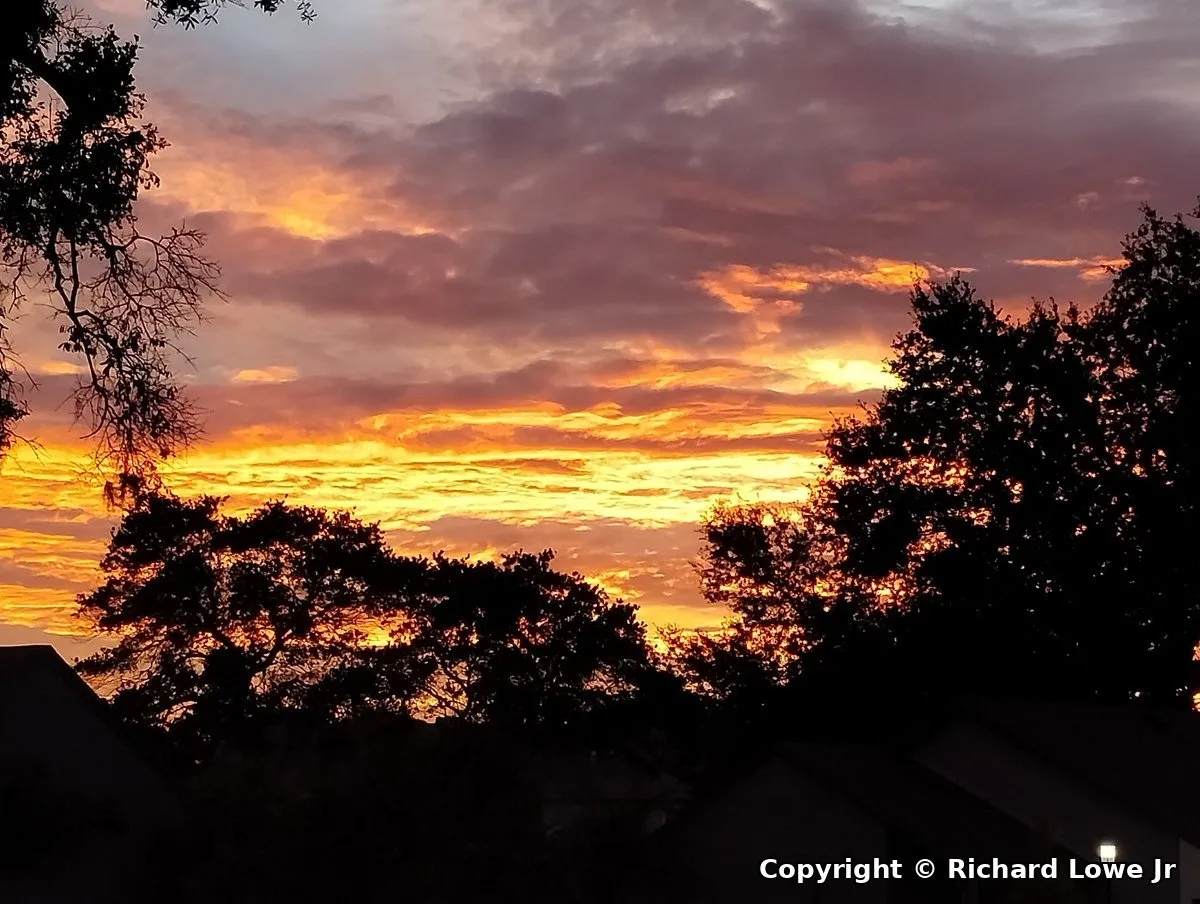
A Florida evening sky behind the live oaks. The light here changes by the hour and by the season. Copyright © Richard Lowe.
What is the transplant narrative trap in Florida fiction?
The most common structure in fiction set here’s somebody arriving from elsewhere. It works, but it’s overused and usually shallow. The version that works acknowledges that almost nobody here’s from here. That means the outsider is just one more person in a county of arrivals, and the interesting tension is the question of what everybody left and why they won’t talk about it.
The version that fails treats Florida as a place the protagonist observes. Observation from the outside produces the postcard again, because a visitor notices exactly the things that are already in every reader’s head. If you’ve lived here long enough to stop noticing the palms, that’s the beginning of being able to write the place. The details that survive familiarity are the ones worth putting on the page.
Dialogue, and who is from here
There’s no Florida accent. That’s the first thing to get right, and writers keep inventing one.
What exists instead is an enormous range of speech in a small area, because almost nobody in this county was born in it. Midwestern flattening from decades of arrivals from Ohio and Michigan. New York and New Jersey. Spanish across several distinct national varieties. Greek in Tarpon Springs.
Genuine rural Southern in the parts of the state people from here call the real South. It’s mostly north and inland of the coast.
Writing a generic Southern drawl into a St. Petersburg character is the clearest possible signal that the writer hasn’t been here.
A Southern drawl on a St. Petersburg character is a clumsy choice every time. One afternoon in a hardware store in this county will give you Ohio, New Jersey, Greek and more than one variety of Spanish in the same aisle, and that mix is far more interesting than the accent writers keep importing.
The useful detail is where somebody came from and when, because that determines almost everything about how they speak and what they assume. A man who arrived in 1974 and a man who arrived in 2019 are living in different cities on the same streets.
Listen for the vocabulary instead of the accent. What people call the roads, which bridge, whether they say the beach or name it, how they refer to seasons in a place with two of them. That’s where local speech lives.
What the state is not
Three corrections worth making, because each one appears constantly in fiction set here.
Florida isn’t the South in the way the rest of the South is the South, and the further south you go the less Southern it gets. Tampa Bay is culturally closer to the Northeast and Midwest than to Alabama, because that’s where the people came from. Writers who reach for Southern Gothic in a St. Petersburg setting are importing a tone from four hundred miles north.
Florida isn’t one place. The panhandle, the north, the central corridor, this coast, the southeast and the Keys have almost nothing in common beyond a state government. A detail borrowed from Miami and dropped into Clearwater will read wrong to anybody local.
And Florida isn’t new. The version in most fiction begins somewhere around the arrival of air conditioning. That erases everything before it. Tarpon Springs was working sponges in the nineteenth century. Ybor was rolling cigars in the 1880s. The photographic record in the Tampa archive runs back to roughly 1850. The place has a past and almost nobody writes it.
My take
Report Florida and stop inventing it. A Southern drawl on a St. Petersburg character tells every local reader you’ve never been here. Spend an afternoon in a hardware store, listen for Ohio, New Jersey, Greek and Spanish in one aisle, and write what you hear. Then go into the archive, because this state had sponges and cigars long before air conditioning. Specific detail is what separates a novel from a postcard.
How do you test whether your Florida setting is real?
Take any paragraph of your Florida setting and ask whether it could be moved to coastal Georgia, southern Alabama or the Texas gulf without changing a word. If it could, it’s not doing anything. Heat, humidity, water, palms and retirees are regional, not local, and a reader who lives on any of that coastline recognizes the generic version instantly. Then ask whether a specific named thing appears. A road, a store, a municipal quirk, a trade, a year something closed. One of those in a paragraph will do more than a page of atmosphere.
And ask whether you could have written it without leaving the house. If yes, go and stand somewhere, and take a notebook.
I’d hold every Florida manuscript to that test before it goes anywhere near an editor. Writers have described this state from the car window for fifty years, and anybody willing to get out and stand somewhere with a notebook has a real shot at writing it well.

Specific detail is what showing is made of. In Show Don’t Tell I explain the difference between handing readers your conclusions and handing them the evidence, with 100+ before and after examples.
