
The 60th anniversary, September 8, 2026
Sixty years to the day. The Original Series premiered on September 8, 1966, and the 2026 anniversary is the largest thing the franchise has ever done for itself.
More than 750 theaters across the United States ran restored 4K presentations of the films paired with Original Series episodes, several reaching a cinema screen for the first time, over the five days ending on the 8th.
There was a screening of The Man Trap at the Autry Museum in Los Angeles, an adults-only evening at the Science Museum in London, a day-long event at Movie Park Germany, and a coordinated attempt at a world record for the Vulcan salute. Paramount released the complete series on Blu-ray and DVD in anniversary packaging the same day.
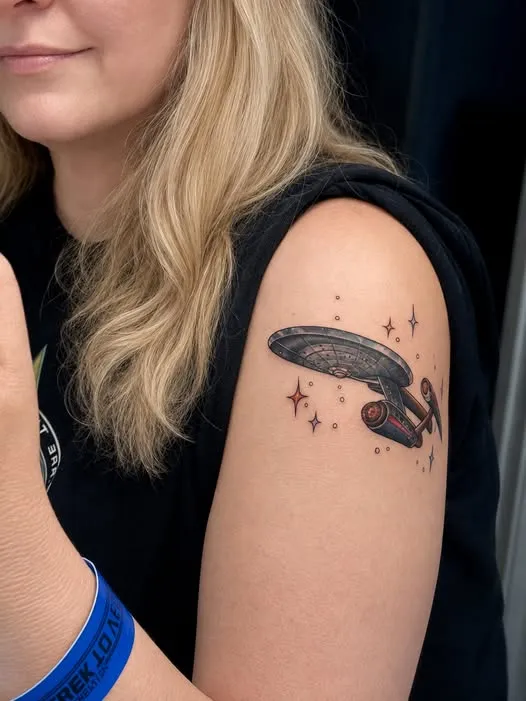
The Smithsonian pulled the eleven-foot studio model of the Enterprise out of its case for a one-day display. That’s the detail I keep thinking about. That model is a physical object made of wood and plastic in 1964, and a national museum treats it the way it would treat an aircraft that flew.
More is still coming. Star Trek takes the Franchise of the Year award at the Broadcasting and Cable Hall of Fame in New York on September 29, and there’s a Star Trek Universe panel at New York Comic Con on October 10.
What strikes me at sixty is that a show canceled after three seasons, on a budget that shows in every episode, is now old enough that the people running its anniversary weren’t born when it ended. Nothing about that was likely. It happened because the writing was good enough to survive the production. That’s the only thing that ever works.
Watch: The Star Trek Pilot That Changed TV Forever | The Center Seat: 55 Years of Star Trek | S1 EP1, Retro Central
Sixty years of accumulation
The anniversary made me look at what is in this house.
A full bookcase of Star Trek novels, from the thin paperbacks up to the heavy hardcovers. Franz Joseph’s Star Fleet Technical Manual and his Booklet of General Plans. They were never canon and were never going to be, and they’re still better than most of what’s been drawn since.
Four binders of the Newfield Star Trek Universe pages, the mail subscription where one page turned up at a time and each covered a character or a planet or a piece of hardware in more depth than it had any business going into. I have the complete set, plus a separate binder of the alternate pages they produced and then replaced.
Models still in boxes. A large Klingon warship waiting on a light kit that cost more than the kit it lights. Cards. The first Enterprise I built at six, which is long gone, and every one since. I have nothing comparable for Star Wars. Not a single piece. I enjoyed the films and that was the end of it, and I’ve never been able to explain the difference except that Star Trek gave me something to look things up in and Star Wars didn’t.
I watched the first episode of Star Trek on its original air date in 1966, on a console television that must have weighed 200 pounds.
It had a massive tube, a record player built into one side, and an 8-track player on the other. The whole family gathered around it the way families gathered around those enormous sets in the 1960s. When the Enterprise appeared on that screen, it was the most interesting thing I had ever seen.
For more, see how science fiction worlds get built. I was hooked immediately. I’d seen Forbidden Planet before that, and the connection was obvious: a ship, a crew, the unknown, the human drama playing out against an alien backdrop.
But Star Trek did something Forbidden Planet didn’t. It came back every week. It built a universe one episode at a time, and I got to live in that universe for an hour every week for three seasons.
Star Trek Day is September 8th, the anniversary of that 1966 premiere. For me it’s a personal milestone, not a fan holiday. That show shaped how I think about storytelling, about characters under pressure, about using impossible situations to reveal human truth. Fifty-some years later, I still think the original series understood something about narrative that most of its successors forgot.
The Original Series and Why It Worked
Kirk, Spock, and McCoy weren’t archetypes moving through a plot.Share on X
The original Star Trek worked because it was about people first and science fiction second. Kirk, Spock, and McCoy were three different approaches to decision-making: instinct, logic, and compassion. Every episode ran the problem through all three lenses. The drama came from the friction between those perspectives. For more, see national ghostwriters week.
Racism, poverty, war on Earth. Then he sent that improved humanity into a galaxy full of new ones.
The genius was the contrast. The crew represented what we could be. The situations they encountered tested whether those ideals held up under pressure. Sometimes they did. Sometimes they didn’t. That tension is what made the show matter. The writing was uneven because television writing in the 1960s was uneven. But the best episodes, “The City on the Edge of Forever,” “Balance of Terror,” “Mirror, Mirror,” “Amok Time,” stand alongside the best science fiction ever produced in any medium.
Harlan Ellison’s time travel tragedy. Paul Schneider’s submarine warfare translated to space. Jerome Bixby’s dark mirror universe. Theodore Sturgeon revealing that Spock’s logic was a cage as much as a gift. These writers understood that science fiction is about what technology reveals about the people using it. That principle drives every piece of fiction I write and every ghostwriting project I take on. The subject matter is the vehicle. The human story is the destination.
My Star Trek Collection
I own over 200 Star Trek books in hardcover, mostly novels.
I have the original Enterprise blueprints from the early 1970s, the Franz Joseph set that every serious Trek fan of that era owned. The best Christmas present I ever received was an Enterprise model kit. It had the little lights you could wire up, so the nacelles glowed and the deflector dish lit up. I built that thing with the care of an engineer assembling the real ship.
The novel collection matters to me as a writer because the Star Trek novels represent one of the longest-running shared universe fiction projects in publishing history. Hundreds of authors writing within the same continuity, maintaining consistent characters while finding new stories to tell. The quality varies enormously, but the best Trek novels, the ones by Diane Duane, Peter David, John M. Ford, are real literature working within a franchise structure.
That shared universe model taught me something about world-building that I use constantly: a well-built world generates stories. Roddenberry didn’t outline every episode in advance. He built a universe with enough depth, enough internal logic, enough unresolved tension, that stories emerged naturally from the setting.
My World Builder’s Handbook teaches this principle directly. Build the world right and the stories come to you.
The Series Ranked by Someone Who Was There from the Beginning
I’ve watched every Star Trek series. My ranking will irritate some fans, but I’ve been watching since 1966 and I have opinions.
Deep Space Nine, especially the last two seasons, is the best Star Trek ever produced.
It’s the only series that committed to long-form serialized storytelling with real consequences. Characters made decisions they couldn’t take back. The Dominion War forced the Federation’s ideals into conflict with survival, and the show didn’t flinch from showing what that cost.
“In the Pale Moonlight” is the single best episode in the franchise. It asks whether a good man can do a terrible thing for the right reasons, and it refuses to give a comfortable answer.
The original series is second. It had the strongest character dynamics, the most daring writing for its era, and the fundamental understanding that science fiction is about people. The best episodes still hold up sixty years later, and that’s more than most television from the 1960s can claim.
Enterprise, especially the last two seasons, is underrated. Once the show committed to the Xindi arc and stopped trying to be a prequel nostalgia trip, it found real dramatic weight. The writing sharpened. The stakes became personal. The network canceled it just as it figured out what it was.
The Next Generation from season three onward is solid. Patrick Stewart lifted everything he touched, and the show produced great episodes.
But the crew harmony problem I described earlier limited how much internal drama the show could generate. I covered this with a guest in my interview with sci-fi author Stephen Oram. It was at its best when something disrupted the professionalism.
Voyager I mostly can’t stand. The premise, a ship stranded on the other side of the galaxy, should have produced desperate, resource-scarce, morally compromising storytelling. Instead the ship looked pristine every week and the crew behaved like they were on a routine mission. The Borg episodes and the Species 8472 arc are the exceptions. Those episodes understood what the show should have been the entire time.
The modern series are simply terrible. Bad writing. Incoherent plotting. Characters who exist to deliver speeches instead of make decisions. Certain craft principles made the original series and Deep Space Nine powerful. Character-driven conflict. Speculative premises serving human stories. Respect for the audience’s intelligence. All of it’s been abandoned in favor of spectacle and sentiment.
They should be burned. I say this as someone who loves this franchise deeply enough to own 200 hardcover novels and a set of 1970s blueprints. Loving something means being honest about when it fails.
The Craft Lesson: Harmony Kills Drama
The difference between the best and worst Trek series comes down to a single storytelling principle: characters who agree with each other produce comfort, characters who clash produce story.
Kirk, Spock, and McCoy had incompatible worldviews and the show let those worldviews collide every episode. Instinct versus logic versus compassion. The drama came from inside the crew as much as from the alien of the week.
Deep Space Nine understood this. Sisko, Kira, Odo, Quark, Bashir, and Garak had competing loyalties, conflicting ethics, and personal agendas that the Dominion War forced into the open.
The Next Generation’s weakness was crew harmony. Picard’s bridge was professional, competent, and largely aligned. When everyone agrees about what to do, the drama has to come entirely from outside the ship.
The best TNG episodes broke this pattern. “The Best of Both Worlds” stripped Picard away and made the crew function without their center. “The Inner Light” put Picard in a situation where his Starfleet identity was irrelevant. “Chain of Command” replaced him with someone the crew couldn’t stand. Every great TNG episode disrupted the harmony that was the show’s default state.
Voyager should have been all disruption. A Starfleet crew and a Maquis crew forced to share a ship seventy thousand light-years from home with no resupply and no reinforcements.
That premise demands friction, rationing, mutiny, moral compromise. Instead the show smoothed every conflict into resolution by the end of each episode and kept the ship looking factory-new. The premise was perfect. The execution wasted it.
The one redeeming element was Seven of Nine. She added tension and real interest to a show that had flattened both. A former Borg drone relearning humanity aboard a ship full of people who didn’t entirely trust her was exactly the kind of internal conflict the show needed from the beginning.
And the real tension between Jeri Ryan and Kate Mulgrew was visible on screen whether the writers intended it or not. When the actors don’t get along and the characters aren’t supposed to get along, you get something electric that no script can manufacture. Voyager was a better show every minute Seven of Nine was on screen. That says more about what the show was missing than what she added.
This principle applies to every kind of fiction, well beyond science fiction. If your characters get along too well, your story is too comfortable. Readers don’t turn pages because characters are happy. They turn pages because characters are in conflict, especially with people they care about.
Star Trek and the Craft of Science Fiction
Science fiction audiences, Star Trek showed, will accept any premise as long as the characters behave like real people within that premise.
Transporters, warp drive, phasers, universal translators, none of it matters if the audience doesn’t believe in the people using the technology. This is the lesson that bad science fiction ignores and great science fiction understands. The technology creates the conditions under which human nature is tested.
A transporter malfunction that splits Kirk into his aggressive and passive halves is a story about the necessity of integrating both aspects of personality. The technology is just how you get there. My own fiction works on this principle. Peacekeeper, a project I’ve been developing for 45 years, uses a cosmic structure to explore how individuals respond to power, isolation, and moral obligation. The science fiction elements serve the character exploration.
For writers working in science fiction or fantasy, the Science Fiction Writer’s Handbook and the Fantasy Writer’s Handbook both address this principle: build the speculative elements to serve character and theme. The Conflict and Tension Handbook covers why tension between allies is more powerful than tension between enemies, a lesson Deep Space Nine understood better than any other Trek series.
What is Star Trek’s legacy for writers?
Popular entertainment can carry serious ideas without sacrificing entertainment value, and Star Trek proved it. It tackled racism, war, imperialism, individual rights, and the nature of consciousness during a decade when most television was afraid to address any of those topics. It did this by wrapping the ideas in alien cultures and interstellar conflicts, giving the audience enough distance to engage with the themes without defensiveness.
That technique, using fictional distance to explore real issues, is among the most powerful tools in a fiction writer’s kit. It’s why science fiction and fantasy endure. They give writers permission to ask questions that contemporary fiction sometimes can’t.
September 8th is Star Trek Day, a good day to revisit the episodes that shaped how a generation of writers thinks about story. It’s also a good day to acknowledge that a television show watched on a 200-pound console TV in 1966 can still teach you something about craft in 2025.
For writers developing their own speculative fiction, my writing handbooks cover every element of the craft. For one-on-one guidance, book coaching is available. Start with a conversation.


