Latest
How to Turn Your Expertise Into a Book People Want to Read | The Expert MethodWhat’s New at The Writing King: Week of October 25, 2026Challenger Remembrance Day: The Engineer Who Wouldn’t SignJoel Salomon: The Truth About MoneyReddit Is Putting Up a Login Wall. Wikipedia Won’t Be Far Behind.Victoria Chemko: The Body Is the First TechnologySir Patrick Stewart: A TributeA Year in the Bank: ADHD, Face Blindness and the Freedom to Walk Out | The Impossible Puzzles Show, Episode 326A Yale Economist Says We Won’t Be Missed. He Forgot the Bread Line.Walter Koenig: A TributeAI Has Paid Off Outside Tech. Apollo Is Reading the Wrong Scoreboard.I Don’t Post Bad ARC Reviews. I Send the Author a Note.The Little Red Book of Stuff That Works!Your Kids Are Your Own FaultGrow a PairYou’re Broke Because You Want to BeIt’s Called Work for a Reason!No Time for TactShut Up, Stop Whining, and Get a LifeWilliam Bessette: AI Enablement and Child Welfare TechnologyFree Book Planning ToolsWhat’s New at The Writing King: Week of October 18, 2026Ghostwriting by the Numbers: Timelines, Word Counts and the First CallPromising Young Woman (2020) ReviewBillions for AI, Pennies for the Plumbing: AI Companies Should Pay to Keep PHP AlivePHP2Shell: AI Found a 22-Year-Old Crack Under Your Website in Two DaysKindle Unlimited Is Now Kindle+. AI Audiobooks Just Joined the BuffetPetrov Day: The Officer Who Didn’t Believe the ComputerWhen to Quit Writing a Book: I’ve Abandoned Dozens, and I’d Do It AgainChina Is Using Bots to Fan the Data Center Backlash. The Backlash Is Still Real.The Society of Authors Signed an Ethical AI Charter, Then Ran From It in Eight DaysMo Gawdat Says the AI Dystopia Starts in 2027. Read the List, Skip the DatesGetty Images Filed for Bankruptcy. Can You Prove You Licensed Your Book’s Images?Fluff Words: Cut Them From Your Prose, Keep Them in Your DialogueWhere Are the Independent Bookstores and Public Libraries Worth Visiting in Tampa Bay? Author Richard Lowe Profiles 44 of ThemWhere Can Writers Learn Storytelling From Movies? Richard Lowe Publishes 1,226 Film and TV Reviews With Writing Craft NotesWhat Should You Know Before Hiring a Ghostwriter? The Writing King Publishes 57 New Answers, Including What to Do When It Goes WrongWhere Can You Hear Founders and Executives Tell Their Own Stories? Richard Lowe’s Leaders and Their Stories Publishes Every Unscripted Interview With a Full TranscriptAuthor Richard Lowe Publishes Eight Volumes of Enemies of You, a Researched Series on the Forces Working Against Ordinary AmericansThe Jackal (1997) ReviewThe Day of the Jackal (2024) ReviewYour First Novel Is an Apprentice Piece: What Beta Readers and Editors Can’t FixWhen the Cloud Gets Bombed: What the AWS Data Center Strikes Teach About BackupsHuman-Written Book Labels Are Gatekeeping With a FeeThe Enshittification of Microsoft Office: Why I Switched to a Free CloneGlobal Encryption Day: The Padlock Every Writer Depends OnWriting Your Worst Moments in a Memoir: Show the Evidence, Skip the VerdictHow to Register a Copyright for Your Book (and What Doesn’t Count)Your AI Chats Aren’t Private: Deleted ChatGPT Logs in CourtThe Board Seat Scam: A 419 Letter in a Business Suit

The Last Beekeeper

The bee landed on Ruth Okafor’s kitchen window at 6:43 on a Tuesday morning in September, and she dropped her coffee cup.

It shattered on the tile floor. She didn’t look at it. She stood at the counter with her hand pressed to her mouth and stared at the small golden body resting on the glass, its wings folded, its antennae twitching in the early light.

There hadn’t been a bee in North America for eleven years.

The collapse had been fast. Faster than the models predicted, faster than the emergency funding could address, faster than the politicians could finish arguing about whether it was happening at all. Colony collapse disorder had been a slow leak for decades. Then the leak became a flood and the flood became an absence and one spring the orchards didn’t bloom and the world understood, too late, what the beekeepers had been screaming about for years.

Ruth had been one of those beekeepers. Forty hives in the hills outside Asheville. She’d watched them die one by one, colony after colony, bees stumbling out of the hive and not coming back, until the last queen stopped laying and the last workers crawled in circles on the landing board and went still.

She’d buried the last hive. Actually buried it, in the ground behind her house, because she didn’t know what else to do and the grief needed a ritual.

That was eleven years ago. The world had adjusted. Robotic pollinators. Hand-pollination crews in the orchards. Food prices tripled, then stabilized at a level that meant a fresh apple was a luxury item. People forgot what honey tasted like. Children grew up not knowing what a bee was except from pictures.

And now one was on her window.

Ruth moved slowly. She’d spent thirty years around bees and the instinct came back without thinking: slow movements, calm breathing, no vibrations. She lowered herself to eye level with the windowsill. The bee sat there, fat and healthy, its body dusted with pollen. Actual pollen. Yellow and abundant, stuck to the fine hairs on its legs like tiny saddlebags.

“Where did you come from?” she whispered.

The bee cleaned its antennae with its front legs. Methodical. Unhurried. Like it had all the time in the world.

Ruth opened the window. She expected the bee to fly away. Instead it walked onto her hand, light as a whisper, and sat on her knuckle.
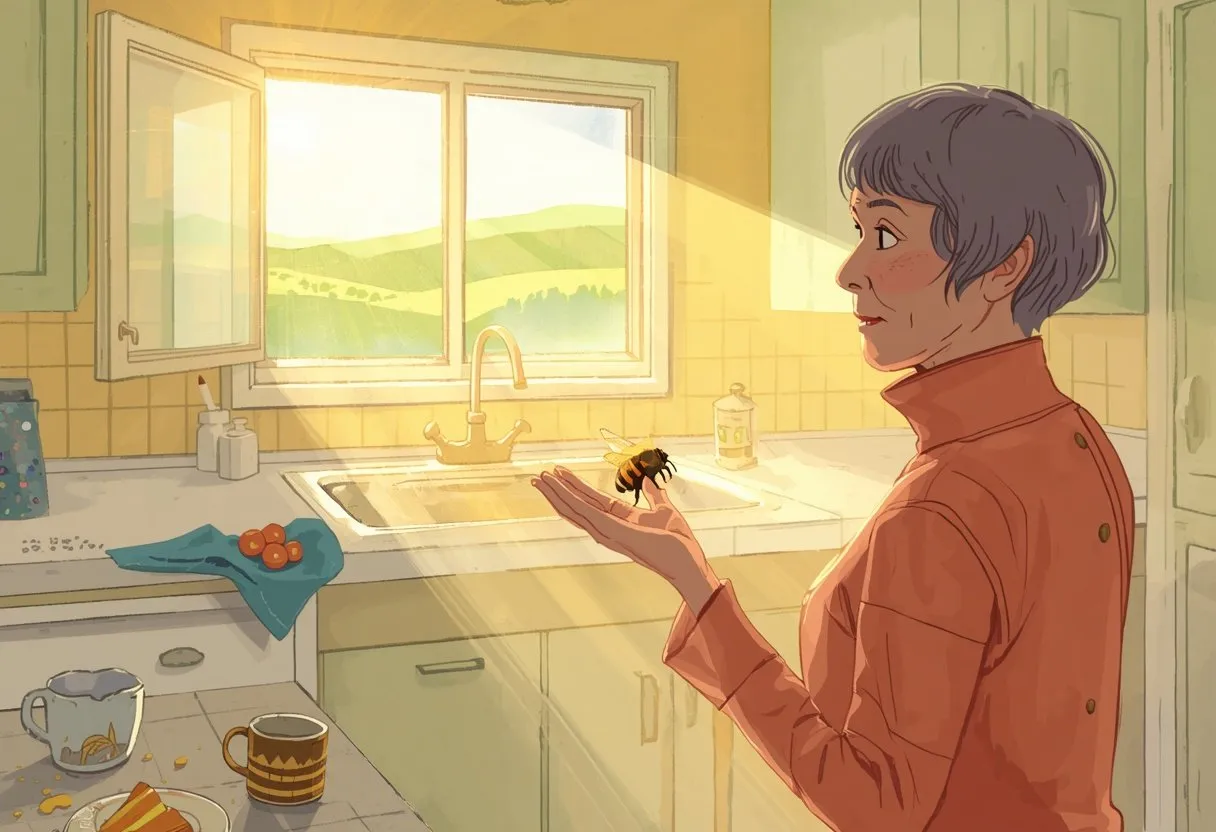
A gray-haired woman in a sunlit kitchen gazes in wonder at a single honeybee resting on her knuckle.

She cried. Standing in her kitchen at forty-seven minutes past six in the morning, coffee pooling on the floor, a single bee on her hand, she cried the way she hadn’t cried since the last hive went silent. Not grief this time. Something she’d forgotten the shape of.

The bee flew off her hand and out the window. Ruth watched it go, tracking its path over the garden, over the fence, toward the hills. It flew straight, with purpose, the way a forager flies when it knows exactly where it’s going.

She put on her boots. She followed.

A mile into the hills, in a hollow oak that had been dead for twenty years, she found them. A wild colony. Small, maybe a few thousand bees, clustered on comb they’d built in the dark cavity of the trunk. The hum hit her chest before she saw them, that low vibration she’d carried in her body for three decades and mourned for eleven years.

Ruth sat on the ground and listened. The bees hummed. The morning sun warmed the oak. Somewhere in the comb, a queen was laying eggs that would become workers that would become foragers that would carry pollen from flowers that hadn’t been properly pollinated in over a decade.

She didn’t call anyone. Not yet. She sat with the bees and listened to the sound of the world beginning to repair itself, one hive at a time.

About the Author
Richard Lowe, professional ghostwriter

Richard Lowe is a professional ghostwriter and author with 113+ books authored and 54+ ghostwritten. Before writing full time he spent 33 years in enterprise technology, including 20 years as Director of Computer Operations and Technical Services at Trader Joe's. He writes nonfiction, fiction and memoir, and works with executives and experts on books that build authority.

More about Richard Lowe →

Disclaimer

The views and opinions expressed in this blog post are solely those of Richard Lowe and are based on personal experience and research. This content is for informational purposes only and should not be construed as professional legal, financial, accounting, or business advice. Always consult with qualified professionals before making important business or legal decisions. Richard Lowe is not a lawyer, accountant, or licensed professional advisor, and this content does not establish any professional relationship.

0 comments

No comments yet. Yours can be the first.

Was this useful?

Leave a comment
